RAF Wattisham in Suffolk occupies a distinctive place in the history of military aviation. Opened shortly before the beginning of the Second World War, it served first as a Royal Air Force bomber station, later became an important United States Army Air Forces fighter base and aircraft-maintenance center, and then returned to the RAF for decades of front-line service during the Cold War. Its best-known American combat unit was the 479th Fighter Group, the P-38 Lightning and P-51 Mustang organization remembered as “Riddle’s Raiders.”
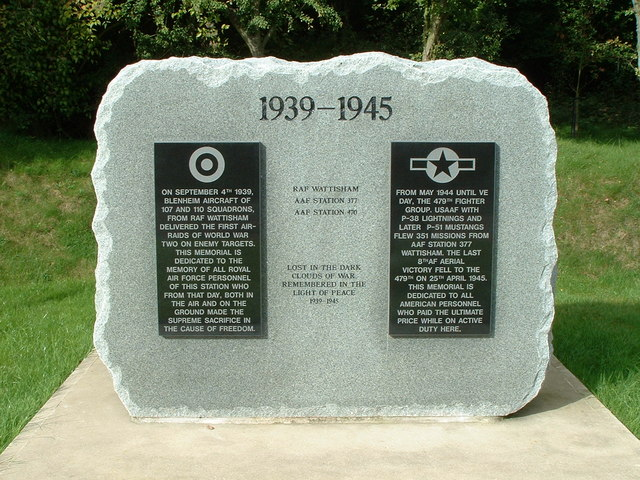
Under the USAAF, the operational airfield was designated Station 377. The large maintenance organization developed beside it became the 4th Strategic Air Depot and was administered separately as Station 470, commonly associated with nearby Hitcham. Together, the fighter station and depot made Wattisham both an operational combat base and an important center for repairing, modifying, and returning American fighter aircraft to service.
Wattisham Before the Americans
RAF Wattisham was constructed during the expansion of the Royal Air Force in the late 1930s and officially opened in April 1939 as a permanent bomber station. Its prewar buildings, hangars, technical facilities, and grass flying field reflected the RAF standards of the period. When Britain entered the war in September 1939, Wattisham immediately assumed an operational role.
On 4 September 1939, only one day after the British declaration of war, Bristol Blenheim bombers operating from Wattisham took part in one of the RAF’s earliest offensive operations of the conflict, attacking German naval targets near Wilhelmshaven. During the early war years, the station supported bomber and fighter operations while the RAF fought the Battle of Britain, defended the British Isles, and carried the air war to targets in occupied Europe.
American Occupation and Expansion
Wattisham was transferred for American use as the Eighth Air Force expanded across East Anglia. Early plans called for its reconstruction as a heavy-bomber station. Work began on hard-surfaced runways, an enlarged perimeter track, additional dispersals, new technical buildings, hangars, workshops, storage areas, and widely scattered domestic camps.
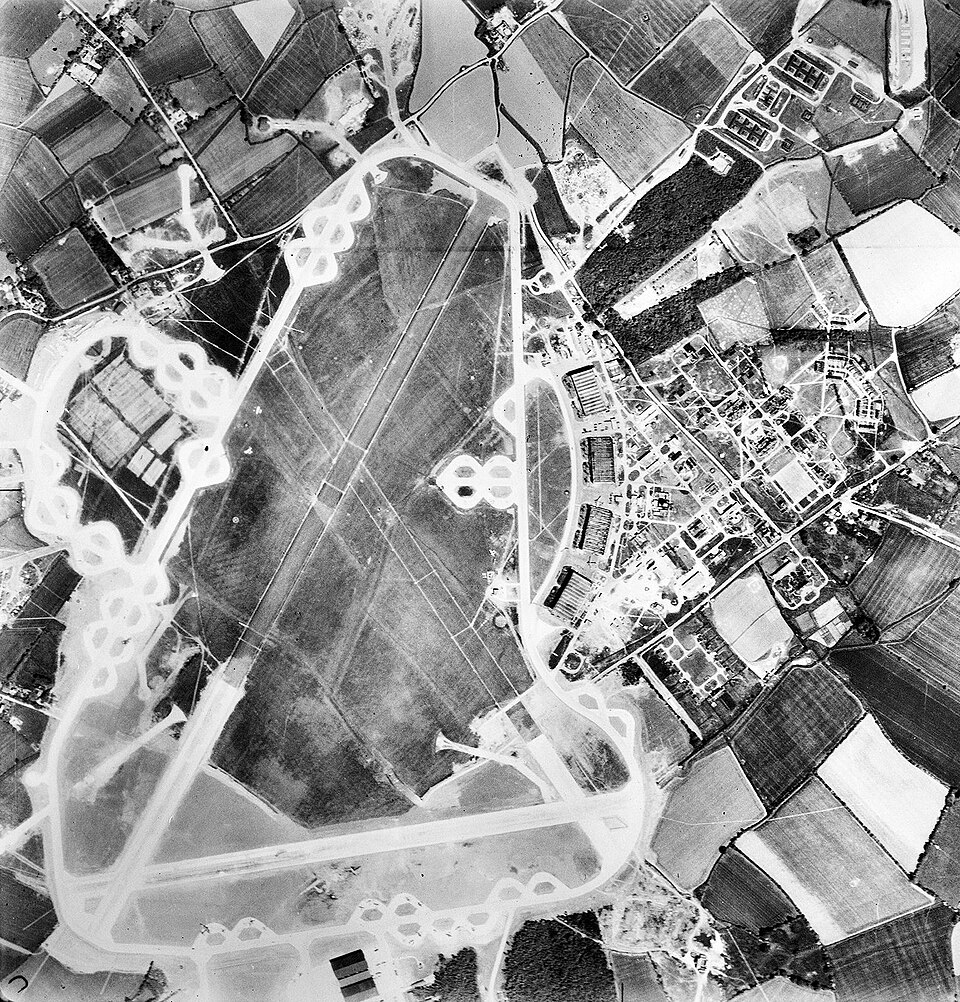
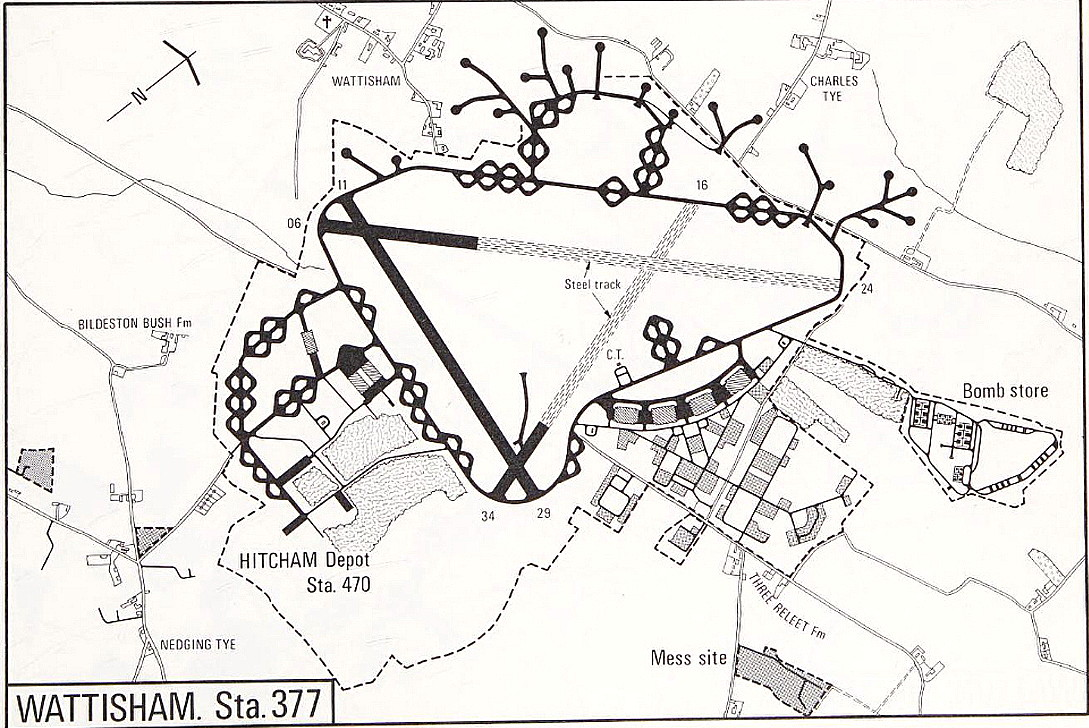
As construction progressed, American requirements changed. A sufficient number of heavy-bomber fields was becoming available, while the growing fighter force required additional operational and maintenance facilities. Wattisham’s full conversion to a standard Class A heavy-bomber station was therefore not completed. The resulting wartime airfield had an unusual mixed configuration: one principal runway was completed in concrete, another used pierced steel planking, and a third remained largely grass. A perimeter taxiway linked the runways, hangars, operational dispersals, technical site, and depot complex.
The flying field included loop and frying-pan hardstands positioned around the perimeter so that aircraft could be dispersed rather than concentrated in one vulnerable area. Earthworks, natural cover, and the separation of aircraft helped reduce the danger from enemy attack and accidental explosions. The station’s technical area contained operations and intelligence offices, briefing rooms, engineering and communications sections, armament facilities, a fire station, and the watch office or control tower.
The 4th Strategic Air Depot
Wattisham’s importance extended far beyond the missions flown from its runways. The maintenance organization initially established as an advanced air depot developed into the 4th Strategic Air Depot. Its large complex south of the operational field included T-2 hangars, engineering shops, warehouses, specialized repair facilities, additional aircraft hardstands, and a separate taxiway connected to the main airfield.
The depot performed major structural and battle-damage repairs, engine and propeller changes, radio and armament modifications, inspections, repainting, and the preparation of replacement aircraft. P-38 Lightnings, P-47 Thunderbolts, and P-51 Mustangs passed through its facilities before being issued or returned to operational units. Wattisham therefore supported the wider Eighth Air Force fighter campaign as well as the group stationed on the field.
The combined operational and depot missions required a population larger and more technically specialized than that found at many fighter stations. Personnel lived and worked in dispersed sites containing Nissen huts, barracks, officers’ quarters, mess halls, medical facilities, recreation buildings, a chapel, headquarters offices, workshops, warehouses, and motor-transport sections. Separate storage areas held aviation fuel, ammunition, bombs, rockets, engines, propellers, and replacement parts. The movement of combat aircraft, damaged airplanes, vehicles, equipment, and personnel made Wattisham one of the busiest American fighter installations in Britain.
Formation of the 479th Fighter Group
The 479th Fighter Group was constituted on 12 October 1943 and activated three days later at Grand Central Air Terminal, California. Its three component units were the 434th, 435th, and 436th Fighter Squadrons. The group was formed as part of the continuing expansion of the Army Air Forces for the air offensive against Germany.
Pilots and ground personnel trained at several California installations, including Lomita Flight Strip and Santa Maria Army Air Field. Their preparation included formation flying, aerial gunnery, instrument navigation, long-range escort procedures, fighter sweeps, air-to-ground attack, aircraft maintenance, communications, and the many support functions required to sustain a combat organization. During part of this period, the group also contributed to the air defense of the western United States.
The 479th trained with the Lockheed P-38 Lightning, a powerful but complex twin-engine fighter. Pilots had to master two engines, propellers, superchargers, fuel systems, and a cockpit more complicated than that of most single-engine fighters. Mechanics likewise faced the demanding task of maintaining two liquid-cooled engines and numerous interconnected systems. The group’s months in California established the technical knowledge and teamwork that would soon be tested in Europe.
Arrival at RAF Wattisham
The 479th Fighter Group moved overseas during the spring of 1944. Much of the ground echelon crossed the Atlantic by troopship with the tools, vehicles, records, and equipment needed to operate the unit, while pilots and aircraft followed the routes assigned for overseas movement. The group arrived at RAF Wattisham in May 1944 and became the last fighter group to join the Eighth Air Force in the European Theater.
At Wattisham, newly arrived personnel had to adjust quickly to British weather, Eighth Air Force operating procedures, unfamiliar geography, radio terminology, aircraft-recognition requirements, and the tightly controlled routine of an active combat station. The timing left little opportunity for a gradual introduction to combat. Allied air forces were completing the campaign to isolate the Normandy battlefield, while heavy bombers continued their strategic offensive against German industry, transportation, oil production, airfields, and the Luftwaffe.
The group flew its first combat mission on 26 May 1944, only eleven days before D-Day. Operating over the Le Mans region of France, its pilots escorted bombers and conducted fighter sweeps, attacking enemy aircraft and suitable ground targets when opportunities arose. The 479th soon became known as “Riddle’s Raiders,” honoring Lieutenant Colonel Kyle L. Riddle, whose leadership helped establish the group’s aggressive combat character.
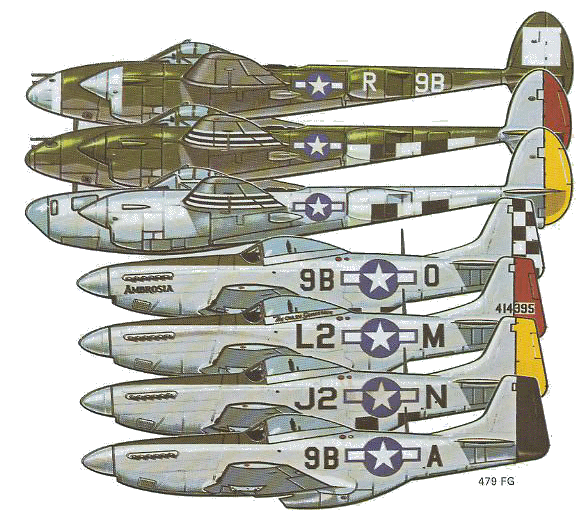
The squadron fuselage codes were L2 for the 434th Fighter Squadron, J2 for the 435th Fighter Squadron, and 9B for the 436th Fighter Squadron. These markings identified the aircraft within Eighth Air Force formations and remain valuable to historians studying wartime photographs.
The P-38 Lightning
The 479th entered combat with the Lockheed P-38 Lightning at a time when most Eighth Air Force fighter groups were operating the P-47 Thunderbolt or P-51 Mustang. The P-38’s twin-boom design, twin engines, long range, strong climb, and concentrated nose armament made it one of the most recognizable fighters of the war.
Its armament of one 20-mm cannon and four .50-caliber machine guns fired directly ahead, avoiding the convergence limitations of wing-mounted guns. Its two engines also sometimes allowed a damaged aircraft to return after one engine had failed. These qualities made the Lightning effective in bomber escort, fighter sweeps, interception, patrol, and ground attack.
The aircraft nevertheless presented difficulties in the European climate. Long missions at high altitude exposed pilots to intense cold, while changing weather over Britain and the Continent complicated navigation and formation keeping. The P-38 also demanded considerable maintenance. Wattisham’s engineering resources and the nearby strategic depot were consequently important advantages for the group.
Normandy and the Liberation of France
In the days preceding the Normandy invasion, the 479th helped protect bombers and attack transportation targets intended to delay German reinforcements. On 6 June 1944 and during the fighting that followed, the group flew escort, patrol, fighter sweep, and ground-attack missions in support of the invasion. Its pilots helped cover the beachhead and struck rail lines, locomotives, road traffic, airfields, and other targets behind the German front.
As Allied armies advanced beyond Normandy, fighter groups assumed an increasingly important interdiction role. The 479th attacked transportation and communications targets across France and challenged Luftwaffe aircraft attempting to interfere with Allied operations. Although ground attack exposed the P-38s to antiaircraft fire and small-arms fire, such missions disrupted the enemy’s ability to move troops, fuel, ammunition, and equipment.
Bomber Escort and Fighter Sweeps
Long-range escort remained one of the group’s central responsibilities. The 479th accompanied Eighth Air Force heavy bombers to targets in occupied Europe and Germany, guarding the formations during the approach, the bomb run, and the withdrawal. Escort missions demanded precise navigation, careful fuel management, disciplined formation flying, and constant observation for enemy fighters.
The group also conducted offensive fighter sweeps designed to find and destroy German aircraft in the air and on their airfields. Armed-reconnaissance missions gave pilots greater freedom to attack locomotives, rolling stock, motor vehicles, airfields, and other targets of military value. By taking the offensive beyond the immediate bomber stream, the group helped reduce the Luftwaffe’s ability to recover and contest Allied air superiority.
The Distinguished Unit Citation
The 479th Fighter Group received a Distinguished Unit Citation for exceptional performance during a series of operations in 1944. The cited actions included attacks against enemy aircraft at French airfields on 18 August and 5 September and aerial combat near Münster, Germany, on 26 September. These missions demonstrated the group’s ability to combine escort, counter-air, and ground-attack operations during a demanding period of the campaign.
Attacking enemy airfields required pilots to fly into concentrated antiaircraft fire and other defenses. Aircraft parked on the ground could be destroyed, but low-level strafing left the attacking fighters vulnerable. The Münster action brought the group into determined aerial combat over Germany. Together, the operations reflected the aggressive tactics that had come to characterize “Riddle’s Raiders.”
Changes in Combat Leadership
Leadership played an important role in the group’s development. Lieutenant Colonel Kyle L. Riddle led the organization during its formation and early combat operations. Colonel Hubert Zemke, already well known for his leadership of the 56th Fighter Group, assumed command in August 1944 and brought extensive combat experience to Wattisham. After Zemke became a prisoner of war when his aircraft was lost in October 1944, Riddle again commanded the group.
Transition to the P-51 Mustang
During the autumn of 1944, the 479th converted from the P-38 Lightning to the North American P-51 Mustang. The transition required pilots to master a single-engine aircraft with different handling characteristics, while ground personnel learned new maintenance procedures and reorganized supplies and equipment.
The P-51 combined long range, speed, maneuverability, and strong high-altitude performance. Its range enabled the group to escort bombers deep into Germany and remain with them for longer portions of a mission. The conversion also brought the 479th into closer alignment with the equipment and tactics then dominating the Eighth Air Force fighter force.
Market Garden and the Battle of the Bulge
In September 1944, the group supported Operation Market Garden, the Allied airborne and ground offensive in the Netherlands. Its missions helped protect troop-carrier and glider formations, suppress enemy air opposition, and attack transportation and military targets that threatened the airborne landings.
When Germany launched its Ardennes offensive in December 1944, poor weather initially restricted Allied air operations. Once conditions improved, the 479th joined the massive air response. Its Mustangs escorted bombers, patrolled the battle area, attacked transportation routes and supply columns, and helped prevent the Luftwaffe from gaining freedom of action over the front. Flying in severe winter weather from Wattisham placed heavy demands on pilots, mechanics, and support personnel, but sustained operations helped weaken the German offensive.
The Final Campaign into Germany
During the opening months of 1945, the 479th continued long-range escort missions, fighter sweeps, and attacks against airfields and transportation targets. Allied fighters increasingly ranged across Germany, searching for aircraft in the air and on the ground while disrupting the movement of forces attempting to resist the advancing Allied armies.
The group supported the Allied crossing of the Rhine and the final drive into Germany. It also faced the declining but still dangerous Luftwaffe, including the new threat posed by German jet aircraft. Despite shrinking fuel supplies and losses of experienced personnel, German defenses remained capable of inflicting casualties until the final weeks of the war.
Life and Work at Wattisham
Every combat mission depended upon far more than the pilots who took off from Wattisham. Mechanics worked outdoors in cold, rain, fog, and darkness to inspect engines, repair damage, service weapons, refuel aircraft, and prepare them for the next operation. Armorers loaded ammunition and bombs; radio specialists maintained communications equipment; intelligence officers studied targets and enemy activity; operations personnel planned routes and schedules; and medical, transportation, clerical, supply, and mess personnel sustained the station.
Briefings often began before dawn. Pilots received weather information, routes, altitudes, target details, expected opposition, identification procedures, and emergency instructions before traveling to their dispersed aircraft. Returning formations were counted as they approached the field, and the absence of an aircraft brought uncertainty to friends and squadron personnel. Debriefing, intelligence reports, claims, maintenance inspections, and repairs followed each mission.
The surrounding Suffolk communities also formed part of the Americans’ wartime experience. Friendships developed between service personnel and local residents despite rationing, transportation difficulties, blackout regulations, and the pressures of war. For many veterans, memories of Wattisham included not only combat but also the villages, farms, pubs, churches, and families they encountered in England.
Combat Record and Return to the United States
From its first mission in May 1944 through the end of hostilities in Europe, the 479th participated in the Air Offensive, Europe; Normandy; Northern France; Rhineland; Ardennes-Alsace; and Central Europe campaigns. Its missions ranged from bomber escort and air superiority to armed reconnaissance, close support, and attacks against enemy airfields and transportation.
Following V-E Day in May 1945, the group remained at Wattisham for several months, conducting training and other post-hostilities duties while men and equipment were prepared for redeployment. The 479th departed England in November 1945 and was inactivated at Camp Kilmer, New Jersey, in December. Although its wartime combat career had lasted less than a year, the group had entered action at a decisive moment and served through the liberation of Western Europe and the defeat of Nazi Germany.
RAF Wattisham After World War II
The United States returned Wattisham to Royal Air Force control in 1946. The station initially entered a period of reduced activity while the RAF evaluated its postwar requirements, but its runways, hangars, technical facilities, and strategic location made it suitable for continued front-line service.
Wattisham soon entered the jet age. Gloster Meteors operated from the station during the late 1940s, marking the transition from piston-engine aircraft to jet fighters. Runways and facilities were progressively improved to accommodate faster and heavier aircraft. During the 1950s, Hawker Hunters and other Fighter Command units helped establish Wattisham as an important part of Britain’s Cold War air-defense system.
In the 1960s, English Electric Lightnings operated from Wattisham on Quick Reaction Alert, ready to intercept unidentified aircraft approaching British airspace. The station later became closely associated with the McDonnell Douglas Phantom FGR.2 and, during the 1980s, the F-4J(UK). No. 56 Squadron and No. 74 Squadron were among the units that continued Wattisham’s front-line interceptor role during the final decades of the Cold War.
Modernization brought strengthened and resurfaced runways, enlarged dispersals, hardened aircraft shelters, improved communications and control systems, expanded fuel and weapons facilities, and other changes required for modern jet operations. Although much of the wartime airfield was altered, the station’s continuing military use helped preserve its aviation character.
Wattisham Flying Station Today
The end of the Cold War brought major reductions in Britain’s military establishment. Wattisham’s role as a front-line RAF fighter station ended in 1992, and control passed to the British Army in 1993. Renamed Wattisham Flying Station, the installation developed into a major Army Air Corps helicopter base.
Today, Wattisham remains an active military aviation station associated with the British Army’s Apache attack-helicopter force, aviation engineering, and operational support. The aircraft and mission have changed dramatically since the P-38s and P-51s of the 479th Fighter Group flew from its runways, but Wattisham continues the military aviation service that began in 1939.
Preserving the Wattisham and 479th Fighter Group Legacy
The Wattisham Station Heritage Museum, veterans’ organizations, local historians, military personnel, and surrounding communities preserve the station’s long history. Photographs, records, artifacts, memorials, and personal recollections commemorate the RAF units, American depot personnel, and members of the 479th Fighter Group who served there.
RAF Wattisham’s wartime importance came from the combination of its missions. It was an operational fighter station from which “Riddle’s Raiders” fought for air superiority and supported the liberation of Europe; it was also a major engineering and logistical center that helped sustain American fighter operations throughout Britain. Its subsequent service as an RAF jet station and an Army Air Corps helicopter base makes Wattisham not simply a surviving former wartime airfield, but a living military installation whose aviation history extends from the opening months of World War II into the present.
Squadrons
434th Fighter Squadron, 1943-1945
435th Fighter Squadron, 1943-1945
436th Fighter Squadron, 1943-1945
Stations
Grand Central Air Terminal, California, October 1943
Lomita Flight Strip, California, February 1944
Santa Maria Army Air Field, California, April 1944
RAF Wattisham, England, May 1944-November 1945
Commanding Officers
Lt. Col. Leo F. Dusard Jr., October 1943
Maj. Francis J. Pope, November 1943
Lt. Col. Kyle L. Riddle, December 1943
Col. Hubert Zemke, August 1944
Col. Kyle L. Riddle, November 1944
Campaigns
Air Offensive, Europe; Normandy; Northern France; Rhineland; Ardennes-Alsace; Central Europe.
Decoration
Distinguished Unit Citation for attacks on enemy aircraft at French airfields on 18 August and 5 September 1944 and aerial combat near Münster, Germany, on 26 September 1944.

479th Fighter Group Roll of Honor: Roll of Honor
Oversea Burials 479th Fighter Group Oversea Burials