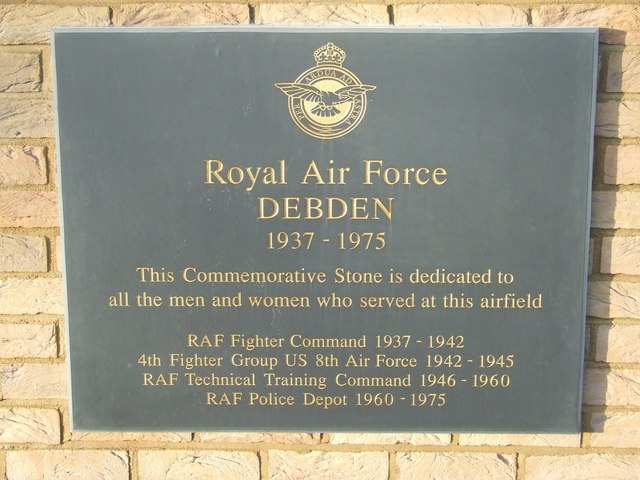
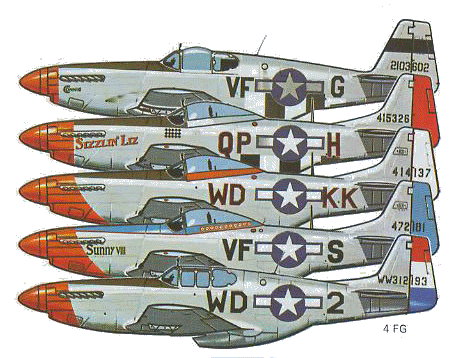
RAF Debden in Essex was one of the best-known fighter stations of the Second World War and the permanent wartime home of the celebrated 4th Fighter Group of the United States Army Air Forces. From September 1942 until July 1945, the airfield supported the combat operations of the group known throughout the Eighth Air Force as the “Debden Eagles.”
Formed from the Royal Air Force’s three American-manned Eagle Squadrons, the 4th Fighter Group brought together experienced combat pilots, skilled ground personnel, and a proud Anglo-American heritage. Flying the Supermarine Spitfire, Republic P-47 Thunderbolt, and North American P-51 Mustang from Debden, the group escorted heavy bombers, fought the Luftwaffe over Germany and occupied Europe, attacked enemy airfields and transportation systems, and supported Allied armies from the Normandy invasion through the final weeks of the war.
By the end of the European conflict, the 4th Fighter Group had become one of the most successful fighter organizations in the history of the Eighth Air Force. Its pilots were credited with destroying more than 1,000 enemy aircraft in aerial combat and attacks against German airfields, while Debden became permanently associated with the courage, sacrifice, and achievements of the American fighter pilots and ground crews who served there.
Overview
Construction and Opening of RAF Debden
Construction of RAF Debden began in 1936 on farmland near Saffron Walden in Essex. The airfield was developed during the expansion and modernization of the Royal Air Force as international tensions increased across Europe. It officially opened on 22 April 1937 as one of Britain’s modern fighter stations and was intended to protect London, southeastern England, and the approaches to the Thames Estuary.
Unlike many temporary wartime airfields constructed after 1939, Debden was originally planned as a permanent RAF station. Its technical and domestic buildings were therefore more substantial than those found at many later dispersal airfields. Brick hangars, administrative buildings, workshops, officers’ quarters, barracks, mess facilities, and other permanent structures were arranged around the flying field.
When Debden opened, aircraft operated from a broad grass landing area rather than from permanent paved runways. The open grass field allowed pilots to take off and land into the prevailing wind, which was particularly useful for the relatively light biplane fighters then in RAF service.
Before the Second World War, Debden housed several RAF fighter squadrons operating aircraft that included the Hawker Fury, Gloster Gladiator, Bristol Blenheim, Hawker Hurricane, and eventually the Supermarine Spitfire. As the performance, speed, and weight of military aircraft increased, Debden’s facilities were progressively expanded and modernized.
RAF Debden Before the Americans
RAF Debden had already established a distinguished operational record before the arrival of the United States Army Air Forces. During the opening years of the war, the station served as an important RAF Fighter Command base and participated in the defense of Britain.
Aircraft operating from Debden took part in operations associated with:
During the Battle of Britain period, Debden’s fighters formed part of the defensive network protecting southern England from Luftwaffe attack. The station’s location allowed its squadrons to respond to enemy formations approaching from the North Sea, the English Channel, France, Belgium, and the Netherlands.
Debden itself was attacked several times by the Luftwaffe during 1940. Bombing damaged runways, buildings, and other installations, but the airfield continued to operate. Repair crews worked quickly to fill bomb craters, restore communications, and keep the station available for fighter operations.
The raids demonstrated the vulnerability of concentrated aircraft and facilities. Dispersal areas, blast protection, air-raid shelters, camouflage, and decentralized maintenance arrangements were consequently important features of the airfield’s wartime development.
Development of the Wartime Airfield
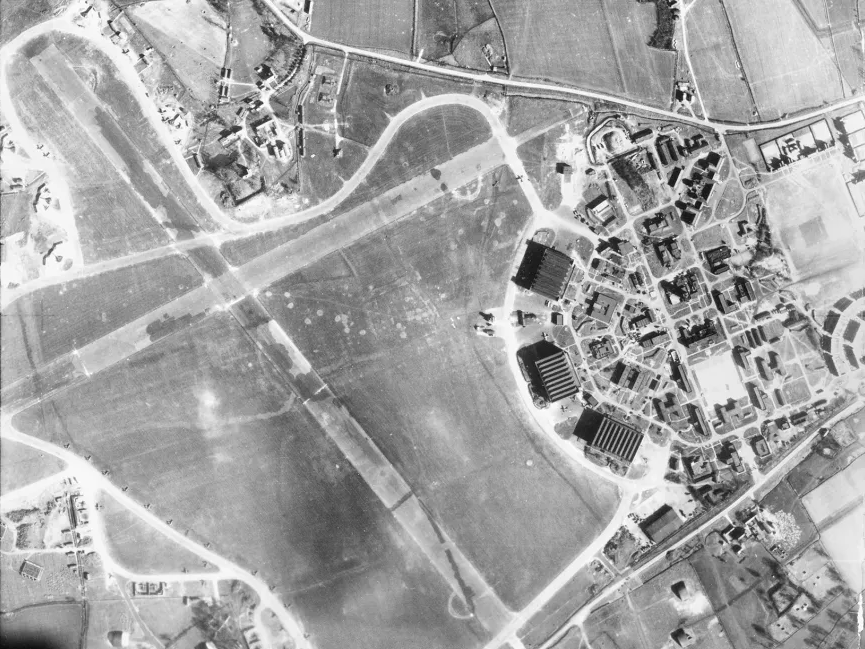
Debden’s original grass flying field was progressively converted into a paved, all-weather airfield as fighter aircraft became heavier and wartime operational demands increased. Concrete runways and taxiways enabled the station to remain active during wet weather and to support more intensive flying operations.
The airfield was unusual when compared with many standardized wartime stations. Rather than possessing the familiar three-runway triangular configuration found at numerous later RAF and USAAF bases, Debden developed around its prewar layout and existing buildings.
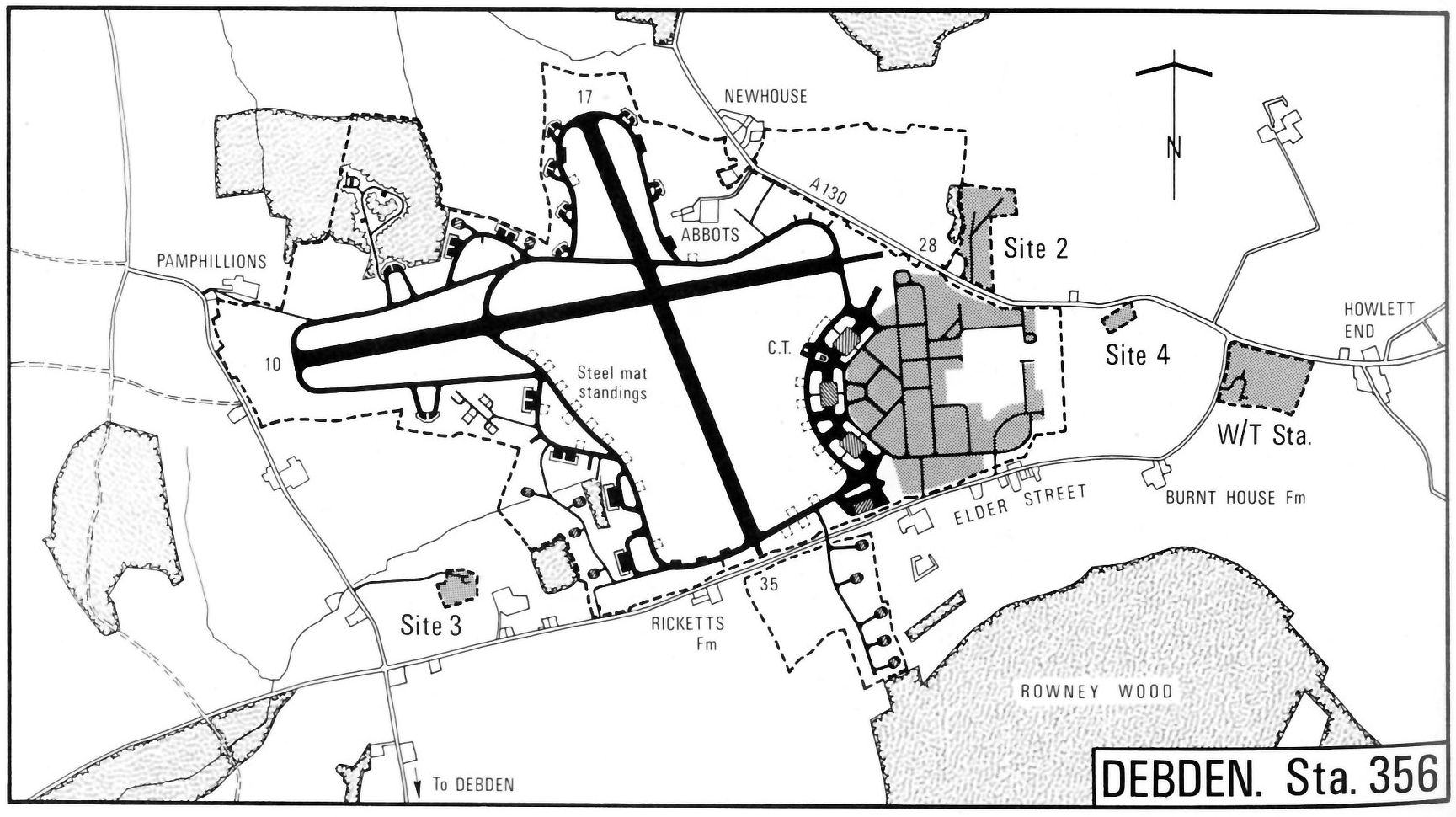
Runway Configuration
The Technical Area and Hangars
Debden’s principal technical area was concentrated along the southeastern side of the flying field. A broad, curved concrete apron provided access between the operational airfield, workshops, hangars, and maintenance facilities.
Important technical facilities included:
The three large Type-C hangars stood along the curved apron at staggered angles. Their arrangement allowed aircraft to be moved between the apron and hangar entrances while reducing congestion in the main technical area.
As the threat of enemy attack increased, aircraft were no longer concentrated immediately beside the hangars. A perimeter track connected numerous dispersal positions around the airfield, allowing fighters to be parked separately. This reduced the likelihood that a single bombing or strafing attack could destroy an entire squadron on the ground.
Historical descriptions of Debden differ concerning the exact number and type of wartime dispersal positions, partly because the airfield was repeatedly modified. The station contained more than 60 prepared aircraft parking points, with additional hardstands, blast pens, and temporary parking areas added as operational requirements changed.
Command and Infrastructure Buildings
Debden’s control tower, or watch office, stood near the main technical area and faced the active runways. From this building, air traffic personnel coordinated departures and arrivals, maintained contact with aircraft, displayed airfield signals, monitored weather conditions, and responded to emergencies.
The station also possessed a specialized Fighter Command Sector Operations building. During RAF use, information concerning enemy aircraft was received from radar stations, observer posts, and higher headquarters. Plotters placed markers on a large map table while controllers directed fighter squadrons toward approaching enemy formations.
The operations room included a central plotting area with raised positions from which controllers and senior officers could observe the developing air situation. This system formed part of the integrated air-defense network that proved so important during the Battle of Britain.
Behind the technical area stood Debden’s permanent domestic site, sometimes described as having a “Garden City” appearance because of its planned arrangement and substantial brick buildings. The domestic area included barracks, mess halls, administrative offices, medical facilities, recreation rooms, air-raid shelters, an armory, and an impressive Neo-Georgian officers’ mess.
The Eagle Squadrons
Before the United States entered World War II, hundreds of American pilots crossed the Atlantic to join the Royal Air Force and fight Nazi Germany. Some traveled through Canada and joined the Royal Canadian Air Force before transferring to the RAF, while others found different routes into British service.
These American volunteers served in three specially organized RAF units known as the Eagle Squadrons:
The Eagle Squadron pilots flew British fighters, principally the Hawker Hurricane and Supermarine Spitfire. They participated in defensive patrols, fighter sweeps, bomber escort missions, and offensive operations over the English Channel and occupied Europe.
Through their RAF service, the Americans gained valuable combat experience before the United States Army Air Forces had established a major operational presence in Britain. They learned RAF fighter tactics, formation flying, radio procedures, aerial gunnery, and the practical realities of combat against experienced Luftwaffe pilots.
Their service also created a powerful symbolic connection between Britain and the United States. The Eagle Squadrons demonstrated that American volunteers were already fighting beside the British before the United States formally entered the war in December 1941.
Transfer to the United States Army Air Forces
After the United States entered the war, plans were developed to transfer the Eagle Squadron personnel into the rapidly expanding United States Army Air Forces. RAF Debden was selected as the base for the new American fighter organization.
The airfield was transferred to American control on 12 September 1942 and became USAAF Station 356. On 29 September 1942, the Eagle Squadrons were formally transferred from the Royal Air Force to the United States Army Air Forces during a ceremony attended by senior British and American officers.
Under the transfer:
Together, the three squadrons formed the 4th Fighter Group. The transfer preserved the organization, experience, and traditions of the Eagle Squadrons while bringing their personnel into American service.
Because the pilots and many members of the ground organizations already possessed substantial operational experience, the newly formed 4th Fighter Group immediately became one of the most capable fighter units in the Eighth Air Force.
The 4th Fighter Group was the second operational American fighter group in England after the 31st Fighter Group. When the 31st departed Britain in October 1942 to participate in Operation Torch, the Allied invasion of North Africa, the 4th briefly became the only operational USAAF fighter group based in Britain.
Because of its origin in the Eagle Squadrons and its permanent wartime home at Debden, the unit proudly adopted the nickname “Debden Eagles.” Throughout the war, its personnel maintained the traditions, professionalism, and aggressive fighting spirit developed during their service with the RAF.
Initial Operations with the Supermarine Spitfire
The 4th Fighter Group began operations using the Supermarine Spitfire Mk V aircraft inherited from the RAF. The group flew its initial combat missions as an American organization in October 1942.
The Spitfire was admired by the former Eagle Squadron pilots for its maneuverability, rate of climb, responsive controls, and proven combat record. It was well suited for air defense and fighter operations over northern France, Belgium, and the English Channel.
However, the Spitfire’s relatively limited range restricted its usefulness as an escort fighter for the growing formations of Eighth Air Force B-17 Flying Fortresses and B-24 Liberators. American planners also wanted USAAF fighter groups to operate standardized American-built aircraft supported by American supply and maintenance systems.
Conversion to the Republic P-47 Thunderbolt
In March 1943, the group began replacing its Spitfires with the Republic P-47 Thunderbolt. Many former Eagle Squadron pilots initially opposed the conversion. Compared with the graceful Spitfire, the P-47 appeared extremely large and heavy, and its handling characteristics were very different.
Combat experience gradually demonstrated the Thunderbolt’s strengths. Powered by a large radial engine, the P-47 was exceptionally rugged and could absorb severe battle damage. It carried eight .50-caliber machine guns, possessed tremendous diving speed, and performed particularly well at high altitude.
The Thunderbolt also proved effective in ground attacks against locomotives, vehicles, airfields, and military installations. Its heavy armament and durability made it one of the most powerful fighter-bombers of the war.
In April 1943, the 4th Fighter Group joined other newly equipped P-47 units in offensive sweeps along the Dutch and French coasts. These missions were intended to challenge German fighters, protect Allied operations, and develop experience with the new aircraft.
The group flew a fighter sweep over the Dunkirk area on 8 April 1943. On 15 April, its pilots participated in one of the early major encounters between American P-47 Thunderbolts and German Focke-Wulf Fw 190 fighters. The engagement helped demonstrate that the large American fighter could compete successfully against the Luftwaffe’s frontline aircraft.
Beginning the Long-Range Escort Campaign
On 4 May 1943, the 4th Fighter Group and the 56th Fighter Group participated in an important escort mission supporting B-17 Flying Fortresses attacking industrial targets at Antwerp. These early operations marked the beginning of the expanding American fighter escort campaign.
During the early phases of the daylight bombing offensive, fighter range remained one of the Eighth Air Force’s most serious problems. German fighters often waited until the shorter-ranged Allied escorts turned back before attacking the bomber formations.
The P-47’s range was progressively increased through the use of external fuel tanks, but the Thunderbolt could not yet accompany bombers throughout the deepest missions into Germany. Nevertheless, the 4th Fighter Group provided vital protection during the outward and returning stages of many bombing missions.
As 1943 progressed, the group developed increasingly effective escort tactics. Its pilots protected formations of B-17 Flying Fortresses and B-24 Liberators, engaged Luftwaffe interceptors, and flew sweeps designed to draw German fighters into combat.
The group’s missions included:
Debden as an American Fighter Station
Under American control, RAF Debden became a busy and crowded fighter base accommodating approximately 2,000 military personnel. Pilots, mechanics, armorers, fuel crews, radio technicians, intelligence officers, medical personnel, cooks, clerks, drivers, and many other specialists worked together to keep the group operational.
The American station included:
Combat days often began long before sunrise. Pilots attended weather and intelligence briefings, studied routes and target areas, and received information concerning expected German fighter opposition. Ground crews prepared aircraft, checked engines and flight controls, loaded ammunition, installed drop tanks, and repaired damage from earlier missions.
During periods of intense operations, pilots sometimes flew more than one sortie in a single day. Ground crews worked through the night to return damaged aircraft to service. Engines, propellers, radios, oxygen systems, weapons, and control surfaces had to be inspected and repaired under difficult wartime conditions.
Debden also received damaged or fuel-starved fighters returning from combat. Medical and emergency crews remained prepared for crash landings, fires, and pilots suffering from wounds, exhaustion, or exposure.
Relationship with the Local Community
The arrival of thousands of Americans had a major effect on the surrounding towns and villages. American servicemen visited Saffron Walden and nearby communities while local residents attended dances, social events, religious services, and other activities associated with the station.
Although wartime shortages, military regulations, and cultural differences occasionally created difficulties, close relationships developed between the Americans and the people of Essex. Local families welcomed servicemen into their homes, and many lasting friendships were formed.
Some American personnel married British women, creating family connections that continued long after the war. The memory of the Debden Eagles remains an important part of the local history of the surrounding area.
Importance to the Eighth Air Force Bombing Campaign
The 4th Fighter Group played an important role in protecting the Eighth Air Force’s heavy bombers. Its pilots escorted both B-17 Flying Fortress and B-24 Liberator formations attacking German industrial, transportation, oil, aircraft-production, and military targets.
The group’s operations were particularly important to the bombers of the Second Air Division, whose B-24 Liberators frequently flew long-range missions over Germany and occupied Europe. Experienced fighter escorts reduced the ability of German interceptors to make coordinated attacks against bomber formations.
Fighter groups did more than remain close to the bombers. As tactics evolved, escorts were permitted to range ahead, seek out German fighters, and attack enemy aircraft before they reached the bomber stream. Other fighters attacked Luftwaffe airfields during takeoffs and landings, when German aircraft were especially vulnerable.
The cooperation between bomber and fighter organizations became one of the decisive elements of the Allied daylight strategic bombing campaign. By weakening the Luftwaffe and forcing it into repeated combat, American fighter groups helped create the air superiority required for the invasion and liberation of Western Europe.
Big Week and the Air War Over Germany
The 4th Fighter Group participated in the massive Big Week air offensive of 20–25 February 1944. During this campaign, the Eighth and Fifteenth Air Forces conducted coordinated attacks against the German aircraft industry.
Heavy bombers attacked aircraft factories, assembly plants, engine works, airframe manufacturers, and component-production facilities. Fighter escorts aggressively engaged German interceptors attempting to reach the bomber formations.
The resulting air battles inflicted severe losses on the Luftwaffe. German fighter pilots were forced to fight increasingly numerous and experienced American escorts, while German aircraft production and maintenance facilities came under sustained bombing attack.
By this stage of the war, pilots of the 4th Fighter Group had developed a reputation for aggressively seeking combat. Rather than remaining immediately beside the bombers after enemy formations had been scattered, they frequently moved ahead of the bomber streams to intercept German fighters before attacks could be organized.
Arrival of the North American P-51 Mustang
In March and April 1944, the 4th Fighter Group converted from the P-47 Thunderbolt to the North American P-51 Mustang. The change gave the group the speed, maneuverability, altitude performance, and range required to escort bombers deep into Germany.
Equipped with external fuel tanks, the Mustang could accompany heavy bombers much farther than earlier Allied fighters. German interceptors could no longer rely on waiting until American escorts turned back because of fuel limitations.
On 4 March 1944, the 4th Fighter Group participated in the first major attempt to escort Eighth Air Force heavy bombers to Berlin using the P-51 Mustang. Although operational circumstances complicated the bomber mission, the event demonstrated the growing ability of American fighters to operate over the German capital.
The Mustang transformed the daylight air offensive. Its combination of range and combat performance allowed American pilots to engage the Luftwaffe throughout the entire mission route. German fighters faced attack while assembling, climbing, approaching the bomber formations, and returning to their bases.
Distinguished Unit Citation
Between 5 March and 24 April 1944, the 4th Fighter Group repeatedly engaged German fighters and attacked Luftwaffe airfields. The group’s pilots aggressively pursued enemy aircraft and sought to prevent them from reaching American bomber formations.
For its extraordinary combat performance during this period, the 4th Fighter Group received a Distinguished Unit Citation. The award recognized the group’s contribution to weakening German fighter strength and helping the Allies achieve air superiority over Western Europe.
Supporting the Normandy Invasion
In the weeks preceding D-Day, the 4th Fighter Group attacked German airfields, railways, bridges, locomotives, road traffic, communications facilities, and other targets that could be used to oppose the invasion.
On and after 6 June 1944, the group flew escort, patrol, and tactical ground-attack missions in support of Allied forces landing in Normandy. Its fighters helped protect the invasion beaches and naval forces while preventing the Luftwaffe from mounting effective attacks against the Allied beachhead.
The overwhelming presence of Allied fighters greatly limited German air operations over the invasion area. The 4th Fighter Group also attacked transportation routes used to move German reinforcements toward Normandy.
Operation Market Garden
During Operation Market Garden in September 1944, the group helped protect transport aircraft and gliders carrying Allied airborne troops into the Netherlands. Its pilots also attacked German defensive positions, transportation routes, and other targets that threatened the airborne forces.
These missions required fighters to operate near large formations of relatively slow transport aircraft while remaining alert for enemy fighters and ground fire. The operation demonstrated the increasingly diverse responsibilities assigned to American fighter groups.
The Battle of the Bulge
During the German Ardennes offensive in December 1944 and January 1945, poor weather initially restricted Allied air operations. Once conditions improved, the 4th Fighter Group resumed fighter sweeps and armed reconnaissance missions over the battle area.
The group attacked German tanks, trucks, locomotives, rail traffic, supply routes, troop concentrations, and other targets supporting the offensive. These attacks disrupted the movement of fuel, ammunition, reinforcements, and supplies at a critical stage of the battle.
Final Operations Over Germany
In March 1945, the group helped escort the enormous Allied air armada supporting the airborne and ground operations associated with the crossing of the Rhine River. This was one of the final major combined operations before Allied armies advanced into the interior of Germany.
As German fighter opposition declined, the group devoted increasing attention to tactical targets. Pilots attacked airfields, aircraft on the ground, fuel installations, locomotives, railcars, road traffic, military columns, and retreating German forces.
The 4th Fighter Group flew its final combat mission on 25 April 1945. The mission consisted of escort and patrol operations over Germany only days before the end of organized combat in Europe.
Leading Pilots of the Debden Eagles
The 4th Fighter Group produced many of the best-known American fighter pilots of the European air war. Its experienced former Eagle Squadron pilots helped establish an aggressive combat culture that influenced the younger replacements who joined the group as the war continued.
Notable pilots associated with the group included:
Their achievements received considerable wartime publicity, but the group’s success depended upon far more than individual aces. Every combat victory required the combined efforts of aircraft mechanics, armorers, crew chiefs, fuel crews, communications personnel, intelligence officers, controllers, medical staff, and many other specialists.
Commanding Officers
The 4th Fighter Group was led by several distinguished officers during its service at RAF Debden:
Colonel Donald Blakeslee became especially closely associated with the group’s aggressive combat philosophy. He encouraged pilots to seek out the Luftwaffe and supported the rapid conversion to the P-51 Mustang at a critical stage of the air campaign.
America’s Highest-Scoring Fighter Group
The 4th Fighter Group became one of the most successful fighter organizations in the Eighth Air Force. It combined the combat experience inherited from the Eagle Squadrons with aggressive leadership, improved fighter aircraft, advanced tactics, and effective pilot training.
The group was credited with destroying more enemy aircraft in aerial combat and ground attacks than any other fighter group in the Eighth Air Force. Its combined total exceeded 1,000 enemy aircraft destroyed in the air and on the ground.
The group also destroyed or damaged large numbers of locomotives, railcars, trucks, armored vehicles, airfield installations, and other military targets during its ground-attack and armed-reconnaissance missions.
Its greatest contribution, however, extended beyond victory totals. By protecting B-17 and B-24 bomber formations and aggressively attacking the Luftwaffe, the 4th Fighter Group helped establish Allied air superiority over Western Europe. That air superiority allowed the strategic bombing campaign to continue and helped make possible the successful invasion and liberation of Europe.
Combat Record and Sacrifice
During its wartime service, the 4th Fighter Group flew hundreds of combat missions throughout France, Belgium, the Netherlands, Germany, and other parts of Western Europe. Its operations included bomber escort, fighter sweeps, interception, airfield attacks, ground support, armed reconnaissance, and transportation attacks.
The group’s achievements came at a considerable cost. Approximately 170 to 180 aircraft were lost through combat and operational causes. Many pilots were killed, wounded, reported missing, or taken prisoner.
Ground personnel also faced the hazards of enemy bombing, aircraft accidents, fires, exploding ammunition, and the physical demands of maintaining constant combat operations. Their work was essential to every mission flown from Debden.
Departure of the 4th Fighter Group
Following the German surrender in May 1945, the 4th Fighter Group remained at Debden while personnel and equipment were prepared for redeployment or return to the United States.
The group departed RAF Debden in July 1945, ending nearly three years of American occupation. During that period, the airfield had become inseparably linked with the Eagle Squadron veterans, the American fighter campaign, and the struggle for air superiority over Europe.
RAF Debden After World War II
After the departure of the 4th Fighter Group, Debden returned to British control. The station continued to serve military purposes during the postwar period, although changes in aviation technology and defense requirements gradually reduced the importance of many wartime fighter bases.
Debden was eventually closed as an active flying station. Parts of the runways, perimeter track, and aircraft dispersal system were removed, abandoned, or returned to agricultural use. Other portions of the former airfield were adapted for new military, governmental, commercial, or agricultural purposes.
Although much of the original flying field has changed, several important wartime buildings and features survived. These remains preserve evidence of both Debden’s RAF Fighter Command history and its service as the home of the 4th Fighter Group.
RAF Debden Today
Surviving reminders of the wartime airfield have included:
The surrounding villages and local communities continue to commemorate the Americans who served at Debden. Veterans, descendants, aviation historians, and members of organizations connected with the 4th Fighter Group have returned to the area for ceremonies, reunions, and historical visits.
Memorials and preserved structures ensure that the contribution of the Debden Eagles remains visible to future generations. The surviving airfield landscape also provides an important physical connection to the men who flew from Essex to fight over occupied Europe and Germany.
Legacy of RAF Debden and the Debden Eagles
RAF Debden occupies a unique place in British and American aviation history. It served first as an important Royal Air Force fighter station during the defense of Britain and later became the home of one of the most distinguished fighter groups in the United States Army Air Forces.
The transfer of the Eagle Squadrons at Debden symbolized the movement from individual American volunteer service in the RAF to the full participation of the United States in the European air war. The 4th Fighter Group preserved its British heritage while becoming a leading American combat organization.
From Debden, the group’s pilots flew Spitfires, Thunderbolts, and Mustangs through every major phase of the Eighth Air Force fighter campaign. They defended bombers, challenged the Luftwaffe, attacked enemy airfields, supported the Normandy invasion, assisted Allied airborne and ground operations, and carried the air war into the heart of Germany.
The achievements of the group were made possible by the service of thousands of pilots, ground crewmen, support personnel, British civilians, and local residents. Their combined efforts helped establish Allied air superiority and contributed directly to victory in Europe.
Today, RAF Debden is remembered not merely as a former military airfield, but as the historic home of the Debden Eagles—a place where the traditions of the Royal Air Force Eagle Squadrons and the United States Army Air Forces came together in one of the most remarkable fighter organizations of World War II.
Campaigns
The 4th Fighter Group participated in the following campaigns: Air Offensive - Europe, Normandy, Northern France, Rhineland, Ardennes-Alsace, Central Europe.
Decorations
Distinguished Unit Citations (DUC): Berlin escort mission 5 March 1944, including achievements of airborne operations (Operation Varsity) 24 March 1945 to 24 April 1944. During that period, the group destroyed 189 enemy a/c in the air and 134 on the ground.
French Citation Award Croix de Guerre and Belgian Fourragère.

4th Fighter Group Roll of Honor: Roll of Honor
Oversea Burials 4th Fighter Group Oversea Burials
Group Web Site http://www.4thfightergroupassociation.org/