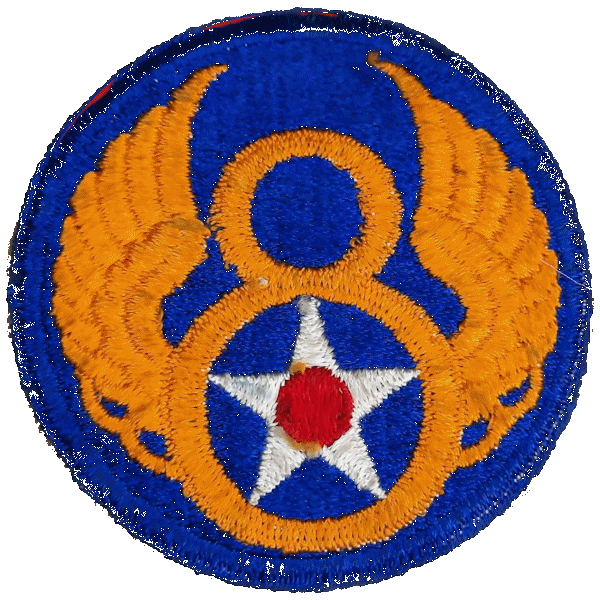
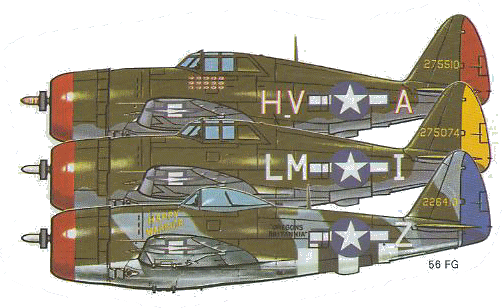
RAF Boxted, designated USAAF Station 150, occupies a distinguished place in the history of the United States Eighth Air Force. Constructed during World War II near Colchester in Essex, the airfield served first as an operational base for the 386th Bombardment Group and the 354th Fighter Group before becoming the principal wartime home of the legendary 56th Fighter Group. Known throughout the Eighth Air Force as "Zemke's Wolfpack," the 56th became the highest-scoring American fighter group in the European Theater while flying the Republic P-47 Thunderbolt.
Boxted's history reflects the rapid development of American air power in Britain. From its runways flew medium bombers, pioneering P-51 Mustang escorts, and heavily armed P-47 Thunderbolts. The airfield became an important center for bomber escort, fighter sweeps, ground attack, armed reconnaissance, and tactical support operations extending from the English Channel to the heart of Germany.
Construction of RAF Boxted
RAF Boxted was constructed during 1942 and 1943 as part of the major wartime expansion of airfields across eastern and southeastern England. The station was built on farmland approximately five miles northeast of Colchester, between the Essex communities of Boxted, Langham, and Great Bromley.
Although identified by the Royal Air Force name RAF Boxted, the station was constructed primarily for use by the United States Army Air Forces. It was designated USAAF Station 150 and developed according to the standard Class A airfield pattern used for permanent American bomber and fighter stations in Britain.
The airfield's location offered several operational advantages. It was close enough to the coast to allow fighters and medium bombers rapid access to occupied Europe, yet far enough inland to provide some protection from German coastal artillery and low-level attacks. Its position also placed it near major roads and railway connections needed to transport personnel, fuel, ammunition, aircraft parts, and construction materials.
The 386th Bombardment Group
The first American combat unit to occupy Boxted was the 386th Bombardment Group (Medium), which arrived during June 1943. Equipped with the Martin B-26 Marauder, the group used Boxted while preparing for operations against German targets in occupied Europe.
The 386th Bombardment Group began combat operations from Boxted during the summer of 1943. Its B-26 crews attacked enemy airfields, railway centers, coastal defenses, industrial installations, and transportation targets in France and the Low Countries. The group remained only briefly before moving to RAF Great Dunmow in September 1943.
Although its stay was relatively short, the 386th helped establish Boxted as an operational American station. Its personnel tested the airfield's runways, technical facilities, communications systems, fuel installations, and domestic accommodations under combat conditions.
The Arrival of the 354th Fighter Group
Following the departure of the 386th Bombardment Group, RAF Boxted became home to the 354th Fighter Group. The group arrived late in 1943 and was equipped with the North American P-51 Mustang, an aircraft that would transform the Allied daylight bombing campaign.
The 354th was assigned to the Ninth Air Force but initially operated under the tactical control of the Eighth Air Force. Its early missions demonstrated that the P-51, when fitted with external fuel tanks, possessed the range required to escort heavy bombers much deeper into Germany than earlier Allied fighters.
From Boxted, the 354th Fighter Group helped pioneer long-range Mustang escort operations. Its pilots protected B-17 Flying Fortress and B-24 Liberator formations while refining procedures for rendezvous, relief, high-altitude escort, aggressive interception, and the use of external fuel tanks.
The success of these missions helped prove that continuous fighter protection could be provided over much of Germany. The group's experience contributed to the wider introduction of the Mustang throughout the Eighth Air Force and to the gradual achievement of Allied air superiority over Western Europe.
During April 1944, as the Ninth Air Force concentrated its units for the invasion of Normandy, the 354th Fighter Group moved from Boxted to RAF Lashenden. Its departure made the airfield available for one of the most celebrated fighter organizations of the war.
Formation of the 56th Fighter Group
The 56th Fighter Group was activated in the United States on 15 January 1941 as one of the Army Air Forces' early pursuit organizations. Initially equipped with Bell P-39 Airacobras and Curtiss P-40 Warhawks, the group served primarily as an air defense and operational training organization while the United States expanded its military aviation forces.
The unit was redesignated the 56th Fighter Group in May 1942. The following month it began converting to the Republic P-47 Thunderbolt, a large, powerful fighter that would become permanently associated with the group's wartime identity.
Training with the P-47 emphasized high-altitude interception, formation flying, aerial gunnery, navigation, bomber escort, and the use of the aircraft's exceptional diving performance. The group's pilots and ground crews also learned to manage the Thunderbolt's complex turbo-supercharger system and powerful Pratt & Whitney radial engine.
The group departed the United States in December 1942 and arrived in England between December 1942 and January 1943. Its three operational squadrons were:
Early Stations in England
After arriving in Britain, the 56th Fighter Group passed through several stations while preparing for combat. Its first English base was RAF Kings Cliffe, followed by RAF Horsham St Faith and RAF Halesworth.
The group's entry into combat was delayed by technical difficulties involving the P-47's radio equipment. Extensive modifications were required before the aircraft could be committed to operations. Once these problems were corrected, the group became operational during April 1943.
The 56th flew its first combat mission on 13 April 1943, conducting a fighter sweep over the coastal region near Cherbourg, France. Under the leadership of Colonel Hubert A. Zemke, the group developed an aggressive tactical philosophy that earned it the enduring nickname "Zemke's Wolfpack."
The P-47 Thunderbolt in Combat
During its early combat operations, the 56th employed the P-47 on fighter sweeps, coastal patrols, interception missions, and limited-range bomber escorts. The early Thunderbolt lacked the range required to accompany bombers deep into Germany, but it possessed several important combat advantages.
The P-47 was powered by a large radial engine and armed with eight .50-caliber machine guns. It could dive at high speed, operate effectively at great altitude, carry a substantial ammunition load, and absorb extensive battle damage. Its ruggedness frequently enabled pilots to return to England in aircraft that would have been lost had they been flying lighter fighters.
On 4 May 1943, the 4th and 56th Fighter Groups became the first American fighter units to escort Eighth Air Force bombers during an attack against Ford and General Motors factories at Antwerp, Belgium. The mission marked an important beginning in the development of organized American fighter escort operations.
Throughout 1943, Colonel Zemke and other leaders refined tactics that exploited the strengths of the Thunderbolt. These included high-altitude interception, disciplined formation flying, high-speed diving attacks, coordinated squadron maneuvers, and aggressive attacks against German fighters before they could reach the bomber formations.
As larger external fuel tanks became available, the operational range of the P-47 increased. The 56th could accompany Eighth Air Force bombers farther into occupied Europe and Germany while continuing to challenge Luftwaffe interceptors in the air.
Protecting the Eighth Air Force
The principal mission of the 56th Fighter Group was the protection of the Eighth Air Force's daylight heavy bomber formations. Its pilots escorted B-17 Flying Fortresses and B-24 Liberators attacking aircraft factories, oil refineries, railway centers, military airfields, submarine facilities, transportation networks, and industrial targets across occupied Europe and Germany.
The group frequently protected B-24 Liberator formations of the Second Air Division. Rather than remaining continuously beside the bombers, Wolfpack pilots often ranged ahead, above, or along the flanks of the formations to intercept German fighters before they could organize attacks.
This aggressive approach reflected the changing purpose of American escort operations. Fighter pilots were expected not merely to defend the bombers but also to seek out and destroy the Luftwaffe in the air and, when circumstances permitted, on the ground.
Big Week and the Battle for Air Superiority
The 56th Fighter Group reached a high level of operational effectiveness during the air battles preceding the Normandy invasion. During Big Week, conducted between 20 and 25 February 1944, Allied heavy bombers struck German aircraft factories, assembly plants, engine works, and other facilities supporting the Luftwaffe.
While the bombers attacked Germany's aircraft industry, the 56th aggressively engaged Luftwaffe interceptors. The campaign forced German fighters into combat against increasingly experienced and numerous American escort units.
Between 20 February and 9 March 1944, the Wolfpack repeatedly sought German aircraft in the air and over their home airfields. For its outstanding combat performance during this period, the 56th Fighter Group received its first Distinguished Unit Citation.
These operations inflicted severe losses upon Germany's experienced fighter force and contributed to the Allies' growing command of the skies over Western Europe.
The 56th Fighter Group Arrives at RAF Boxted
On 19 April 1944, the 56th Fighter Group moved from RAF Halesworth to RAF Boxted. The move placed the group at a modern fighter station that was well positioned for escort missions, offensive fighter sweeps, and preparations for the invasion of continental Europe.
Boxted became the group's principal wartime home. From its runways the 56th conducted operations during some of the most important campaigns of the European war, including Normandy, the Allied advance across France, Operation Market Garden, the Battle of the Bulge, the crossing of the Rhine, and the final advance into Germany.
Unlike most Eighth Air Force fighter groups, the 56th did not convert to the P-51 Mustang. Its leaders believed that the Thunderbolt's rugged construction, firepower, high-altitude performance, and exceptional diving ability continued to make it a formidable combat aircraft. Improved external fuel tanks helped overcome many of its earlier range limitations.
Physical Configuration of RAF Boxted
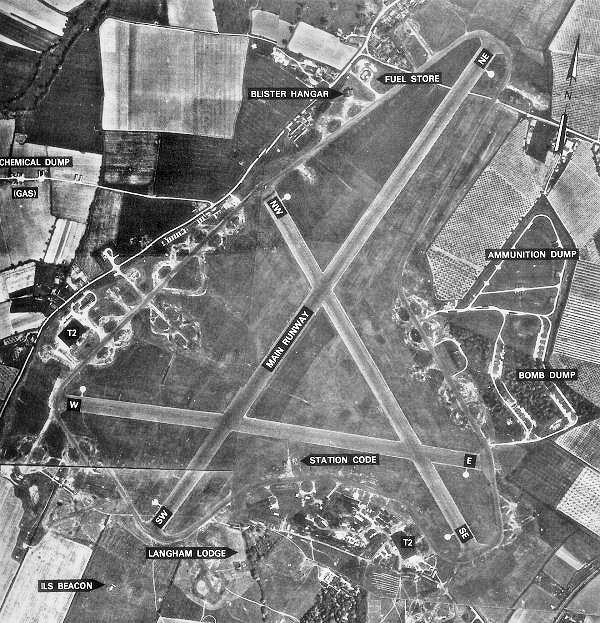
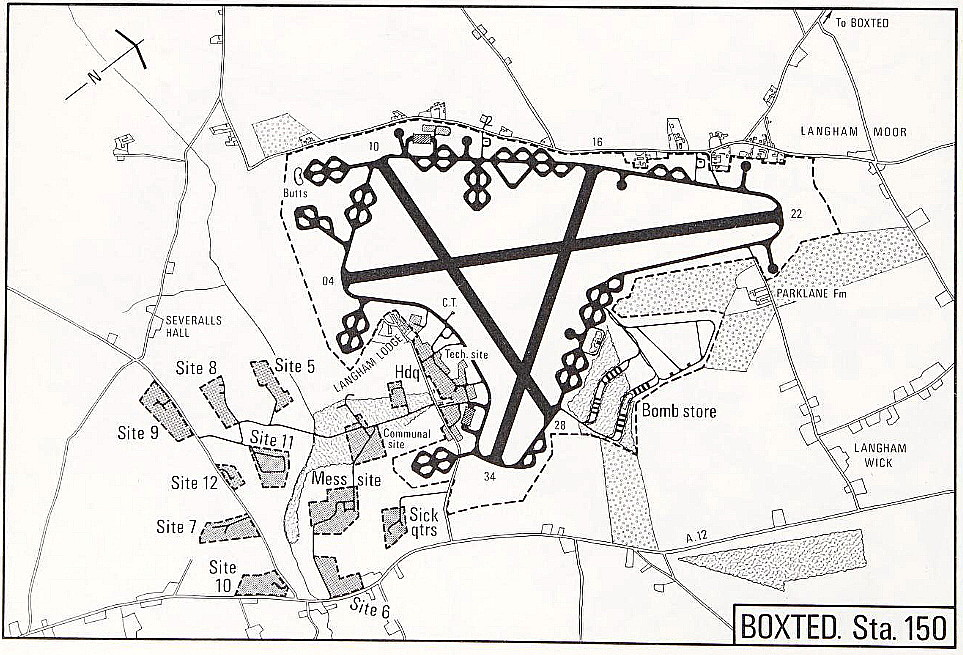
RAF Boxted followed the standard Class A airfield design. Its layout was intended to support sustained combat operations while dispersing aircraft and essential facilities to reduce their vulnerability to enemy attack.
Runway System
The airfield featured three intersecting concrete runways arranged in the standard triangular pattern:
The runway system allowed aircraft to take off and land under varying wind conditions. It was capable of supporting heavily loaded P-47 Thunderbolts carrying external fuel tanks, bombs, ammunition, and other operational equipment.
Perimeter Taxiway and Aircraft Dispersals
A complete concrete perimeter taxiway encircled the flying field and connected the runways with the dispersal areas, technical site, hangars, maintenance facilities, and aircraft servicing points. This arrangement allowed large formations to taxi efficiently and reduced congestion during mass departures and recoveries.
Approximately 50 loop-type hardstands were constructed around the perimeter track. These dispersals separated aircraft from one another and reduced the possibility that a single bombing or strafing attack could destroy several fighters at once.
The aircraft dispersals were generally:
Many P-47s were fueled, armed, and prepared before dawn. Ground crews worked in darkness or poor weather so that formations could be launched as soon as operational orders were received.
Hangars and Maintenance Facilities
Although much routine servicing was conducted at the dispersal hardstands, Boxted included several large maintenance buildings, including T-2 type hangars.
These facilities were used for:
Maintenance personnel played an essential role in the group's combat success. The Thunderbolt was a rugged aircraft, but the high tempo of operations demanded constant inspection and repair. Crew chiefs, armorers, mechanics, radio technicians, sheet-metal workers, and engine specialists frequently worked through the night to return damaged aircraft to service.
Technical Site
The technical site formed the operational center of RAF Boxted. It contained the buildings and services required to plan, direct, support, and evaluate combat missions.
Facilities included:
Before missions, pilots assembled in briefing rooms to receive information concerning targets, routes, altitudes, weather, radio procedures, friendly forces, flak concentrations, and expected Luftwaffe opposition. After returning, they were questioned by intelligence officers, and their combat claims were compared with gun-camera film and reports from other pilots.
Control Tower and Flying Control
The control tower coordinated aircraft movements on the runways and taxiways. Flying control personnel monitored weather, organized departures, directed returning formations, and assisted damaged or fuel-short aircraft attempting emergency landings.
The return of a large fighter formation could create intense activity. Aircraft often arrived with battle damage, wounded pilots, landing-gear problems, failing engines, or dangerously low fuel. Fire crews and ambulances remained ready whenever operational formations returned.
Domestic Camps
The domestic and communal camps were separated from the flying field and technical area. Dispersing the accommodation sites reduced casualties in the event of enemy bombing and allowed thousands of personnel to be housed without concentrating them in one location.
The domestic sites contained:
Living conditions could be uncomfortable, particularly during the cold and damp English winters. Personnel contended with mud, blackout restrictions, limited heating, crowded quarters, and the constant demands of combat operations.
Fuel, Ammunition, and Armament Areas
Fuel and ammunition storage areas were positioned away from the domestic camps and principal technical buildings. This reduced the risk that an accident or enemy attack would cause catastrophic damage to the station.
Separate compounds stored:
The P-47's eight .50-caliber machine guns required large quantities of ammunition. Armorers loaded ammunition belts, maintained the guns, installed bombs, and checked firing and release mechanisms before each mission.
D-Day and the Normandy Campaign
During the invasion of Normandy on 6 June 1944, the 56th Fighter Group flew protective patrols and tactical support missions over the invasion area. Its pilots helped prevent Luftwaffe attacks against Allied naval forces, transport aircraft, landing craft, and troops establishing the beachhead.
The group's missions included fighter cover, armed reconnaissance, attacks against transportation routes, and strikes against German vehicles, communications, artillery positions, and troop movements.
Following the landings, the 56th continued supporting Allied operations in Normandy. During the breakout from Saint-Lô in July 1944, its P-47s attacked bridges, railway lines, roads, armored vehicles, supply columns, and other targets behind the German front.
These operations demonstrated the versatility of the Thunderbolt. Originally developed as a high-altitude fighter, the P-47 became one of the most effective fighter-bombers of the war because of its heavy armament, ability to carry bombs and rockets, and resistance to ground fire.
Operation Market Garden
During Operation Market Garden in September 1944, the group escorted troop carrier aircraft and gliders supporting the Allied airborne landings in the Netherlands. Its pilots also attacked German anti-aircraft positions, transportation routes, and other threats to the airborne formations.
For its outstanding performance in connection with these operations, the 56th Fighter Group received a second Distinguished Unit Citation.
Leadership of the Wolfpack
Colonel Hubert A. Zemke played a central role in establishing the combat identity of the 56th Fighter Group. His emphasis on tactical discipline, formation integrity, mutual protection, and controlled aggression helped turn the Wolfpack into one of the most effective fighter organizations in the Eighth Air Force.
In August 1944, Colonel David C. Schilling succeeded Zemke as group commander. Schilling continued the aggressive operational policies developed under Zemke and led the group during the transition from primarily escort operations to increasingly extensive fighter sweeps and ground attacks.
The 56th produced many of the leading American fighter pilots of the European war. Among those closely associated with the group were Hubert Zemke, David C. Schilling, Robert S. Johnson, and Francis S. Gabreski. Gabreski became the highest-scoring American fighter ace in the European Theater with 28 confirmed aerial victories during World War II.
Battle of the Bulge
During the Battle of the Bulge in December 1944 and January 1945, poor winter weather initially restricted Allied flying. When conditions improved, the 56th launched repeated missions against German armored vehicles, trucks, railway traffic, troop concentrations, supply routes, and airfields.
These attacks disrupted the movement of German reinforcements and supplies while assisting Allied ground forces in containing and ultimately defeating Germany's final major offensive in Western Europe.
Final Campaigns Across Europe
During late 1944 and early 1945, the group's missions increasingly emphasized armed reconnaissance and tactical ground attack. Wolfpack pilots strafed airfields, destroyed locomotives and railcars, attacked military convoys, struck bridges, and disrupted fuel and communications networks.
In March 1945, the group helped protect the strategically important bridgehead at Remagen. Its pilots provided cover for Allied forces crossing the Rhine while attacking German artillery, transportation routes, airfields, and reinforcements attempting to threaten the bridgehead.
As Allied armies advanced deeper into Germany, the 56th continued flying bomber escort, fighter sweeps, ground attack, and armed reconnaissance missions against retreating German forces.
The 56th Fighter Group flew its final combat mission on 21 April 1945, conducting escort and armed reconnaissance operations over Germany only weeks before the end of the war in Europe.
Daily Life at RAF Boxted
Thousands of American airmen lived and worked at RAF Boxted between 1943 and 1945. Although combat missions dominated station activity, daily life included aircraft maintenance, training flights, intelligence briefings, physical conditioning, inspections, administrative work, and periods of recreation.
Mission days often began before sunrise. Pilots ate an early breakfast before attending briefing, while mechanics, armorers, fuel crews, and drivers had already spent hours preparing the aircraft. After takeoff, personnel on the ground waited for the sound of returning engines and watched for signs of missing or damaged aircraft.
The relationship between American personnel and the surrounding Essex communities became an important part of life at Boxted. Airmen visited Colchester and nearby villages, attended local churches and dances, and formed friendships with British families. Many of those relationships continued long after the war.
Sporting events, motion pictures, concerts, dances, and visits by entertainers provided relief from the strain of combat. One of the station's most memorable events occurred in August 1944, when Major Glenn Miller and the Army Air Forces Band performed at Boxted for American servicemen.
America's Highest-Scoring P-47 Fighter Group
The 56th Fighter Group became the highest-scoring P-47 Thunderbolt organization in the European Theater and one of the most successful fighter groups in the history of the United States Army Air Forces.
Unlike many Eighth Air Force groups that converted to the P-51 Mustang during 1944, the 56th retained the P-47 throughout the European campaign. Its success demonstrated that the Thunderbolt remained an exceptional combat aircraft when flown by experienced pilots using tactics suited to its strengths.
By the end of World War II, the group had flown more than 650 combat missions. Its pilots were credited with destroying well over 1,000 enemy aircraft in the air and on the ground. They also destroyed locomotives, railcars, military vehicles, bridges, armored vehicles, airfield installations, and other targets supporting the German war effort.
These achievements were costly. Aircraft were lost in combat and operational accidents, while many pilots were killed, wounded, captured, or reported missing. The accomplishments of the group were made possible not only by its pilots but also by the thousands of ground personnel who maintained, armed, fueled, repaired, supplied, and supported its aircraft.
End of the War
Following Germany's surrender in May 1945, the operational tempo at RAF Boxted declined. Training flights continued while aircraft and equipment were prepared for redistribution or shipment. Personnel awaited reassignment, occupation duties, or transportation back to the United States.
The 56th Fighter Group remained at Boxted until the autumn of 1945. It departed England during September and October, bringing to an end the American operational occupation of one of the Eighth Air Force's best-known fighter stations.
Postwar RAF Use
After the departure of the Americans, RAF Boxted returned to Royal Air Force control. The station was used for a short period by RAF flying units, including aircraft associated with the transition from wartime piston-engine fighters to the first generation of British jet aircraft.
RAF units operating de Havilland Mosquitos and Gloster Meteors used Boxted during the immediate postwar period. However, the Royal Air Force possessed more airfields than it required after the reduction of Britain's wartime forces, and Boxted had only a limited postwar military future.
Military flying ended, and the station closed during the late 1940s. Buildings and installations were sold, dismantled, or adapted for civilian use. Much of the former flying field gradually returned to agriculture.
RAF Boxted Today
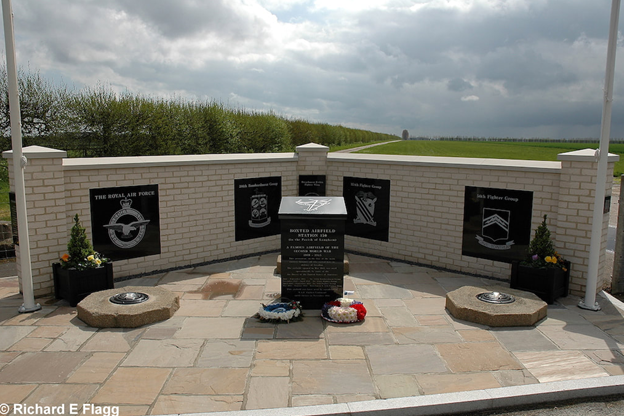
Today, much of the former RAF Boxted airfield is farmland, but important traces of USAAF Station 150 remain. Sections of the original runways, perimeter taxiway, dispersal hardstands, access roads, and wartime buildings can still be identified.
Some surviving structures have been adapted for agricultural, industrial, aviation, or private use. Their continued presence provides a physical connection to the thousands of American and British personnel who served at the station.
Local historians and preservation organizations, including the Friends of Boxted Airfield and the Boxted Airfield Museum, have worked to preserve photographs, documents, artifacts, aircraft components, uniforms, equipment, and personal accounts connected with the airfield.
Memorials, museum displays, historical publications, and commemorative events continue to honor the personnel of the 386th Bombardment Group, the 354th Fighter Group, the 56th Fighter Group, and the supporting units that served at RAF Boxted.
Legacy of RAF Boxted and the 56th Fighter Group
RAF Boxted is remembered primarily as the wartime home of Zemke's Wolfpack, one of the most celebrated fighter groups of World War II. The station witnessed the evolution of American fighter operations from medium-range escort and defensive patrols to long-range escort, offensive fighter sweeps, fighter-bomber attacks, and armed reconnaissance deep inside Germany.
The 56th Fighter Group helped protect the heavy bombers of the Eighth Air Force, weakened the Luftwaffe, supported the invasion of Normandy, attacked German transportation and military forces, and assisted the Allied armies during their advance across Western Europe.
Through the courage of its pilots, the skill of its ground personnel, and the leadership of men such as Hubert Zemke and David Schilling, the 56th established a combat record that remains inseparable from the history of the Republic P-47 Thunderbolt.
The surviving remains of RAF Boxted and the continuing work of local preservation organizations ensure that the airfield and the men who served there retain an enduring place in the history of the Eighth Air Force and the Allied victory in Europe.
Squadrons
61st Fighter Squadron, 1941-1945
62nd Fighter Squadron, 1941-1945
63rd Fighter Squadron, 1941-1945
Principal Wartime Commanding Officers
Lt. Col. Davis D. Graves, June 1941
Col. John C. Crosthwaite, July 1942
Col. Hubert A. Zemke, September 1942
Col. Robert B. Landry, October 1943
Col. Hubert A. Zemke, January 1944
Col. David C. Schilling, August 1944
Lt. Col. Lucian A. Dade Jr., October 1945
Stations
Savannah, Georgia, January 1941
Charlotte, North Carolina, May 1941
Charleston, South Carolina, December 1941
Bendix, New Jersey, January 1942
Bridgeport, Connecticut, July 1942
RAF Kings Cliffe, England, January 1943
RAF Horsham St Faith, England, April 1943
RAF Halesworth, England, July 1943
RAF Boxted, England, April 1944
Campaigns
Air Offensive, Europe
Normandy
Northern France
Rhineland
Ardennes-Alsace
Central Europe

56th Fighter Group Roll of Honor: Roll of Honor
Oversea Burials 56th Fighter Group Oversea Burials
Group Web Site https://www.56thfightergroup.co.uk/