RAF ATTLEBRIDGE AIRBASE
HOME OF THE 466th Bomb Group
RAF Attlebridge, located approximately eight miles northwest of Norwich in Norfolk, was one of the earlier Royal Air Force bomber stations constructed during the Second World War. Work on the airfield began in 1941 as part of Britain's rapid expansion of bomber bases following the outbreak of war. The station was initially intended for the RAF's No. 2 Group, which operated Bristol Blenheim light bombers before later transitioning to Douglas Boston aircraft. Although the base served the RAF during the early years of the war, its strategic importance increased dramatically as American heavy bomber forces began arriving in East Anglia.
RAF Attlebridge was one of more than one hundred airfields constructed during Britain's massive wartime expansion under the Royal Air Force Expansion Scheme. Work began in the spring of 1941 on farmland between the villages of Attlebridge, Great Witchingham, and Weston Longville, approximately eight miles northwest of Norwich. The relatively flat terrain, stable soil, and proximity to rail lines made the site ideal for a bomber station capable of supporting continuous military operations.
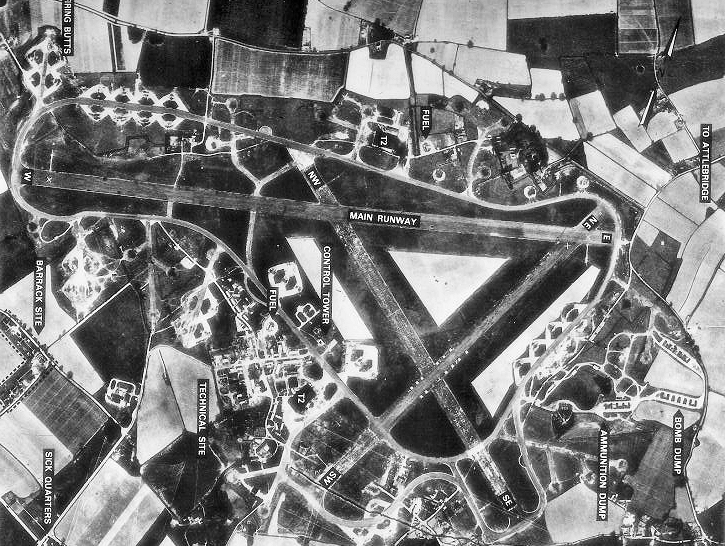
Originally built with relatively short concrete runways suitable for light and medium bombers, Attlebridge underwent extensive reconstruction in late 1942 and 1943 after being selected for use by the United States Army Air Forces. Engineers enlarged the entire station to meet the demanding requirements of B-24 Liberator operations. The principal east-west runway was extended to approximately 2,000 yards, while the two intersecting runways were lengthened to about 1,400 yards each. New taxiways, perimeter tracks, dispersal hardstands, maintenance facilities, and expanded technical and administrative areas transformed Attlebridge into a modern heavy bomber station capable of supporting sustained strategic bombing operations. These improvements required the closure of several country lanes and significantly altered the surrounding agricultural landscape.
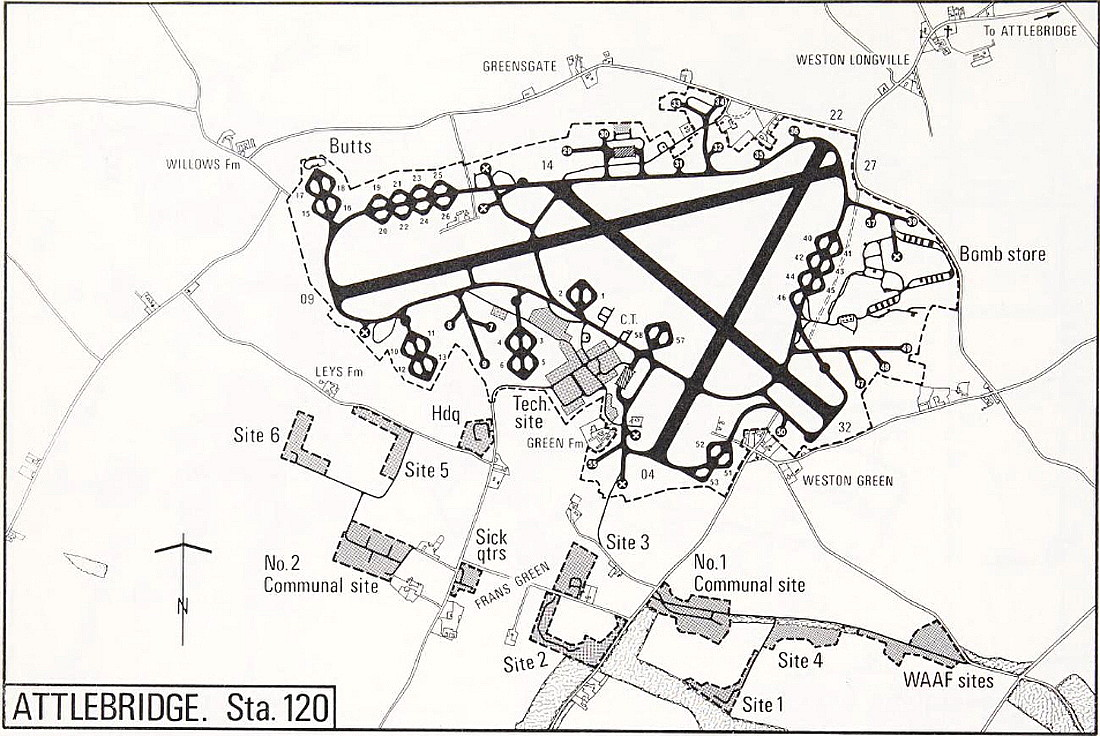
The station officially became USAAF Station 120 and was assigned to the Eighth Air Force's Second Air Division. Like many American airfields in Norfolk, Attlebridge developed into a self-contained military community. The base included barracks for more than 2,500 personnel, operations buildings, briefing rooms, engineering shops, ammunition storage areas, fuel facilities, medical stations, mess halls, recreation buildings, and a control tower overlooking the three-runway airfield. A network of Nissen huts housed both aircrews and ground personnel, while numerous aircraft dispersal areas around the perimeter allowed Liberators to be serviced and armed before missions.
A Standard Class "A" Heavy Bomber Airfield
Following its reconstruction in 1942-43, RAF Attlebridge became a standard Class "A" bomber station, the design adopted throughout Britain for heavy bomber operations. This standardized layout enabled aircrews from different stations to operate under nearly identical conditions.
The completed station included:
- Three intersecting concrete runways arranged in a triangular pattern.
- More than ten miles of perimeter taxiway.
- Approximately fifty aircraft dispersal hardstands.
- Two large T-2 steel hangars for major aircraft maintenance.
- Numerous blister hangars for routine servicing.
- Bomb storage compounds located well away from living quarters.
- Underground fuel storage tanks connected to fueling points around the airfield.
- Fire stations strategically positioned for rapid emergency response.
- A modern control tower providing excellent visibility across the flying field.
The standardized layout allowed aircraft to taxi directly from dispersal areas to any active runway while minimizing congestion during large-scale bomber launches.
Engineering Challenges
Constructing RAF Attlebridge presented numerous engineering challenges. Norfolk's heavy clay soil required extensive drainage before concrete could be poured. Engineers installed underground drainage systems beneath each runway to prevent frost damage and standing water during winter months.
Each runway consisted of multiple layers of crushed stone topped with reinforced concrete designed to support aircraft weighing more than 60,000 pounds. Expansion joints were carefully installed to prevent cracking caused by temperature changes and repeated landings by heavy bombers.
The perimeter track alone required thousands of tons of aggregate and concrete, allowing aircraft to circulate continuously around the airfield without interfering with takeoffs or landings.
Technical Site
The technical site served as the operational heart of RAF Attlebridge.
Here were located:
- Operations headquarters
- Flight briefing rooms
- Weather office
- Intelligence section
- Communications center
- Engineering offices
- Aircraft maintenance shops
- Radio repair workshops
- Armament shops
- Vehicle maintenance garages
- Medical station
- Fire headquarters
This area functioned almost continuously throughout the war. During flying operations personnel worked around the clock to maintain aircraft, prepare navigation equipment, issue weather forecasts, and coordinate mission activities.
Domestic Camps
Unlike modern military bases, RAF Attlebridge was divided into separate domestic camps located away from the active flying field.
The camps consisted primarily of:
- Nissen huts
- Brick administration buildings
- Dining halls
- Recreation rooms
- Chapels
- Medical facilities
- Bath houses
- Libraries
- Athletic fields
The dispersed layout reduced vulnerability to enemy attack while allowing thousands of officers and enlisted personnel to live relatively comfortably despite wartime conditions.
Roads and footpaths connected the domestic sites with the technical area and airfield, while shuttle trucks transported personnel between various parts of the station.
Airfield Operations
Although attention often focuses on combat missions, the operation of RAF Attlebridge itself was a remarkable logistical achievement.
Every aircraft movement required coordination between:
- Air Traffic Control
- Flight Operations
- Meteorological personnel
- Engineering crews
- Fuel services
- Armament sections
- Communications specialists
- Fire and crash rescue units
Ground crews often began work long before sunrise. Aircraft were fueled, oil levels checked, hydraulic systems inspected, engines tested, radios calibrated, bombs loaded, and oxygen bottles replenished before flight crews even arrived. Following missions, maintenance personnel immediately began repairing battle damage so aircraft could be prepared for the next operation.
Utilities and Infrastructure
RAF Attlebridge functioned much like a small town.
The station maintained its own:
- Electrical distribution system
- Water supply
- Sewage treatment facilities
- Telephone exchange
- Vehicle fleet
- Fuel depot
- Warehouses
- Laundry
- Kitchens
- Heating plants
Supplying thousands of personnel required enormous quantities of food, aviation gasoline, lubricants, spare parts, ammunition, and construction materials. Much of these supplies arrived by rail before being transported by truck to the station.
Security and Defense
Although located well inland, RAF Attlebridge maintained extensive security measures.
These included:
- Guard posts around the perimeter
- Security fencing
- Controlled access gates
- Military police patrols
- Camouflaged buildings
- Blackout lighting
- Air raid shelters
- Anti-aircraft positions nearby
Enemy aircraft seldom penetrated East Anglia after 1943, but every station remained prepared for possible attack until the end of the war.
Relationship with the Norfolk Community
Construction of the airfield dramatically changed the surrounding countryside.
Farm roads disappeared beneath concrete runways, while nearby villages experienced an influx of thousands of American personnel. Local businesses expanded to accommodate the newcomers, and many residents found employment maintaining the station or providing services.
Strong friendships developed between local families and American servicemen, relationships that continued through reunions and commemorative visits for decades after the war.
The End of Wartime Operations
With the defeat of Germany in May 1945, flying activity gradually declined. Following the departure of American forces during the summer of 1945, RAF Attlebridge reverted to Royal Air Force control. The station served briefly as a maintenance and storage facility before being placed on inactive status.
During the late 1940s and early 1950s many temporary wartime buildings were sold or demolished. Equipment was removed, and portions of the technical site were dismantled. Large sections of the airfield eventually returned to agricultural use.
RAF Attlebridge Today
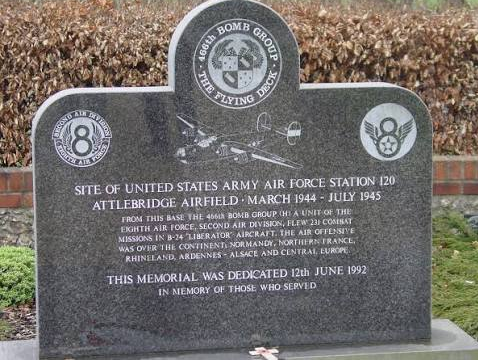
Today, much of RAF Attlebridge has returned to agricultural use, although portions of the original runways, perimeter tracks, and dispersal areas remain visible. Several wartime buildings still survive, and memorials near the former station commemorate the officers and enlisted men of the 466th Bomb Group who served from Attlebridge. The site remains an important landmark in the history of the Eighth Air Force and the Second Air Division, preserving the legacy of the American airmen who launched hundreds of combat missions from this Norfolk airfield.
Although many wartime buildings have disappeared, visitors can still identify:
- Portions of the main runway
- Long stretches of perimeter track
- Aircraft dispersal hardstands
- Foundations of technical buildings
- Roadways laid out during wartime
- Several surviving support structures
Modern aerial photography clearly reveals the original triangular runway pattern that once launched heavy bombers into the skies over Europe.
Historical organizations, veterans' associations, and local preservation groups continue to document and protect the remaining features of the station. Memorials near the former airfield honor the thousands of American and British personnel who served there, ensuring that RAF Attlebridge's role as USAAF Station 120 remains an enduring part of the history of the Eighth Air Force and the Second Air Division.
This surviving landscape provides a tangible reminder of the immense engineering effort required to build and operate one of the many heavy bomber bases that supported the Allied strategic air offensive during the Second World War.
Aircrew Memorial