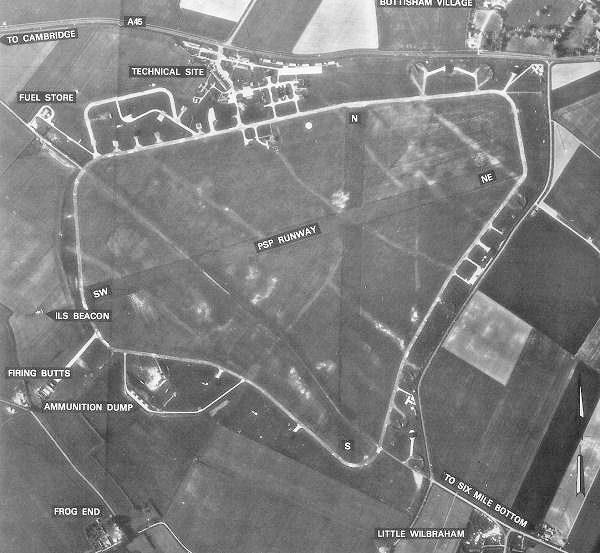
RAF BOTTISHAM AIR BASE
HOME OF THE 361st FIGHTER GROUP
Although it never possessed the extensive concrete facilities of many permanent Eighth Air Force fighter stations, Bottisham became one of the most famous Mustang bases in England. From here, the 361st Fighter Group earned a reputation as one of the premier long-range escort units of the war and flew some of the best-known P-51 Mustangs of the European Theater, including "Lou IV."
History - Early RAF Development
Bottisham was constructed in 1940 as a grass satellite airfield for RAF Waterbeach. Initially it served as a relief landing ground for training aircraft before becoming home to several RAF Army Cooperation squadrons operating Lysanders, Tomahawks, Austers, and early Mustangs. Unlike purpose-built heavy bomber stations, Bottisham remained a comparatively small and lightly developed fighter field during its RAF service.
Conversion for the USAAF
In mid-1943, the Air Ministry enlarged the airfield specifically for American fighter operations. The improvements included: " Enlarged flying field " Expanded dispersal system " Additional technical buildings " Improved accommodation " Steel-planked runways " New maintenance facilities
On 3 January 1944, the station officially became USAAF Station 374, and the 361st Fighter Group assumed operational control. Initially equipped with the Republic P-47 Thunderbolt, the group converted to the North American P-51 Mustang in May 1944, dramatically extending its escort range and effectiveness.
Its escort missions reached deep into Germany, protecting B-17 and B-24 formations while also attacking Luftwaffe fighters whenever possible. The group distinguished itself during Big Week (February 1944), the Normandy invasion, and the breakout from Saint-Lô.
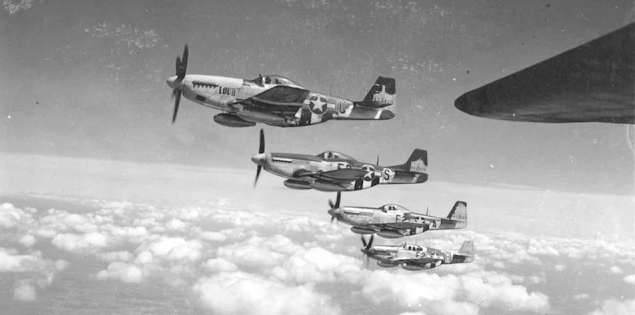
"The Bottisham Four"
Perhaps the station's most enduring legacy is the famous July 1944 photograph known as "The Bottisham Four." It depicts four P-51 Mustangs of the 375th Fighter Squadron in formation, led by Col. Thomas J. J. Christian Jr.'s celebrated "Lou IV." The image has become one of the iconic photographs of the Eighth Air Force fighter campaign.
Physical Configuration During 1944
Unlike permanent Class A bomber stations, Bottisham retained many characteristics of its earlier grass-airfield origins. The airfield occupied relatively level farmland southwest of the village of Bottisham. Its operational area consisted of:
- Two principal Pierced Steel Planking (PSP) runways
- Large surrounding grass maneuvering areas
- Steel taxiways
- Fighter dispersals around the perimeter
The heavy P-47 Thunderbolts quickly damaged the wet grass surfaces, prompting American engineers to construct a 1,470-yard PSP runway in just three days during January 1944-a remarkable engineering achievement.
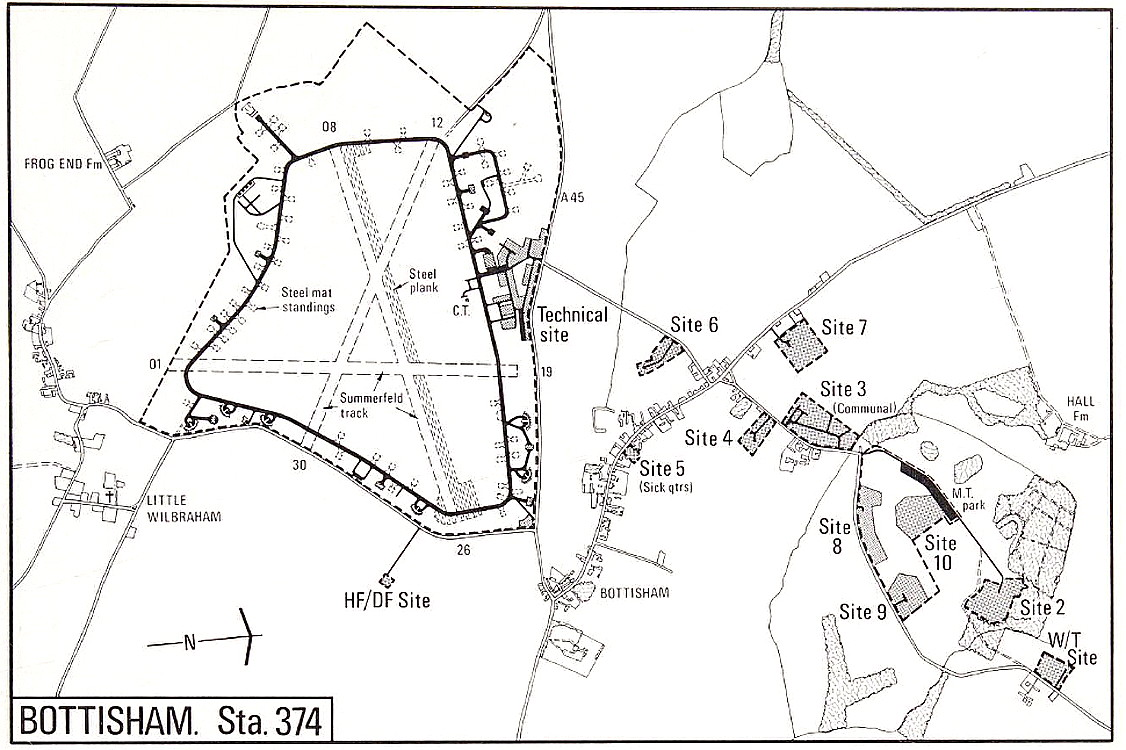
Runways
By spring 1944 the station operated primarily from PSP runways rather than concrete. These were entirely adequate for P-47s and P-51s but unsuitable for heavy bombers. The compact layout minimized taxi time and allowed rapid launches of escort formations:
- Main PSP runway approximately 4,410 feet (1,470 yards) long
- Secondary PSP runway
- Extensive grass landing areasc
Perimeter Taxiways
The compact layout minimized taxi time and allowed rapid launches of escort formations. A steel-mat taxiway linked:
- dispersal hardstands
- maintenance areas
- runways
- technical site
Aircraft Dispersals
Aircraft were parked individually on loop or frying-pan hardstands around the perimeter. The dispersed arrangement reduced the risk from air attack and allowed each squadron to occupy its own section of the airfield. Each dispersal typically contained:
- one or two fighters
- revetments or tree cover
- nearby ammunition carts
- fuel servicing points
Technical Site
Located adjacent to the flying field, this was the operational hub of the station. The technical area contained:
- Operations building
- Intelligence and briefing rooms
- Engineering offices
- Radio maintenance
- Armament workshops
- Fire station
- Watch Office (control tower)
Hangars
Routine servicing was often performed directly on the dispersal pans. Unlike larger bomber fields with multiple permanent hangars, Bottisham relied on a more modest maintenance complex:
- T2 hangar
- Maintenance shops
- Engine overhaul buildings
- Component repair facilities
Domestic Area
The camps were connected to the airfield by service roads and screened by trees where possible. Separate camps housed officers and enlisted personnel in:
- Nissen huts
- Barracks
- Officers' quarters
- Mess halls
- Recreation buildings
- Medical station
- Headquarters
- Motor transport section
Fuel and Ammunition Storage
Fuel and ordnance were stored away from the flying field in dispersed locations. This separation reduced the danger of accidental explosions. Facilities included:
- Aviation gasoline tanks
- Bomb storage
- .50-caliber ammunition magazines
- Rocket storage (later in 1944)
Following the end of World War II, RAF Bottisham, near Cambridge in Cambridgeshire, entered a period of rapid decline as Britain's enormous wartime airfield network was reduced. Unlike a few former RAF stations that continued as active military bases, Bottisham's flying career ended within a year of the war.
Belgian Air Force Training (1945–1946)
After the departure of the U.S. Eighth Air Force's 361st Fighter Group in September 1944, the airfield remained largely inactive until June 1945, when it became a relief landing ground for the RAF (Belgian) Initial Training School, which was based nearby at RAF Snailwell. The Belgian airmen used Bottisham for pilot training and flying operations while rebuilding Belgium's postwar military aviation capability.
On 1 October 1945, Bottisham officially became a satellite airfield of RAF Snailwell. Training continued only a few months before the Belgian units returned home in early 1946.
Closure of the Airfield
The rapid demobilization of the RAF meant Bottisham was no longer needed.
- Belgian personnel departed in March 1946.
- The airfield officially closed on 1 May 1946.
- Flying operations ceased permanently after only six years of military use.
A New Role After the War
Rather than being immediately demolished, many of the airfield buildings found new civilian uses.
One particularly interesting chapter occurred beginning in 1948, when portions of the station were taken over by the National Coal Board. The former barracks and support buildings became a training center for European Volunteer Workers—primarily displaced young men from Ukraine, Poland, Latvia, and other Eastern European countries who had been uprooted during the war. They received instruction before beginning work in Britain's coal mines.
Return to Agriculture
As happened at hundreds of former wartime airfields: The property was eventually sold for agricultural use in 1958. Today, crops cover much of what was once one of the Eighth Air Force's fighter bases: Most temporary buildings were dismantled, hardstands and taxiways were broken up or buried, the surrounding land was returned to farming.
What Can Still Be Seen Today?
Although much of RAF Bottisham has disappeared, visitors can still identify several reminders of its wartime past:
- Portions of the perimeter track
- Remnants of taxiways
- Reveral original airfield buildings
- Surviving Nissen huts,
- Outlines of the wartime runway visible in the landscape
- Memorials to the American and Belgian personnel who served there
Bottisham Airfield Museum
One of the greatest successes in preserving the station's history has been the creation of the Bottisham Airfield Museum, which opened in 2009. Located in the last surviving wartime buildings within the original airfield perimeter, the museum is dedicated to the three principal users of the base:
- The Royal Air Force
- The U.S. Eighth Air Force (especially the 361st Fighter Group)
- The Belgian Air Force
The museum has restored original structures, reconstructed a Nissen hut, and displays artifacts, uniforms, photographs, aircraft equipment, and personal stories from those who served there.
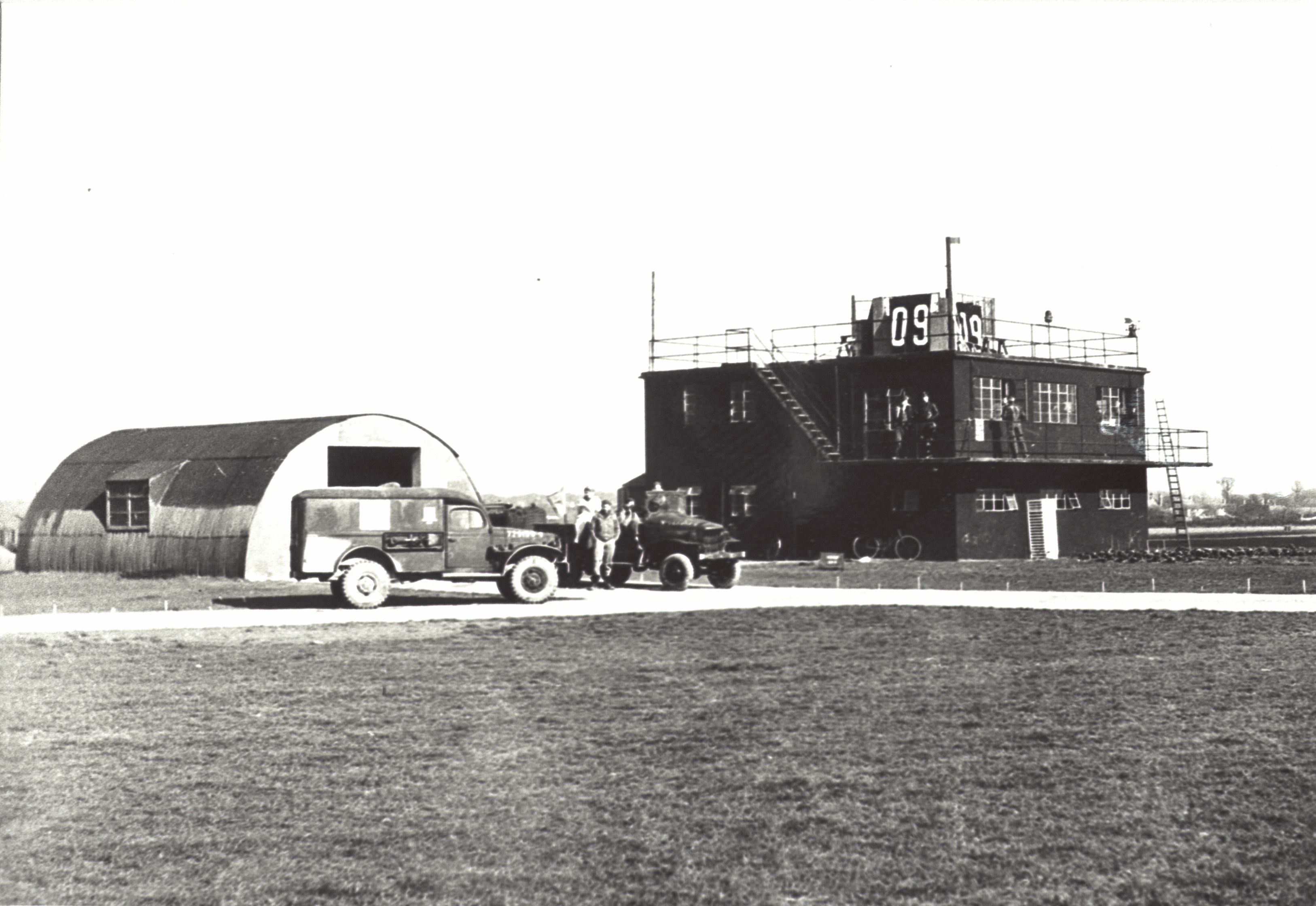
Bottisham Control Tower