RAF BOXED AIR BASE
HOME OF THE 56th FIGHTER GROUP
RAF Boxted Station 150 occupies a distinguished place in Eighth Air Force history as one of its premier fighter stations. During 1944 it became home to the legendary 56th Fighter Group, the highest-scoring American fighter group in the European Theater while flying the Republic P-47 Thunderbolt.
History
RAF Boxted was constructed during 1943 as a Class A fighter airfield near Colchester, Essex. Unlike many earlier RAF stations that were later expanded, Boxted was purpose-built with American fighter operations in mind.
The airfield opened in 1943 and was immediately transferred to the USAAF as Station 150. It was one of the newer American stations in southeast England, positioned close enough to the Channel for rapid access to occupied Europe while remaining outside the range of most Luftwaffe nuisance attacks.
The 354th Fighter Group
Boxted's first operational unit was the 354th Fighter Group, equipped with the new North American P-51 Mustang.
From Boxted, the 354th pioneered long-range Mustang escort tactics, proving that the P-51 could accompany heavy bombers deep into Germany. Many of the escort procedures later adopted throughout the Eighth Air Force were refined during this period. In April 1944 the group departed for RAF Lashenden to support the coming invasion of Normandy.
The Arrival of the 56th Fighter Group
On 19 April 1944, the famous 56th Fighter Group moved from RAF Halesworth to Boxted under the command of Colonel Hubert "Hub" Zemke.
Unlike most Eighth Air Force fighter groups, the 56th retained the Republic P-47 Thunderbolt throughout the war instead of converting to the P-51 Mustang. The group's leaders believed the Thunderbolt's ruggedness, firepower, and diving ability outweighed its shorter range, particularly after the introduction of improved drop tanks.
Physical Configuration During 1944
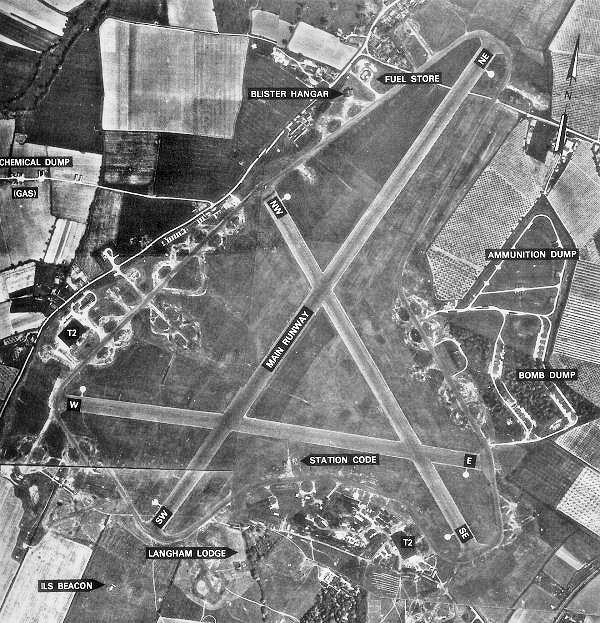
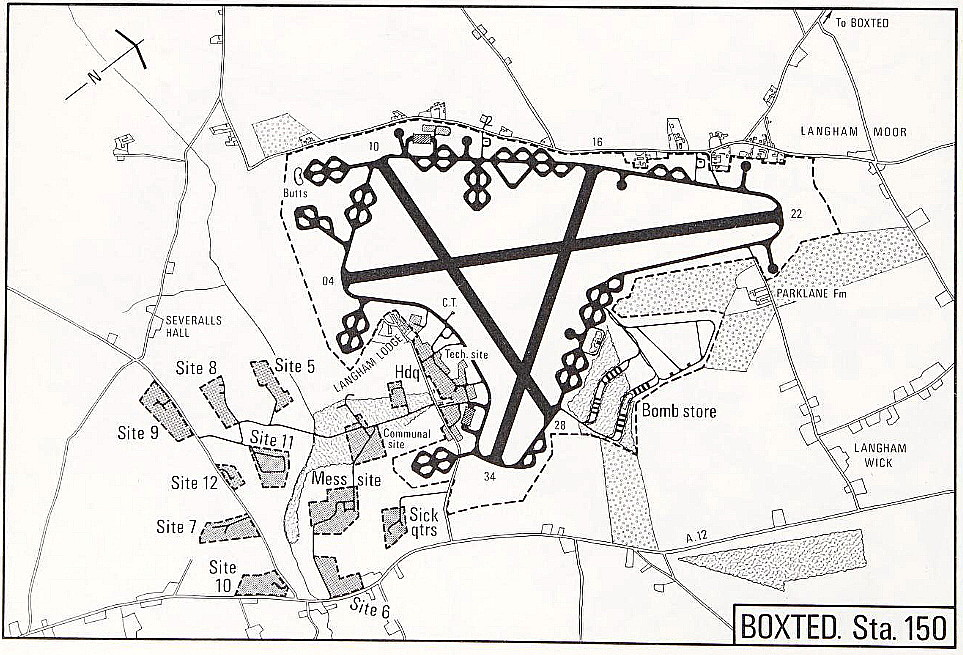
Boxted followed the standard pattern for a permanent Eighth Air Force fighter station. The airfield featured three intersecting concrete runways. These provided ample performance for heavily loaded P-47 Thunderbolts, even with external fuel tanks and bombs:
- Main runway approximately 6,000 feet
- Two secondary runways approximately 4,200 feet each
Perimeter Taxiway
A complete concrete perimeter track encircled the flying field, this arrangement enabled rapid launches of large escort formations.
- All three runways
- Dispersal areas
- Technical site
- Hangars
- Servicing areas
This arrangement enabled rapid launches of large escort formations. Around the perimeter were approximately 50 loop hardstands, each designed for one or two aircraft. Because the 56th flew primarily escort missions, aircraft were typically parked fully fueled and armed before dawn. The dispersals were:
- Separated by trees or earth revetments
- Organized by squadron
- Connected directly to the perimeter track
Hangars
Most daily servicing occurred on the dispersal pans, however the station included several permanent maintenance hangars, principally T2 hangars, used for:
- Engine changes
- Battle-damage repair
- Major inspections
- Propeller replacement
Technical Site
Adjacent to the flying field lay the operational heart of the station. This area coordinated daily fighter escort missions and intelligence debriefings. These facilities included:
- Group Operations
- Intelligence offices
- Briefing rooms
- Engineering section
- Radio repair shopsv
- Armament workshops
- Fire station
- Control tower (Watch Office)
Domestic Camps
The camps were intentionally separated from the flying field to reduce vulnerability and improve efficiency. Personnel lived in dispersed accommodation sites containing:
- Nissen huts
- Officers' quarters
- Enlisted barracks
- Mess halls
- Chapel
- Medical station
- Recreation hall
- Headquarters
- Motor transport area
Fuel and Ammunition
Bomb-loading and ammunition servicing areas were positioned away from the domestic camps for safety. Separate storage compounds held:
- 100-octane aviation gasoline
- .50-caliber ammunition
- Bombs
- Rockets (late 1944 onward)
- Spare engines and propellers
Daily Life at RAF Boxted
Thousands of American airmen called RAF Boxted home between 1943 and 1945. While missions dominated daily operations, life also included maintenance work, training flights, intelligence briefings, physical conditioning, and periods of recreation. The surrounding Essex communities welcomed many American personnel, creating friendships that continued long after the war. Dances, sporting events, concerts, and visits by entertainers helped boost morale. One of the most memorable events occurred in August 1944 when Glenn Miller and the Army Air Forces Band performed at Boxted, providing an unforgettable concert for American servicemen stationed there.
Legacy
RAF Boxted is remembered as the home of Zemke's Wolfpack, arguably the most famous P-47 fighter group of the Second World War. The station symbolizes the evolution of American long-range fighter tactics, from bomber escort to aggressive fighter sweeps and ground attack. Many original features of the airfield-including sections of the perimeter track, dispersal loops, and some wartime buildings-survive today, and local historical organizations continue to preserve the memory of the airmen who served there.
End of the War and Postwar Years
The 56th Fighter Group remained at RAF Boxted until September 1945, making the station one of the longest continuously occupied American fighter bases in England. Following Japan's surrender, the group departed for the United States, and the airfield returned to Royal Air Force control. During the immediate postwar years the station was briefly used by RAF Mosquito night fighters and later Gloster Meteor jet aircraft before military flying ceased. The airfield officially closed in 1947, and much of the surrounding land gradually returned to agricultural use. Although many wartime buildings disappeared over subsequent decades, sections of the runways, perimeter roads, and several structures survived as reminders of Boxted's wartime service.
RAF Boxted Today
Today, RAF Boxted remains one of the best-remembered American fighter stations in Essex. Portions of the original runways, taxiways, and perimeter track are still visible, while several wartime buildings survive in adapted civilian use. Much of the former airfield has returned to farmland, with portions now supporting light aviation, industry, and renewable energy projects. Local preservation organizations, including the Friends of Boxted Airfield and the Boxted Airfield Museum, have worked to preserve artifacts, photographs, documents, and personal stories associated with the station. Memorials and annual commemorative events continue to honor the American airmen who served from USAAF Station 150, ensuring that the legacy of the 386th Bombardment Group, 354th Fighter Group, and the legendary 56th Fighter Group remains an enduring part of the history of the Eighth Air Force and the Second Air Division.
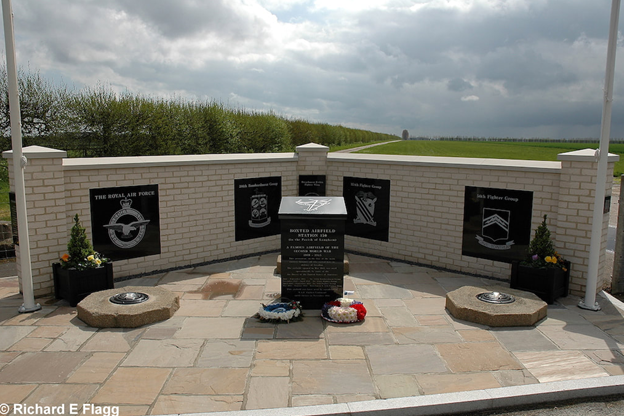
Boxted Memorial