HALESWORTH AIR BASE
HOME OF THE 489th BOMB GROUP
The wartime “489th airbase” was officially RAF Halesworth, designated USAAF Station 365. It stood near Halesworth and Holton in Suffolk and served as the combat home of the 489th Bombardment Group (Heavy) for roughly seven months in 1944.
RAF Halesworth was one of the important American airbases in Suffolk during World War II. Although it was built as a heavy bomber station, it became famous for hosting one of the Eighth Air Force's greatest fighter groups before later serving as the home of a distinguished B-24 Liberator bomb group.
Airfield Construction
RAF Halesworth was constructed during 1942–1943 on farmland between the villages of Holton, Westhall, and Sotherton in Suffolk, approximately two miles northeast of Halesworth. Built to the Royal Air Force's standard Class A heavy bomber design, the station was intended from the outset to support large four-engine bombers of the United States Army Air Forces.
Before the 489th arrived, the airfield had been occupied by the P-47 Thunderbolts of the 56th Fighter Group. The 56th moved to Boxted in April 1944, allowing Halesworth to return to its intended heavy-bomber role.
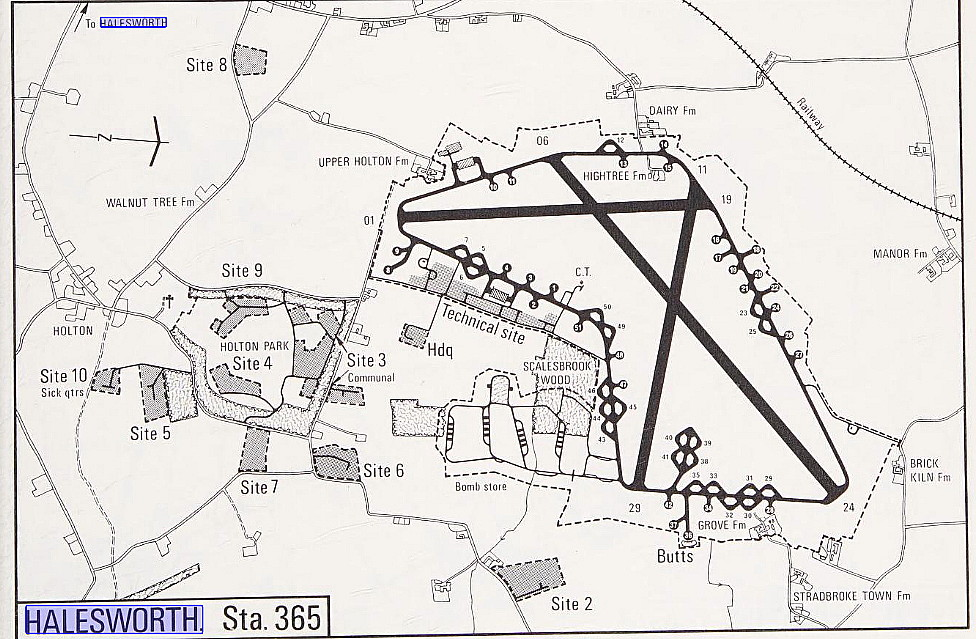
Halesworth had originally been built as a heavy-bomber airfield, with:
- Three concrete runways
- A perimeter taxiway
- Over 50 Dispersal hardstands for aircraft
- Two large T-2 hangars and repair areas
- Bomb and ammunition storage sites
- Fuel storage
- Operations and briefing buildings
- Barracks and communal facilities scattered around the surrounding countryside
- USAAF designation: Station 365 (HA)
Strategic Location
Halesworth's location in northeastern Suffolk made it one of the easternmost heavy bomber bases assigned to the Eighth Air Force's Second Air Division. Aircraft departing from Station 365 reached the North Sea within minutes after takeoff, reducing flying time over England and allowing bomber formations to assemble quickly before crossing into occupied Europe.
Its proximity to the coast also made the base valuable for fighter escort operations, a role it initially fulfilled before becoming a heavy bomber station.
Airfield Layout
Like most Eighth Air Force bomber stations, RAF Halesworth followed the standardized wartime layout adopted throughout East Anglia. The technical site was positioned adjacent to the flying field, while personnel lived in dispersed camps connected by narrow roads to reduce vulnerability to enemy attack.
Aircraft were parked individually on "frying pan" and loop hardstands around the perimeter track, allowing bombers to taxi directly to the runways without congestion. Extensive bomb dumps and fuel storage areas were located well away from the accommodation sites for safety.
The station was almost entirely self-contained, with its own:
- Operations block
- Control tower
- Fire station
- Motor transport depot
- Medical facilities
- Mess halls
- Recreation buildings
- Workshops
- Electrical and water systems
During full operations, Station 365 functioned much like a small military town.
After the War
Following Germany's surrender:
- RAF Bomber Command briefly controlled the base.
- The Royal Navy used it as HMS Sparrowhawk for advanced flying training.
- RAF Halesworth officially closed later that year.
Flying operations at RAF Halesworth ended in 1946. Much of the airfield was subsequently returned to agricultural use, while other portions became industrial property. Over the decades, many wartime buildings disappeared, although sections of the concrete runways, perimeter track, dispersal hardstands, and several support buildings have survived.
Today, visitors can still identify the original wartime layout from aerial photographs and by exploring the remaining perimeter roads. The preserved control tower area is now home to the Halesworth Airfield Museum, where artifacts, photographs, and personal accounts tell the story of the Americans who served at Station 365. Memorials near the museum commemorate the 56th Fighter Group, the 489th Bomb Group, and the men who served from the base during World War II.
RAF Halesworth Today
Much of the airfield has been redeveloped for industrial and agricultural use, but several wartime features survive:
Although transformed by post-war development, RAF Halesworth remains one of the better-preserved former USAAF stations in East Anglia. Portions of the main runway, perimeter track, aircraft dispersals, and numerous foundations still survive, allowing visitors to appreciate the scale of a wartime Eighth Air Force airfield.
The continued preservation of the museum and memorials ensures that Station 365 remains an enduring tribute to the thousands of American and British personnel who served there during the Second World War.
The Halesworth Airfield Museum preserves artifacts, photographs, uniforms, aircraft parts, and personal stories from the Americans who served there.