RAF HARDWICK AIR BASE
HOME OF THE 93rd Bomb GROUP
Among all B-24 Liberator stations in England, Hardwick occupies a particularly important place. It was home to the 93rd Bomb Group, one of the first American heavy bombardment groups to enter combat in the European Theater and one of the most decorated Liberator units of the war. The station became a major operational center within the 2nd Bomb Division and helped pioneer American strategic bombing operations over occupied Europe and Germany.
Historical Significance
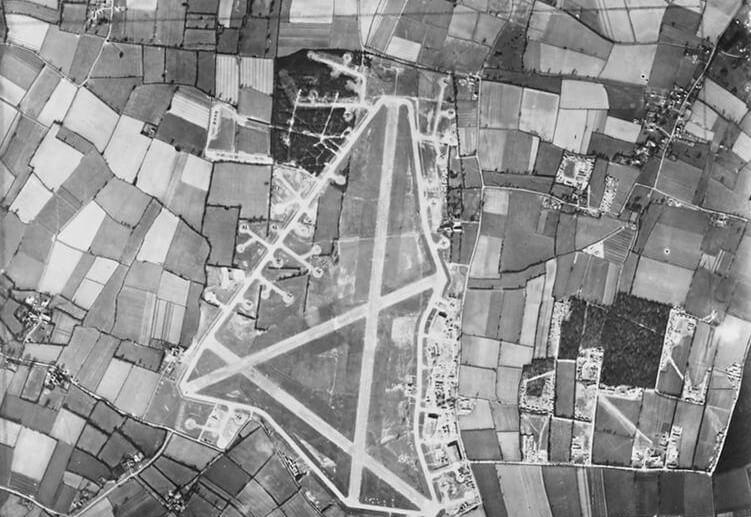
Hardwick was planned in 1941 as a standard RAF heavy-bomber station and constructed during 1941-42 on farmland near Topcroft and Hempnall in Norfolk. The project required extensive drainage, roads, sewers, and utility infrastructure before the runways could be built.
The airfield first opened in September 1942 and was initially occupied by the 310th Bombardment Group (Medium) flying B-25 Mitchells while en route to North Africa as part of Operation Torch. Their stay was brief, lasting only a few weeks.
Arrival of the 93rd Bomb Group
In December 1942 the 93rd Bomb Group moved to Hardwick from Alconbury and remained there until the end of the war. Its aircraft carried the famous Circle-B tail marking.
The 93rd became known as "The Traveling Circus" because of its repeated deployments between England and the Mediterranean Theater. The unit earned multiple Distinguished Unit Citations and became one of the most famous B-24 groups in the Eighth Air Force. The group participated in:
- Strategic bombing of Germany
- Anti-submarine operations
- The North African campaign
- The invasion of Sicily
- The invasion of Italy
- D-Day support operations
- The Battle of the Bulge
- The Rhine crossing campaign
Headquarters of the 20th Combat Bombardment Wing
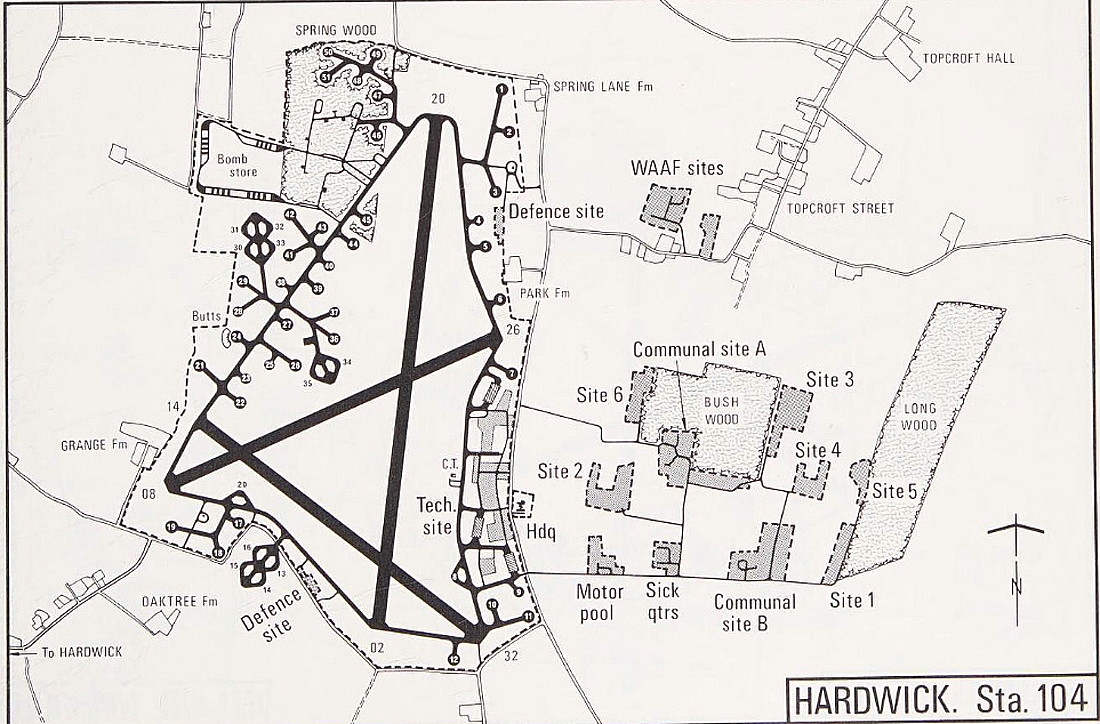
On 7 November 1943, Hardwick became headquarters of the 20th Combat Bombardment Wing, making it not merely a bomber station but also a major command center within the 2nd Bomb Division. Wing headquarters personnel coordinated combat operations among multiple Liberator groups throughout East Anglia. By 1944 Hardwick had reached its mature wartime configuration and closely followed the standard layout of a Class A Eighth Air Force heavy bomber station.
Runways
All runways were 50 yards wide and designed for heavily loaded B-24 Liberators. The airfield featured three concrete runways:
- Main Runway 1,975 yards (5,925 ft)
- Secondary 1,400 yards (4,200 ft)
- Secondary 1,400 yards (4,200 ft)
Perimeter Track
A complete perimeter taxiway surrounded the airfield. This arrangement allowed dozens of Liberators to taxi simultaneously before large mission launches. The perimeter track connected:
- Runways
- Hangars
- Technical site
- Squadron dispersals
- Bomb loading points
Aircraft Dispersals
Originally designed with approximately 30 hardstands, the airfield was expanded for American requirements to roughly 50 aircraft dispersals. Of these, 39 were frying-pan type hardstands and the remainder loop dispersals. The dispersals were organized by squadron and spaced around the perimeter track to reduce vulnerability to accidents or enemy attack.
Hangars
Hardwick possessed three T-2 hangars, the three-hangar arrangement was typical of large B-24 stations. The hangers positioned adjacent to the technical area. These facilities handled:
- Major maintenance
- Engine replacement
- Battle damage repair
- Aircraft modification
- Structural work
Technical Site
The technical area was located adjacent to the flying field. This area served as the operational heart of Station 104.
- Group Operations
- Wing Headquarters
- Intelligence section
- Briefing rooms
- Communications
- Engineering offices
- Armament workshops
- Fire station
- Control tower (Watch Office)
Bomb Dump
The bomb storage complex was located away from the active airfield for safety. Thousands of tons of ordnance passed through these facilities during the strategic bombing campaign. Facilities included:
- Earth-banked bomb stores
- Assembly buildings
- Ammunition magazines
- Bomb-loading roads
Fuel Storage
Fuel storage was dispersed around the station and connected through underground systems to refueling points. The station maintained sufficient aviation gasoline reserves to support frequent launches of large B-24 formations.
Domestic Camps
The dispersed layout reduced congestion and increased survivability. Accommodation areas were spread across multiple dispersed sites around the station. The facilities included:
- Officers' quarters
- Enlisted barracks
- Nissen huts
- Mess halls
- Hospital facilities
- Chapel
- Recreation buildings
- Motor transport sections
After the 93rd Bombardment Group Departure
After the 93rd Bombardment Group departed RAF Hardwick in June 1945, the airfield entered a very different chapter of its history. Like many Eighth Air Force bases in East Anglia, RAF Hardwick transitioned from a bustling wartime bomber station into a quiet rural landscape, with only scattered reminders of its important role during World War II.
Return to Royal Air Force Control
The United States Army Air Forces officially relinquished RAF Hardwick (USAAF Station 104) to the Royal Air Force on 25 June 1945. By that time, the need for hundreds of heavy bomber bases had disappeared, and the station was immediately placed in Care and Maintenance status. Rather than becoming an active RAF flying station, Hardwick was maintained only at a minimal level while the Air Ministry determined its long-term future.
Hardwick remained officially under RAF control until 1962, when the station was finally closed.
Following closure, most of the wartime infrastructure was gradually removed. The three large T-2 hangars, control tower, technical buildings, workshops, and many administrative structures were demolished. Thousands of tons of concrete from the taxiways and two of the three runways were broken up and reused as aggregate for local construction and road projects.
Unlike a few former RAF stations that remained active during the Cold War, Hardwick never became part of Britain's post-war air defense network. Instead, the landscape slowly returned to agricultural use.
Return to Farming
Today much of the former airfield is farmland. The expansive areas that once held B-24 Liberators are now cultivated fields. The wartime perimeter track still serves as farm roads in several places, and portions of the original concrete runway survive, providing a clear indication of the airfield's wartime layout.
Several dispersed accommodation sites were never completely removed and have been adapted for agricultural purposes. Some former military buildings continue to serve as storage barns, workshops, and farm buildings.
Remaining Wartime Features
Although much has disappeared, visitors can still identify numerous reminders of the wartime base:
- One runway remains substantially intact.
- Sections of perimeter track survive.
- Several dispersal hardstands remain visible.
- Nissen huts and brick service buildings still exist on former domestic sites.
- Foundations of wartime structures can still be found throughout the property.
These surviving features make Hardwick one of the better locations for understanding the layout of an early Eighth Air Force heavy bomber station.
93rd Bomb Group Museum
One of Hardwick's greatest historical assets is the 93rd Bomb Group Museum, located in restored wartime Nissen huts on Airfield Farm. Volunteers have spent decades recovering artifacts from the airfield and preserving the history of one of the Eighth Air Force's first B-24 Liberator groups in England. The museum preserves:
- Original 93rd Bomb Group artifacts
- Uniforms and equipment
- Aircraft components
- Wartime photographs
- Maps and mission records
- Personal stories of the airmen who served at Hardwick
Memorial to the Airmen
In 1987, veterans of the 93rd Bomb Group returned to Hardwick for a reunion and dedicated a stone memorial near one of the former barracks sites. The memorial has become a place of remembrance for veterans' families, historians, and visitors interested in the history of the Eighth Air Force.
The memorial honors:
- The men of the 93rd Bombardment Group
- American personnel stationed at Hardwick
- Their contribution to the Allied victory in Europe
Civil Aviation Use
Following military closure, portions of the former airfield found a new purpose in civilian aviation.
For many years, Mindacre Ltd., an agricultural aviation company, operated from Hardwick using Cessna A188 Agwagons for crop-spraying throughout Britain. In the early 1970s, aircraft and crews from Hardwick even deployed to Sudan for large-scale agricultural spraying contracts before returning to Norfolk. This marked one of the few periods when the wartime airfield again became an active flying base, albeit for peaceful agricultural work rather than military operations.
RAF Hardwick Today
Today RAF Hardwick is a quiet rural landscape where agriculture has replaced wartime activity. Yet the surviving runway, perimeter roads, scattered wartime buildings, museum, and memorial continue to preserve the legacy of the thousands of American airmen who served there.
As the wartime home of the 93rd Bombardment Group ("Ted's Travelling Circus"), Hardwick played a significant role in the Eighth Air Force's strategic bombing campaign. Although no longer an operational airfield, it remains one of Norfolk's most important surviving Second World War aviation heritage sites and continues to attract veterans' families, researchers, and aviation enthusiasts from around the world.
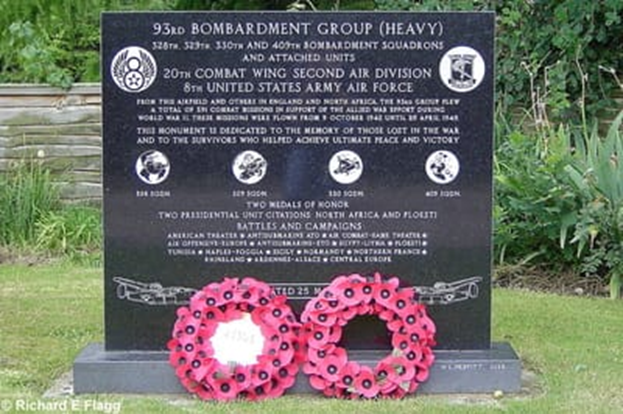
Hardwick Memorial
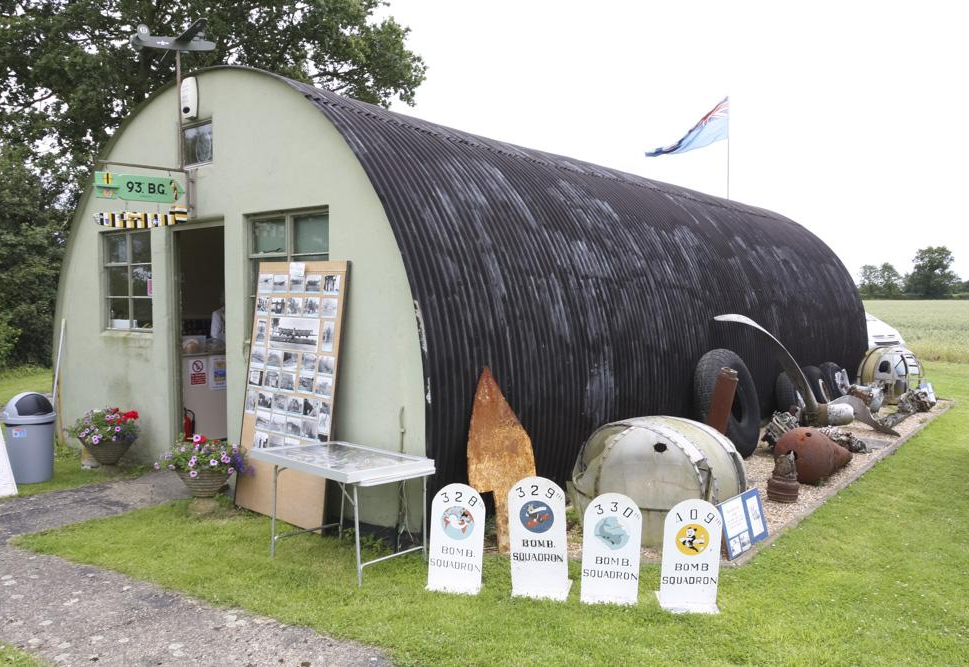
Hardwick Airfield Museum