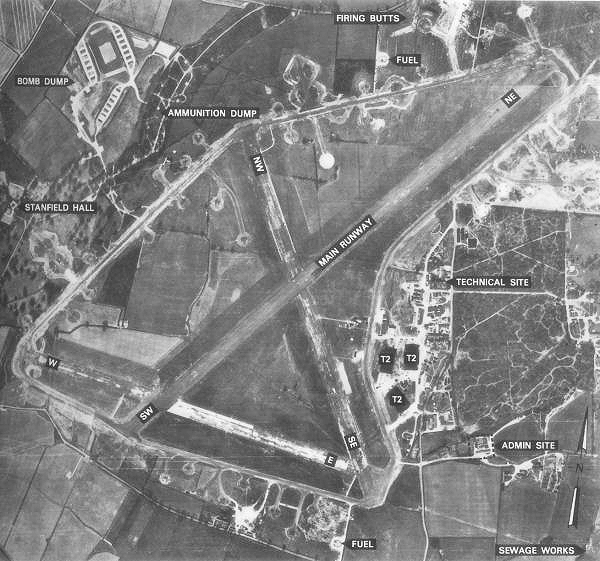
RAF HETHEL AIR BASE
HOME OF THE 389th BOMB GROUP
RAF Hethel (USAAF Station 114) was one of the permanent Class "A" heavy bomber airfields constructed in Norfolk as part of Britain's rapid wartime expansion of Bomber Command airfields. Construction began during 1942 on former agricultural land southeast of Norwich. Before the station became operational, however, it was transferred to the United States Army Air Forces under agreements expanding the American strategic bombing campaign from England. Hethel became one of the earliest permanent B-24 Liberator bases assigned to the Eighth Air Force's Second Bombardment Division (later the Second Air Division).
The station was designed specifically to accommodate heavy four-engine bombers and the thousands of personnel required to support continuous combat operations. Engineers constructed an extensive network of concrete runways, taxiways, dispersal areas, maintenance facilities, bomb storage sites, fuel installations, and domestic camps. By mid-1943, RAF Hethel had developed into a self-contained military community capable of sustaining large-scale strategic bombing operations against occupied Europe and Nazi Germany.
The 389th Bombardment Group (Heavy) arrived from Lowry Field, Colorado, during June 1943. Equipped with Consolidated B-24 Liberator bombers, the group became one of the earliest B-24 units to enter combat with the Eighth Air Force. Its first combat mission was flown on 9 July 1943 against Rotterdam in the German-occupied Netherlands. Throughout the remainder of the war the group flew more than 300 combat missions against enemy industrial centers, oil refineries, aircraft factories, marshaling yards, submarine facilities, bridges, and transportation networks while also supporting Allied ground forces during the invasion of Europe.
The 389th Bombardment Group consisted of four flying squadrons:
- 564th Bomb Squadron
- 565th Bomb Squadron
- 566th Bomb Squadron
- 567th Bomb Squadron
RAF Hethel quickly earned an outstanding reputation throughout the Eighth Air Force for operational efficiency and combat effectiveness. Ground crews worked around the clock servicing dozens of Liberators after every mission, often repairing extensive battle damage overnight so aircraft could return to combat the following morning. The close cooperation between aircrews, maintenance personnel, armorers, engineers, communications specialists, and medical staff enabled the station to sustain an exceptionally demanding operational tempo throughout the war.
Physical Configuration During 1944
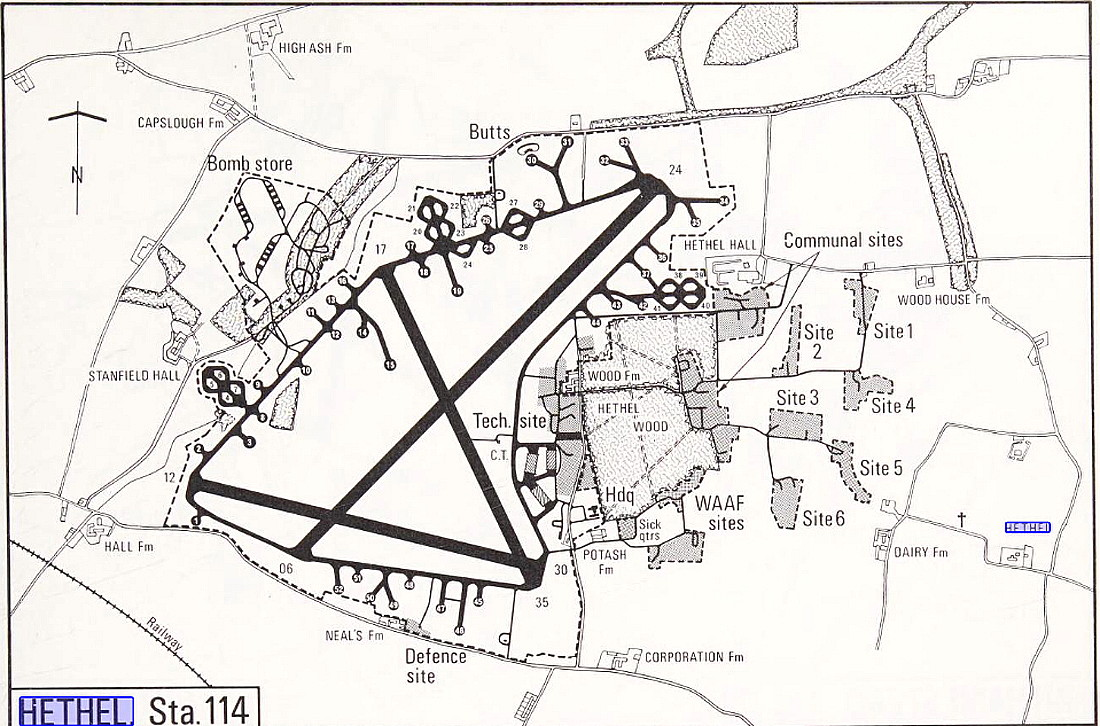
Like other permanent heavy bomber stations built for RAF Bomber Command, Hethel followed the standardized Class "A" airfield design while incorporating local variations dictated by the surrounding terrain. The layout emphasized efficient aircraft movement, protection against enemy attack, and the ability to launch large bomber formations in the shortest possible time.
Runway System
Unlike temporary satellite fields, Hethel was a fully developed permanent heavy bomber station. The concrete runways were engineered to support fully loaded Consolidated B-24 Liberators carrying maximum bomb loads and fuel for long-range missions deep into occupied Europe and Germany. Hethel featured the standard RAF Class "A" triangular runway arrangement:
- Main concrete runway approximately 2,000 yards (6,000 ft / 1,830 m)
- Two intersecting secondary runways approximately 1,400 yards (4,200 ft / 1,280 m) each
The triangular design allowed safe takeoffs and landings regardless of changing wind conditions. During major operations dozens of Liberators taxied into position before dawn and departed in carefully timed succession to assemble into massive Eighth Air Force combat formations over East Anglia.
Perimeter Track
A full loop perimeter taxiway connected every operational area, allowing aircraft to taxi without occupying active runways. The perimeter track linked:
- All dispersal hardstands
- Technical site
- Maintenance areas
- Bomb loading points
Approximately 50 frying-pan hardstands were positioned around the perimeter track. Aircraft were widely dispersed among wooded areas and protected by earthen revetments to minimize damage from possible enemy air attacks, accidental explosions, or crashes during takeoff and landing operations. This arrangement also allowed maintenance crews to work simultaneously on numerous aircraft.
Technical Site
The technical site was located immediately east of the flying field. Several large T-2 hangars provided space for major inspections, engine changes, structural repairs, and modifications to the group's B-24 Liberators. Supporting facilities included:
- Maintenance hangars
- Engineering workshops
- Machine shops
- Parachute section
- Operations building
- Control tower
- Weather office
- Communications center
- Intelligence briefing rooms
- Fuel storage
- Fire station
The operations building became the center of daily mission planning where intelligence officers briefed aircrews using detailed target maps, weather forecasts, and aerial reconnaissance photographs. Following each mission, crews returned for intelligence debriefings that provided valuable information on enemy defenses and bombing results.
Bomb Storage
Bomb storage areas were constructed well away from the flying field and domestic camps. Large quantities of general-purpose bombs, incendiaries, armor-piercing bombs, fragmentation bombs, and specialized ordnance were stored in individually revetted compounds connected by dedicated service roads. Armorers transported bombs to loading points where they were carefully installed aboard each Liberator before every mission.
Fuel Storage
Fuel installations were dispersed throughout protected compounds using underground or bermed storage tanks connected to aircraft refueling points. Thousands of gallons of high-octane aviation gasoline were required daily to support the heavy bomber force, making efficient fuel distribution one of the station's most important logistical functions.
Living Sites
Unlike stations where accommodation was concentrated in a single camp, Hethel utilized several dispersed domestic sites connected by roads that separated personnel traffic from flying operations. Facilities included:
- Officers' quarters
- Enlisted barracks (Nissen huts)
- Mess halls
- Hospital and dispensary
- Dental clinic
- Chapel
- Recreation hall
- Red Cross club
- Theater
- PX (Post Exchange)
- Athletic fields
- Motor pool
- Laundry facilities
Although living conditions were often basic, efforts were made to provide recreational opportunities that helped maintain morale during the intense operational schedule. Athletic competitions, dances, movies, USO performances, chapel services, and Red Cross activities offered temporary relief from the stress of combat operations.
Control Tower and Daily Operations
The control tower served as the nerve center for all flying activities. Controllers coordinated takeoffs, recoveries, emergency landings, and communication with aircraft operating throughout the region. Although the threat of Luftwaffe attacks against East Anglian airfields had diminished by 1944, blackout regulations, air raid procedures, and defensive precautions remained in effect.
A typical combat mission day included:
- Weather forecasting before dawn
- Mission briefing by intelligence officers
- Bomb loading beginning several hours before takeoff
- Fueling of all aircraft
- Final mechanical inspections
- Engine run-ups on dispersal hardstands
- Taxiing along the perimeter track
- Sequential departures approximately every 30 seconds
- Formation assembly over East Anglia before crossing the North Sea
- Recovery several hours later, often with battle-damaged aircraft requiring immediate maintenance and medical assistance
Mission days demanded the coordinated efforts of thousands of personnel. While aircrews flew over occupied Europe, hundreds of ground personnel remained at Hethel preparing replacement aircraft, repairing damaged bombers, processing intelligence reports, and readying the station for the next mission.
Strategic Importance
RAF Hethel occupied an important position within the network of Eighth Air Force heavy bomber stations across East Anglia. Its proximity to the North Sea enabled bomber formations to assemble efficiently before crossing into occupied Europe while providing relatively direct routes to strategic targets throughout Germany. From Hethel, the 389th Bomb Group participated in many of the Eighth Air Force's most significant operations, including attacks during Big Week, the Combined Bomber Offensive, the oil campaign against German synthetic fuel production, transportation interdiction before D-Day, support for Operation Market Garden, the Battle of the Bulge, and the final assaults on the collapsing Third Reich during 1945.
Post-WWII History
Following the end of World War II, RAF Hethel's role as a heavy bomber station quickly came to an end. The 389th Bomb Group departed England during the summer of 1945, and the airfield was returned to the Royal Air Force. Like many wartime bomber stations in East Anglia, the rapid postwar reduction in military aviation left Hethel with no long-term operational flying mission.
During the late 1940s and early 1950s much of the station was placed in care and maintenance. While portions of the domestic camps continued to serve limited military and civilian purposes, many temporary wartime buildings were gradually demolished or removed. Agricultural use returned to many sections of the former airfield, reflecting the broader transition taking place across Norfolk following the war.
A major new chapter in the history of RAF Hethel began in 1966 when Lotus Cars established its manufacturing headquarters on part of the former airfield. The company converted former technical buildings and hangars into engineering, research, and production facilities while incorporating sections of the wartime runway and perimeter roads into its vehicle testing complex. The former bomber base thus evolved into one of Britain's best-known centers of automotive engineering and high-performance sports car production.
Although industrial development altered portions of the station, significant elements of the wartime airfield survived. Historians, local preservation groups, veterans, and descendants have worked together to document the history of the 389th Bomb Group and preserve important structures associated with the airbase. Memorials throughout the area commemorate the American airmen who served from Hethel during the strategic air campaign over Europe.
Present Day
Today RAF Hethel remains one of the better-preserved former Eighth Air Force heavy bomber stations in Norfolk. Although much of the airfield has been adapted for modern industrial use, visitors can still recognize many features of the original wartime layout.
- Large sections of the original runway system and perimeter track remain visible.
- Several wartime buildings, including maintenance structures, continue in use.
- The technical site has been redeveloped for industrial and commercial purposes.
- Lotus Cars continues to occupy a significant portion of the former airfield for engineering, manufacturing, and vehicle testing.
- The surviving control tower houses the 389th Bomb Group Memorial Exhibition, featuring photographs, artifacts, uniforms, equipment, and personal stories of the men who served at RAF Hethel.
- Interpretive displays and memorials throughout the area commemorate the service and sacrifice of the 389th Bomb Group.
- Annual commemorative events, heritage tours, and veterans' remembrance ceremonies continue to preserve the legacy of RAF Hethel and educate future generations about the role the station played in the Allied victory during World War II.
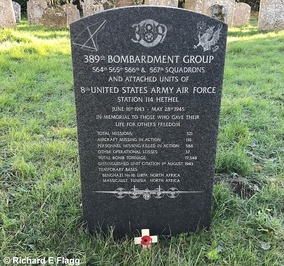
Hethel Memorial