RAF RACKHEATH AIR BASE
HOME OF THE 467th BOMB GROUP
RAF Rackheath, located about five miles (8 km) northeast of Norwich in Norfolk, England, was one of the last heavy bomber airfields built for the Eighth Air Force during World War II. Although constructed as a Royal Air Force station, it was built specifically for use by the United States Army Air Forces (USAAF) and became one of the most successful B-24 Liberator bases in Europe.
Construction of the Airfield
The airfield was constructed during 1943 by the British building firm John Laing and Company. It was one of several new airfields built in East Anglia to accommodate the rapidly expanding United States Eighth Air Force.
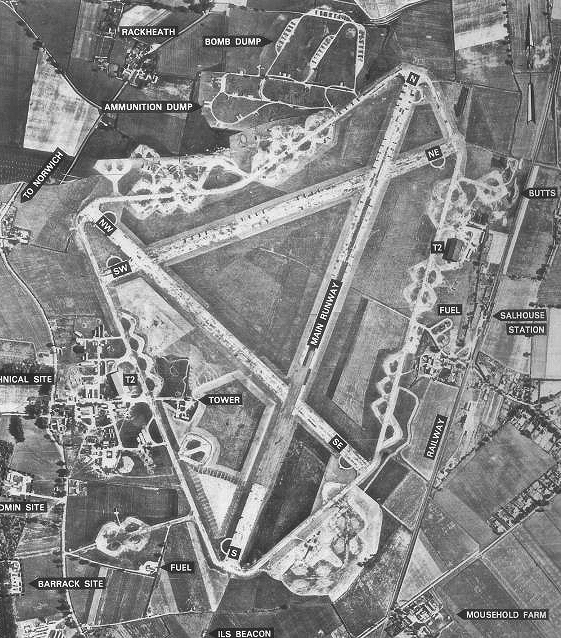
Rackheath was built to the standard Class A bomber-airfield design, suitable for heavily loaded four-engine aircraft. Its three concrete runways formed the familiar triangular pattern used at many wartime bomber stations. The main runway was approximately 2,000 yards long, while the two intersecting secondary runways were approximately 1,400 yards long.
A concrete perimeter track connected the runways with 50 loop-type aircraft hardstands distributed around the outer edges of the flying field. These dispersed parking positions reduced congestion and limited the number of aircraft that could be damaged during an enemy air raid. Two large T-2 hangars were positioned on opposite sides of the airfield so that aircraft maintenance could continue even if one section of the station were damaged.
Airfield Layout
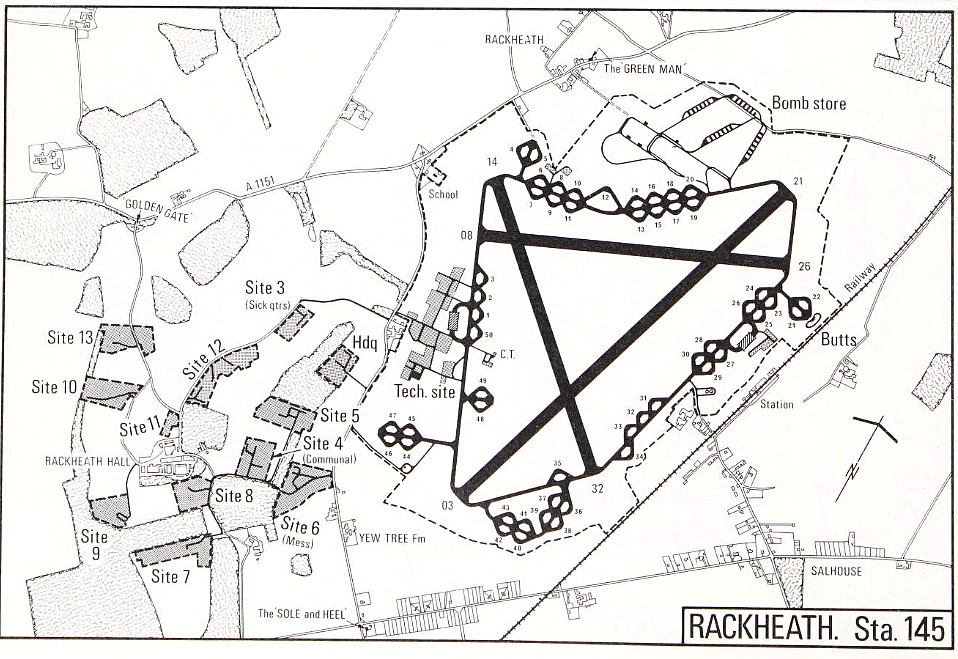
The airfield occupied a large area of farmland between Rackheath, Salhouse and the northeastern outskirts of Norwich. Its principal installations were deliberately dispersed rather than concentrated in one location.
The technical site stood on the western side of the airfield and contained workshops, stores, offices and aircraft-maintenance facilities. The control tower, or watch office, was positioned near the southwestern end of the runway system, where controllers had a clear view of aircraft movements.
The bomb-storage and ammunition areas were located at the northern end of the station, well away from the living quarters and technical buildings. Their storage bays were surrounded by earth banks intended to contain an explosion. Fuel-storage installations, firing butts and other specialist facilities were also placed around the perimeter.
Administrative buildings, mess halls, barracks and recreational facilities were constructed in several dispersed sites beyond the western and southern boundaries. Separating the domestic sites reduced the danger that a single bombing attack would destroy a large proportion of the station's accommodation.
A postwar aerial survey clearly shows Rackheath's three-runway layout, perimeter track, hardstands, hangars, technical area, accommodation sites and separate bomb and ammunition dumps.
Preparing the Station for Operations
During the closing months of 1943 and the beginning of 1944, construction crews worked to complete the airfield and prepare it for American occupation. Roads had to be improved, utilities installed and accommodation completed for several thousand flying and ground personnel.
The station required workshops for aircraft engines, instruments, radios, armament and electrical equipment. Additional buildings provided parachute storage, photographic processing, briefing rooms, medical care, fire protection and vehicle maintenance.
Large quantities of aviation fuel, bombs, ammunition, spare parts and food had to be stored and distributed. The nearby railway and road network helped supply the station, while Norwich provided access to additional services, transportation and labor.
Wartime Life at Rackheath
Rackheath became fully operational during the spring of 1944. At peak strength, the airfield resembled a small town, with thousands of American servicemen and British civilian employees working across its flying, technical and domestic sites.
The station operated around the clock. Before a mission, ground crews inspected and serviced aircraft on their hardstands. Fuel trucks, bomb tractors and ammunition vehicles circulated around the perimeter track as aircraft were prepared for flight.
Engines were frequently tested during the night, and aircraft began taking off soon after daybreak. Departures by formations of heavily loaded B-24 Liberators created tremendous noise throughout the surrounding countryside.
Aircraft returning from operations were directed to the runway by the control tower. Damaged bombers were sometimes given priority while fire engines, ambulances and recovery crews waited nearby. Once an aircraft reached its hardstand, maintenance personnel immediately began inspecting it and repairing battle damage.
During poor weather, the station relied on radio-navigation equipment and airfield lighting to help crews locate and approach Rackheath. Fog, low cloud and ice frequently made flying from East Anglia hazardous, particularly during winter.
The Control Tower
Rackheath's control tower was the operational center of the flying field. From its upper observation room, controllers coordinated takeoffs, landings and vehicle movements on the runways.
The lower floors contained offices, communications equipment and meteorological services. Airfield controllers maintained contact with aircraft and neighboring stations to reduce the danger of collisions as large bomber formations assembled over eastern England.
Unlike many wartime control towers that were demolished after the war, Rackheath's tower survived. After years of deterioration and the threat of demolition, it was restored and converted for commercial office use.
Relationship with the Surrounding Community
The construction and operation of the airfield transformed the quiet rural district around Rackheath. Local roads carried military trucks, buses and construction vehicles, while nearby villages became accustomed to American uniforms and the constant sound of aircraft.
American personnel visited Norwich and surrounding communities during their off-duty hours. Friendships developed between local residents and servicemen, and some airmen were welcomed into British homes.
The airfield also created employment for British civilians who worked in construction, catering, transportation, maintenance and clerical positions. At the same time, residents had to cope with traffic, noise, blackout restrictions and the risks associated with living near a major military installation.
Airfield Defenses
Rackheath was protected against possible German attack by camouflage, dispersed facilities and ground defenses. Defensive positions and light anti-aircraft weapons guarded important parts of the station, while blackout regulations limited visible lighting at night.
Buildings were painted in subdued colors, and important supplies were distributed among separate storage areas. Aircraft were parked around the perimeter instead of being grouped together near the hangars. Although the threat of a major German air raid had diminished by the time Rackheath became operational, the possibility of attack remained. Airfield personnel conducted emergency exercises and maintained firefighting, medical and bomb-disposal services.
Closure of the Wartime Station
Flying activity declined rapidly after the end of the war in Europe. The American units and aircraft gradually departed during 1945, and Rackheath was returned to British control.
The airfield did not become a permanent postwar RAF flying station. It was closed during late 1945, and much of the land was eventually returned to agricultural use.
Postwar Use and Demolition
After closure, many temporary buildings were sold, removed or allowed to deteriorate. Most of the runways, perimeter track and hardstands were later broken up, with the concrete reused as construction material. The former technical site developed into the Rackheath Industrial Estate. Some wartime buildings were adapted, enlarged or reclad for commercial and industrial use, making their original military purpose difficult to recognize. One road on the estate was named Wendover Road in remembrance of the American airfield where Rackheath's principal wartime flying unit had been formed.
Surviving Remains
Only limited portions of the original flying field survive. These include:
- A small section of the main runway
- Sections of the perimeter track
- Several former aircraft hardstands
- Modified buildings within the technical area
- The restored wartime control tower
- Portions of roads and foundations associated with dispersed sites
Most of the former runway area has returned to farmland, while industrial development occupies parts of the technical and administrative sites. Many surviving structures are on private property and should only be approached with the owner's permission.
Memorial and Legacy
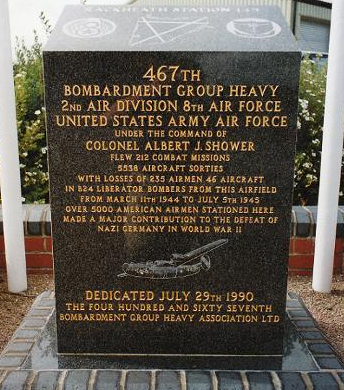
A memorial on the former technical site commemorates the American personnel who served at Rackheath. Additional photographs and historical material are preserved locally, including displays associated with the village church. Although little remains of the original runway complex, the surviving control tower, scattered buildings and sections of concrete preserve the outline of what was once a busy wartime bomber station. RAF Rackheath remains an important part of Norfolk's aviation heritage and a reminder of the enormous network of airfields constructed in eastern England during the Second World War. The "Rackheath Aggies" are remembered not only for their distinguished combat record but also for achieving one of the highest bombing accuracy records in the Eighth Air Force.
Aircrew Memorial