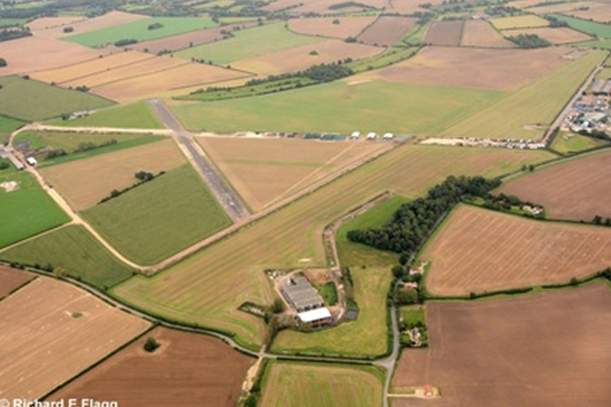
SHIPDHAM AIR BASE
HOME OF THE 44th Bomb Group
From September 1943 until June 1945, Shipdham also served as Headquarters, 14th Combat Bombardment Wing, making it one of the principal command centers of the 2nd Bomb Division. Historical Significance
Shipdham Station 115 occupies a unique place in Eighth Air Force history.
- The first permanent USAAF heavy bomber base established in Norfolk.
- The longest continuously occupied B-24 Liberator station of the Eighth Air Force in Britain, operating Liberators from October 1942 until June 1945.
- Home of the 44th Bomb Group ("The Flying Eight-Balls"), one of the original heavy bombardment groups deployed to England.
Early History
Construction began in 1941 on farmland between Shipdham and Cranworth as a standard RAF Class A heavy bomber airfield. The station officially opened in June 1942. The first American unit to arrive was the 319th Bombardment Group (Medium) with B-26 Marauders, which used Shipdham briefly as a staging base before deploying to North Africa for Operation Torch. In October 1942, the 44th Bomb Group arrived from Oklahoma and remained for the rest of the war.
Runways
The airfield featured three tarmac (asphalt) runways. These dimensions accommodated fully loaded B-24 Liberators operating on long-range missions:
- Main runway: approximately 6,000 feet (2,000 yards)
- Secondary runway: approximately 4,200 feet
- Secondary runway: approximately 4,200 feet
Perimeter Track
A continuous concrete perimeter taxiway encircled the flying field. It connected:
- All three runways
- Aircraft dispersals
- Technical site
- Hangars
- Bomb-loading areas
This allowed large formations of Liberators to taxi efficiently to the active runway. Aircraft Dispersals. Approximately 50 loop hardstands were positioned around the perimeter track.
Each dispersal minimized damage from accidents and potential air attack. Hangars:
- Accommodated one heavy bomber
- Was separated by earth revetments or woodland
- Had adjacent servicing areas
- Was organized by squadron
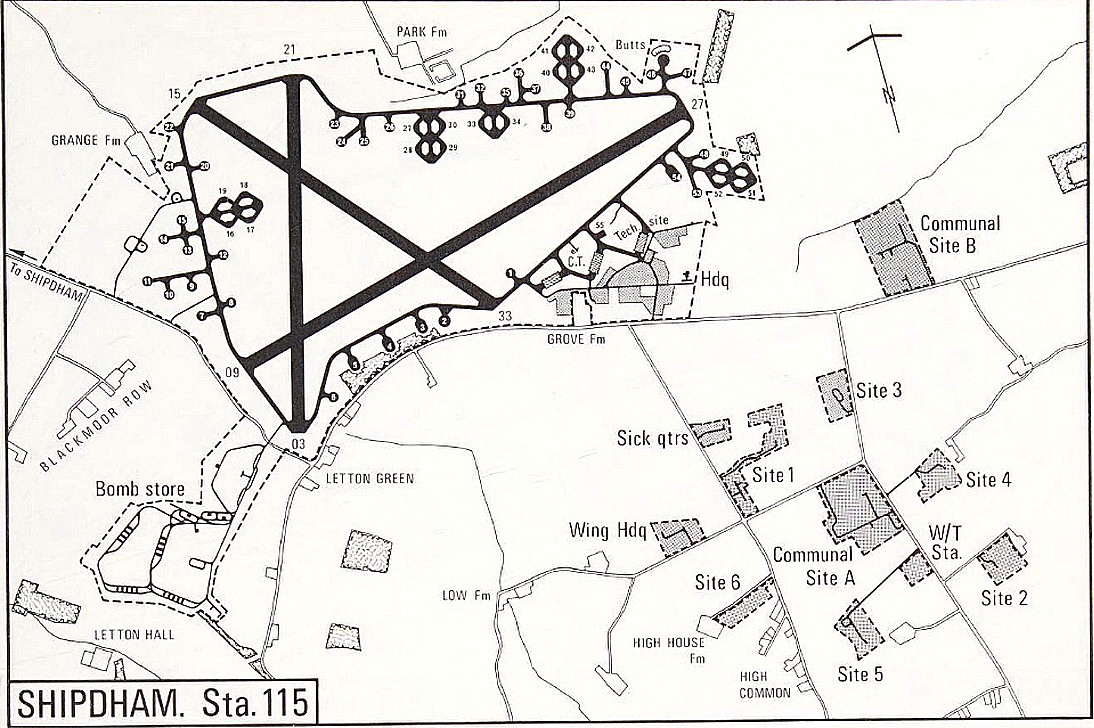
Three T2 hangars stood on the south side of the airfield. These handled:
- Major maintenance
- Engine replacement
- Battle-damage repair
- Aircraft modification
Technical Site
This complex coordinated both the 44th Bomb Group and, later, the 14th Combat Bombardment Wing. Immediately south of the flying field was the technical area, containing:
- Group Operations
- Wing Headquarters (after September 1943)
- Intelligence section
- Engineering offices
- Armament workshops
- Radio maintenance
- Fire station
- Watch Office (control tower)
Bomb Dump
The bomb storage area was located southwest of the airfield, separated from operational areas for safety. This complex coordinated both the 44th Bomb Group and, later, the 14th Combat Bombardment Wing. It included:
- Earth-banked bomb stores
- Bomb assembly areas
- loading roads
- Ammunition magazines
Fuel Storage
Bulk aviation gasoline was stored in dispersed underground tanks connected by pipelines and refueling points around the station.
Domestic Camps
Accommodation for approximately 3,000 personnel was dispersed across fields southeast of the airfield. The dispersed arrangement reduced vulnerability and eased congestion. Daily Operations Facilities included:
- Officers' quarters
- Enlisted barracks (primarily Nissen huts)
- Mess halls
- Chapel
- Hospital
- Recreation hall
- Headquarters
- Motor transport area
A typical mission day began before dawn:
- Crews assembled in the briefing room.
- Intelligence officers presented the target and route.
- Bombs were loaded while aircraft were fueled.
- B-24s taxied from dispersal loops to the perimeter track.
- Aircraft departed in sequence, formed over Norfolk, and joined the larger bomber stream bound for Europe.
With more than 60 Liberators based at Shipdham during peak periods, these launches were among the largest routine operations conducted by the 2nd Bomb Division.
Airbase Today
Following the war, the station briefly served as a transit center for German prisoners of war awaiting repatriation before the property was gradually sold into private ownership during the late 1950s and early 1960s. In 1970, part of the former airfield reopened for civilian aviation, allowing a new generation of pilots to use the historic runways.
Shipdham ceased operating as a civilian airfield in November 2023, ending more than fifty years of postwar private flying and approximately eighty-one years of aviation activity at the site. The former airfield is now officially regarded as disused, with portions of the property devoted to agriculture and industrial activity. Proposals for renewable-energy development have also been associated with land in and around the former airfield, although future development remains subject to the planning process.
Despite the closure of the civilian airfield and the loss of the control tower, the wartime landscape has not completely disappeared. Sections of runway pavement, perimeter track, hardstands, hangars, foundations, and other fragments of the former station continue to mark the countryside. Some surviving areas are located on privately owned land, and permission should be obtained before attempting to visit or examine them.
Memorials to the 44th Bomb Group
The men of the 44th Bomb Group are commemorated by memorials in the Shipdham area. A granite memorial dedicated during a veterans’ reunion in September 1983 honors the group and the Americans who served at the airfield. Another memorial stands near All Saints Church in Shipdham, maintaining the connection between the village and the thousands of American servicemen who lived and worked nearby during the war.
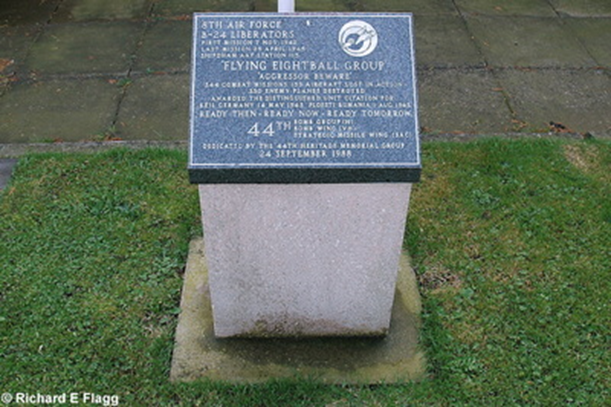
Shipdham-Plaque