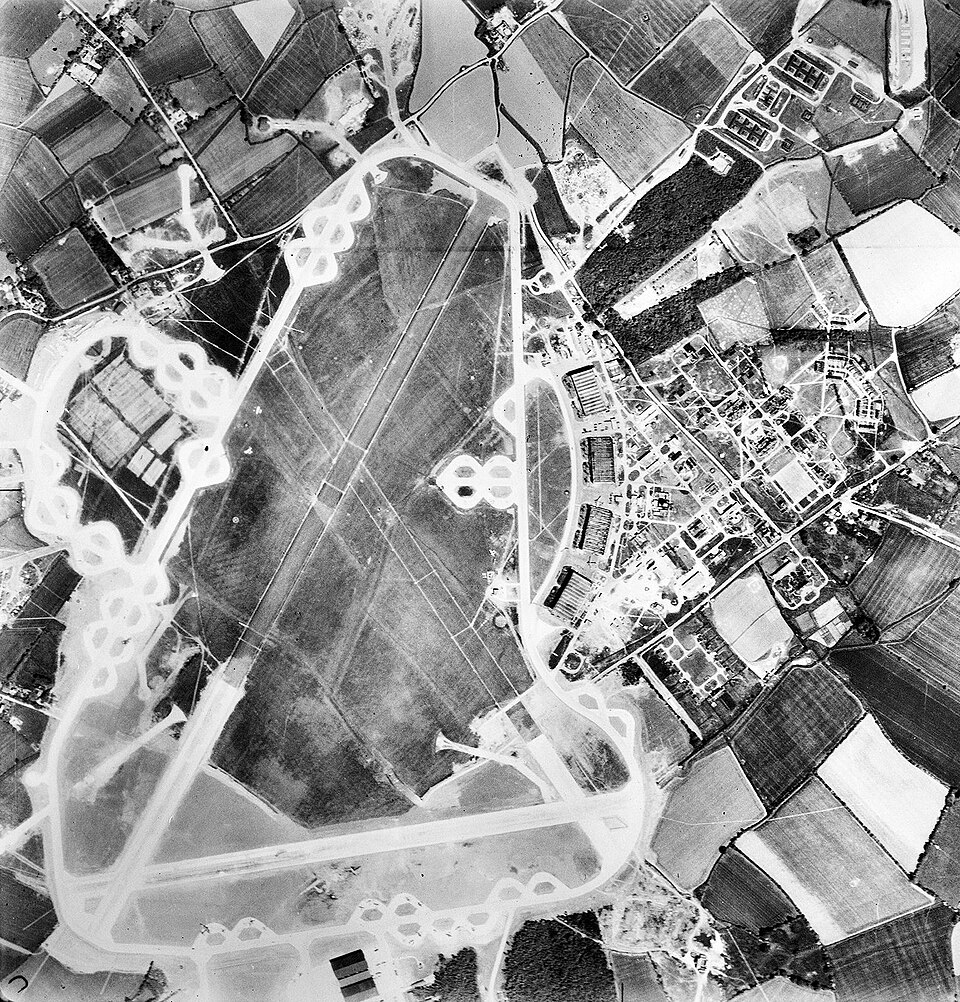
RAF WATTISHAM AIR BASE
HOME OF THE 479th FIGHTER GROUP
USAAF Designation: AAF Station 377 (later, the adjacent 4th Strategic Air Depot was redesignated AAF Station 470, known as "Hitcham")
Primary Support Unit: 4th Strategic Air Depot (Hitcham)
RAF Wattisham was unique among Eighth Air Force fighter stations because it served two equally important roles: it was both an operational fighter base and the principal maintenance center for American fighter aircraft in Britain.
During 1944, thousands of P-38 Lightnings, P-47 Thunderbolts, and P-51 Mustangs passed through Wattisham for repair, modification, and overhaul before returning to combat.
History
RAF Wattisham opened in April 1939 as a permanent RAF bomber station. On 4 September 1939-just one day after Britain declared war-Bristol Blenheims from Wattisham flew among the RAF's first offensive missions of the Second World War against German naval targets at Wilhelmshaven.
During the Battle of Britain and the early war years, the station hosted bomber and fighter units before being transferred to the USAAF in 1942.
American Conversion
Initially, American planners intended to transform Wattisham into a heavy bomber base. Construction began on:
- Three hard-surface runways
- Enlarged taxiways
- Additional hangars
- Expanded domestic camps
As construction progressed, however, it became clear that enough heavy bomber stations already existed in East Anglia. Rather than complete the full bomber conversion, the USAAF altered its plans. Only one runway was fully paved in concrete, another was completed with steel matting (PSP), and the third remained largely grass. This decision ultimately gave Wattisham a distinctive hybrid layout unlike most Eighth Air Force fighter fields.
The 4th Strategic Air Depot
Perhaps Wattisham's greatest contribution to the air war was not combat flying but logistics. Originally organized as the 3rd Advanced Air Depot, it became the 4th Strategic Air Depot and by 1944 was responsible for maintaining virtually every USAAF fighter aircraft operating from Britain. Its responsibilities included:
- Major structural repairs
- Engine replacement
- Propeller changes
- Battle damage repair
- Radio installation
- Armament modification
- Aircraft repainting
- Acceptance of new aircraft arriving from the United States
A separate technical complex was constructed south of the flying field with:
- Four T-2 hangars
- Approximately eighteen additional hardstands
- Engineering workshops
- Warehouse buildings
- specialized repair shops
- Its own taxiway loop connected to the main perimeter track
Because of its size, this depot was officially designated Hitcham (Station 470) to distinguish it administratively from the operational fighter station.
The 479th Fighter Group
The 479th Fighter Group arrived on 15 May 1944, becoming the last fighter group assigned to the Eighth Air Force. The group initially flew the Lockheed P-38J Lightning before converting to the North American P-51D Mustang in late 1944. The unit became known as "Riddle's Raiders," after Lt. Col. Kyle L. Riddle. Its squadrons were:
- 434th Fighter Squadron
- 435th Fighter Squadron
- 436th Fighter Squadron
Runways
The 1944 flying field consisted of:
- One fully completed concrete runway (East-West)
- One principal runway surfaced with Pierced Steel Planking (PSP)
- One partially completed grass runway
This mixed-surface arrangement was unusual and resulted directly from the cancellation of the heavy-bomber conversion.
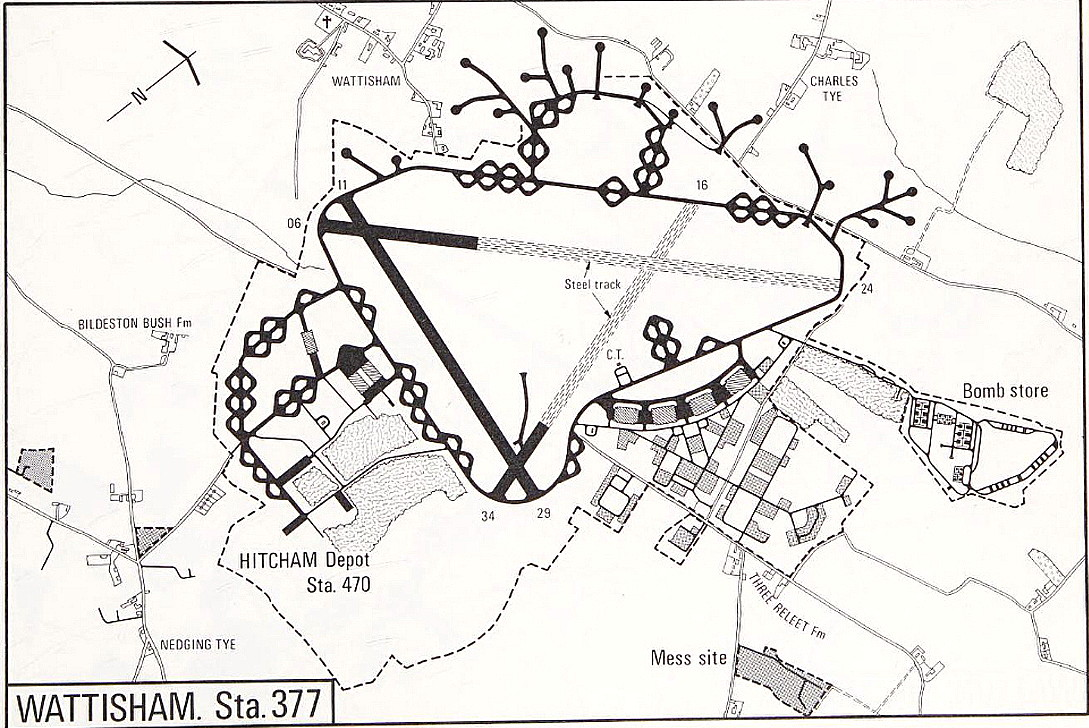
Perimeter Taxiway
A full perimeter taxi track connected. This arrangement allowed both combat aircraft and depot aircraft to move independently around the station:
- Operational dispersals
- Technical area
- Hangars
- Depot complex
- Runways
Aircraft Dispersals
The operational side of the station included numerous loop and frying-pan hardstands. Aircraft were dispersed by squadron around the perimeter and protected by earth revetments and vegetation. The depot area contained approximately 18 additional hardstands dedicated to aircraft awaiting repair or modification.
Hangars
One of Wattisham's defining characteristics was its extensive maintenance infrastructure. Few Eighth Air Force fighter stations possessed such comprehensive engineering facilities. The station contained:
- Four large C-Type hangars dating from the RAF period
- Four additional T-2 hangars serving the Strategic Air Depot
- Specialized engine shops
- Sheet-metal repair shops
- Radio maintenance facilities
- Propeller overhaul shops
Technical Area
The operational technical site included:
- Group Operations
- Intelligence
- Briefing rooms
- Engineering offices
- Communications
- Armament section
- Fire station
- Watch Office (control tower
Adjacent to this lay the much larger depot engineering complex, which effectively functioned as a major aircraft industrial facility.
Domestic Camps
Because of the depot mission, the station housed a substantially larger population of mechanics and technical specialists than a typical fighter base. Personnel lived in dispersed camps containing:
- Nissen huts
- Officers' quarters
- Enlisted barracks
- Mess halls
- Chapel
- Recreation hall
- Hospital
- Headquarters
- Motor transport section
Fuel and Ammunition
The depot warehouses were among the largest in the Eighth Air Force fighter system. Separate storage areas accommodated:
- Aviation gasoline
- Machine-gun ammunition
- Bombs
- Rockets
- Spare engines
- Propellers
- Replacement aircraft components
This combination of combat operations and large-scale maintenance made Wattisham one of the busiest fighter installations in Britain.
Legacy
RAF Wattisham occupies a distinctive place in Eighth Air Force history. It was not simply another fighter station-it was the logistical backbone that helped keep the Eighth Air Force's fighter force in the air. The pairing of the 479th Fighter Group with the 4th Strategic Air Depot made Station 377 an essential link in sustaining long-range escort operations during the decisive final year of the air war. After V-E Day, the Americans departed, and the station returned to RAF control in 1946, later becoming a major postwar fighter base.
RAF Wattisham Post WWI
When the war in Europe ended in May 1945, RAF Wattisham remained one of the last Eighth Air Force fighter stations still occupied by the United States Army Air Forces. The 479th Fighter Group, known as "Riddle's Raiders," continued flying occupation and training missions for several months after V-E Day before departing England in November 1945. The group was inactivated at Camp Kilmer, New Jersey, in December 1945.
The United States officially returned RAF Wattisham to Royal Air Force control in January 1946. Although the extensive wartime facilities remained intact, the station initially entered a period of care and maintenance while the RAF decided how the large airfield would fit into Britain's postwar defense plans. Because the airfield possessed long concrete runways, substantial hangars, and extensive technical and domestic sites built during the American occupation, it was selected to become one of the RAF's principal fighter stations.
Beginning of the Jet Age
RAF Wattisham quickly entered the jet era. During late 1946, No. 245 Squadron became one of the first postwar units to operate from the station, flying the Gloster Meteor F.3, Britain's first operational jet fighter. Other Meteor-equipped squadrons soon followed, marking the transition from piston-powered aircraft to modern jet operations. Additional improvements were made to the runways and infrastructure during the late 1940s to accommodate faster and heavier jet aircraft.
Expansion During the Cold War
Throughout the 1950s, RAF Wattisham became an increasingly important Fighter Command base. Squadrons equipped with the Hawker Hunter were stationed there, providing Britain's first line of defense against potential Soviet bomber attacks. The station also became home to radar facilities, improved aircraft dispersal areas, hardened maintenance facilities, and expanded support infrastructure necessary for Cold War operations.
During the 1960s, Wattisham received the English Electric Lightning, Britain's first truly supersonic interceptor. These aircraft maintained constant readiness under the nation's Quick Reaction Alert (QRA) system, allowing fighters to scramble within minutes to intercept unidentified aircraft approaching British airspace. The airfield became one of the RAF's most important air-defense stations.
Phantom Era
The Lightning force was eventually replaced by the McDonnell Douglas Phantom FGR.2, followed in the 1980s by F-4J(UK) Phantom aircraft acquired from the U.S. Navy. Squadrons such as No. 74 (Tiger) Squadron and No. 56 Squadron operated from Wattisham, continuing the station's role as one of Britain's premier fighter bases throughout the latter years of the Cold War. The distinctive Phantoms became synonymous with RAF Wattisham during the 1980s.
Airfield Improvements
The wartime American airfield underwent numerous modernization projects during the Cold War:
- Runways were strengthened and resurfaced for jet operations.
- Aircraft dispersal areas were enlarged.
- Hardened aircraft shelters were constructed.
- Modern control tower and communications systems were installed.
- Surface-to-air missile defenses, including nearby Bloodhound missile sites, enhanced the station's protection.
- Fuel storage, maintenance hangars, and weapons facilities were expanded to support continuous fighter operations.
- End of RAF Operations
Following the end of the Cold War and reductions in Britain's defense requirements, RAF Wattisham's role as a front-line fighter station came to an end. Flying operations ceased in 1992, and in 1993 the station was transferred from the Royal Air Force to the British Army.
Wattisham Flying Station Today
Today the former RAF base operates as Wattisham Flying Station, home to the British Army's Army Air Corps Apache attack helicopter force. The station houses Apache AH-64 units, aviation engineering support organizations, and training facilities. Although the aircraft and mission have changed dramatically since the days of the 479th Fighter Group, the airfield remains one of Britain's most important military aviation installations.
Wattisham Station Heritage Museum
Visitors to Wattisham today can still find reminders of its American wartime heritage. The Wattisham Station Heritage Museum preserves the history of the USAAF years, including the 479th Fighter Group's service with P-38 Lightnings and P-51 Mustangs. Memorials, photographs, and restored artifacts commemorate the pilots, ground crews, and support personnel who served there between 1944 and 1945, ensuring that the legacy of the 479th Fighter Group remains an important part of the station's history.
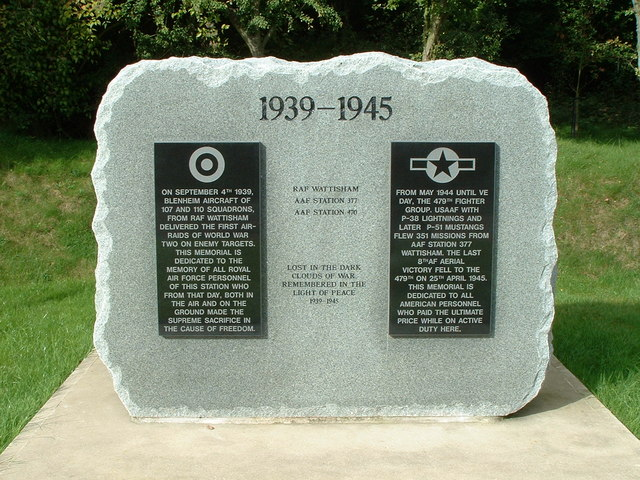
Wattisham Memorial