


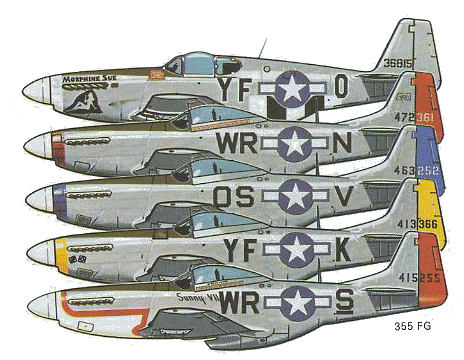
RAF Steeple Morden, designated USAAF Station 122, was one of the principal American fighter bases in England during World War II. Located in Cambridgeshire near the villages of Steeple Morden, Guilden Morden, and Litlington, the airfield became the wartime home of the United States Army Air Forces' 355th Fighter Group.
Unlike the large B-17 Flying Fortress and B-24 Liberator stations of the Eighth Air Force's bombardment divisions, Steeple Morden was developed primarily as a fighter base. From its runways, American fighter pilots escorted heavy bombers deep into Germany, conducted fighter sweeps over occupied Europe, protected Allied forces during the Normandy invasion, and attacked German airfields, transportation systems, military vehicles, and other targets at low altitude.
The history of RAF Steeple Morden and the 355th Fighter Group became inseparably connected. The airfield provided the facilities from which the group carried out nearly all its wartime combat operations, while the achievements of the group made Steeple Morden one of the best-known fighter stations of the Eighth Air Force.
Construction and Early RAF Use
Steeple Morden opened in September 1940 as a grass satellite airfield for nearby RAF Bassingbourn. During this early period, it was used principally as a dispersal and training field by Royal Air Force units operating aircraft such as the Vickers Wellington. Its grass landing area and limited facilities were suitable for training and temporary operations but were not adequate for the intensive fighter activity that would later take place there.
As the American air buildup in Britain accelerated, the Air Ministry selected Steeple Morden for conversion into a permanent military airfield. The station's location in eastern England placed it within convenient flying distance of occupied France, Belgium, the Netherlands, and the principal routes followed by Eighth Air Force bomber formations flying toward Germany.
Conversion into USAAF Station 122
During late 1942 and early 1943, Steeple Morden underwent extensive reconstruction. The original grass landing field was replaced by a permanent runway system, and the station was expanded to accommodate American fighter operations, aircraft maintenance, fuel and ammunition storage, communications, administration, and several thousand military personnel.
The principal improvements included:
When reconstruction was completed, the station was transferred to the United States Army Air Forces and designated USAAF Station 122. It became part of the extensive network of American airfields established across East Anglia to support the strategic air campaign against Nazi Germany.
Early American Occupants
Before the arrival of the 355th Fighter Group, Steeple Morden briefly accommodated elements of the 3rd Photographic Reconnaissance Group. Its aircrews operated F-4 photographic reconnaissance aircraft, a reconnaissance version of the Lockheed P-38 Lightning. The group prepared at Steeple Morden before deploying to North Africa in support of the Allied landings associated with Operation Torch.
After the reconnaissance personnel departed, preparations continued for the arrival of the fighter organization that would make Steeple Morden its permanent wartime home.
Formation of the 355th Fighter Group
The 355th Fighter Group was constituted and activated in the United States on November 12, 1942. The group was initially equipped with the Republic P-47 Thunderbolt, a powerful and heavily armed fighter capable of operating at high altitude and surviving considerable combat damage.
During its training in the United States, the pilots and ground personnel received instruction in formation flying, aerial gunnery, navigation, instrument flying, aircraft maintenance, bomber escort procedures, fighter sweeps, and air-to-ground attack techniques. These skills would soon be tested in sustained combat over occupied Europe and Germany.
The group consisted of three operational fighter squadrons:
The 355th Fighter Group departed the United States during the summer of 1943. Its personnel arrived in England during July and August and assembled at RAF Steeple Morden. The group became part of VIII Fighter Command and would conduct nearly all its wartime operations from Station 122.
Arrival at Steeple Morden
The arrival of the 355th Fighter Group transformed Steeple Morden into a fully operational American fighter station. Pilots became familiar with British weather, European navigation, radio procedures, enemy aircraft, and the complex escort formations used to protect Eighth Air Force heavy bombers.
Ground crews worked continuously to prepare the group's P-47 Thunderbolts for combat. Aircraft engines, guns, radios, oxygen equipment, instruments, and fuel systems had to be inspected before each mission. Armorers loaded the eight wing-mounted .50-caliber machine guns, while fuel crews filled the aircraft with high-octane aviation gasoline.
The group flew its first combat mission on September 14, 1943, conducting a fighter sweep over Belgium. Early missions were intended to introduce pilots to combat conditions while seeking opportunities to engage German fighters and disrupt enemy air operations.
Early Fighter Operations
Early operations consisted primarily of fighter sweeps, area patrols, and bomber escort missions over France, Belgium, and the Netherlands. Fighter sweeps were intended to draw German aircraft into combat, damage enemy airfields, and reduce the Luftwaffe's ability to attack Allied bomber formations.
As the Eighth Air Force expanded its daylight strategic bombing offensive, escorting B-17 Flying Fortresses and B-24 Liberators became one of the group's principal responsibilities. The 355th accompanied bombers attacking aircraft factories, rail centers, industrial plants, military airfields, oil installations, and other important targets.
The P-47 Thunderbolt was an effective high-altitude fighter, but its fuel consumption initially limited the distance it could accompany the bombers. External fuel tanks gradually extended its operating range, but the need for an escort fighter capable of remaining with the bombers throughout their deepest penetrations into Germany remained urgent.
Physical Configuration of Steeple Morden
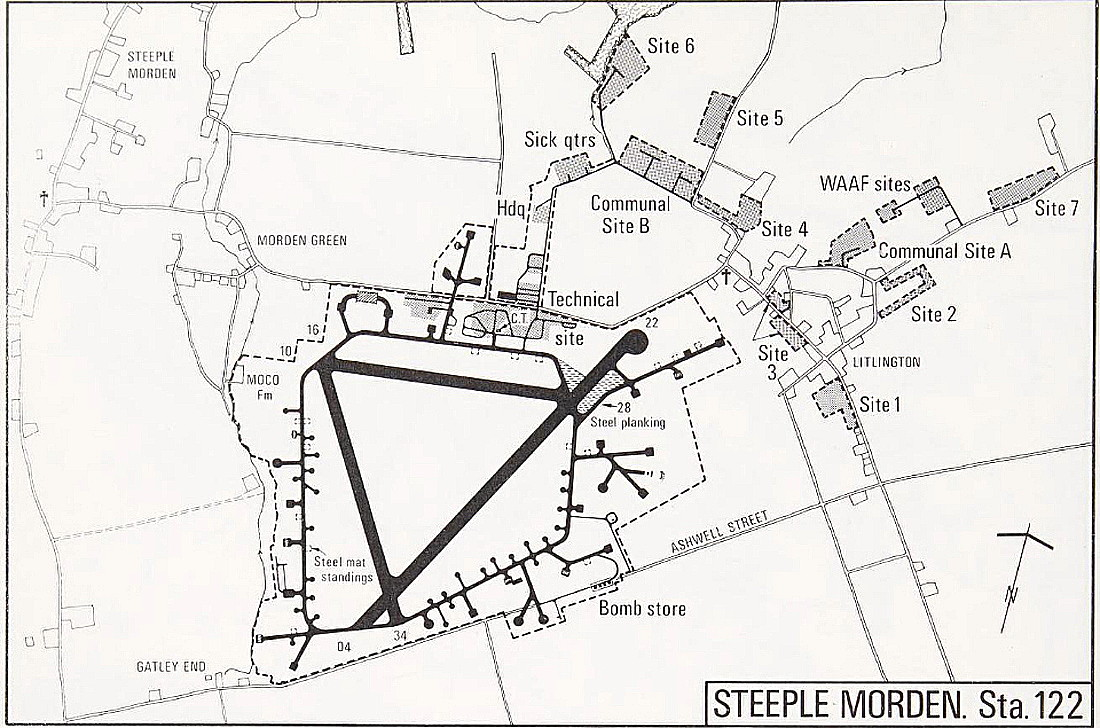
By 1944, RAF Steeple Morden possessed the principal features of a standard American fighter station. Its facilities were spread across a wide area so that a single bombing or strafing attack would be less likely to disable the entire base.
Runway System
The airfield had three intersecting concrete runways:
The runways were shorter than those normally found at heavy bomber stations because single-engine fighters required less takeoff and landing distance than fully loaded four-engine bombers. Nevertheless, the paved surfaces allowed operations to continue during much of the wet and unpredictable British weather.
Perimeter Track
A continuous concrete perimeter track connected the three runways, aircraft dispersals, technical area, maintenance hangar, refueling points, and other operational facilities. This allowed fighters to taxi directly between their parking areas and the active runway without crossing the center of the airfield unnecessarily.
The perimeter track was especially important when large numbers of aircraft were being launched or recovered within a short period. Fighters returning from combat could clear the runway quickly, allowing following aircraft—sometimes damaged or low on fuel—to land safely.
Aircraft Dispersals
Numerous loop and frying-pan hardstands were constructed around the perimeter track. These dispersals allowed aircraft to be parked separately rather than concentrated in a single vulnerable area.
The dispersal system:
Some parking positions were protected by earth banks or natural vegetation. Ground crews frequently worked at the dispersals in rain, wind, cold, and darkness to ensure that the aircraft were ready for the next mission.
Hangar and Maintenance Facilities
Aircraft maintenance facilities included:
Routine servicing normally took place at the dispersals, while major repairs were performed in or near the hangar. Damaged fighters were sometimes repaired and returned to combat despite having suffered bullet holes, flak damage, landing-gear failures, or engine problems.
Technical and Operational Sites
The technical and operational center included:
Before each mission, pilots assembled in the briefing rooms to receive information about the target, route, weather, enemy fighter activity, anti-aircraft defenses, radio frequencies, emergency airfields, and rendezvous points with the bomber formations.
After returning, pilots were questioned by intelligence officers. Their reports helped determine enemy aircraft claims, damage inflicted on ground targets, locations of anti-aircraft defenses, weather conditions, and changes in German tactics.
Domestic and Administrative Sites
Living quarters and support facilities were dispersed beyond the flying field to reduce congestion and limit casualties if the airfield were attacked. Personnel were housed principally in Nissen huts and other temporary wartime buildings.
The domestic and administrative sites included:
Life at Steeple Morden alternated between long periods of preparation and brief periods of intense activity. Ground crews might work throughout the night repairing aircraft, while pilots waited for weather reports and mission orders. Local villages and towns provided opportunities for recreation, and lasting friendships developed between American personnel and British residents.
Fuel and Ammunition Storage
Fuel and ammunition were stored in separate, dispersed locations to reduce the danger of catastrophic explosions. The fighter group required large quantities of aviation gasoline, machine-gun ammunition, bombs, and—during the later stages of the war—air-to-ground rockets.
The storage and armament areas handled:
The increasing use of fighters as fighter-bombers and ground-attack aircraft required substantial armament facilities. Aircraft often departed Steeple Morden carrying bombs or rockets in addition to their machine-gun ammunition and external fuel tanks.
Conversion to the P-51 Mustang
In early 1944, the 355th Fighter Group converted from the Republic P-47 Thunderbolt to the North American P-51 Mustang. The transition substantially increased the group's escort range and changed the nature of its operations.
The Mustang combined speed, maneuverability, firepower, and excellent high-altitude performance with the endurance needed to accompany bomber formations deep into Germany and return to England. With external fuel tanks, the P-51 could remain with the bombers much farther beyond the range previously possible with many Allied fighters.
The 355th became one of the early Eighth Air Force groups to employ the P-51B Mustang in long-range escort operations. The ability to provide sustained escort placed German fighter units under increasing pressure and reduced opportunities for the Luftwaffe to attack unprotected bomber formations.
Steeple Morden's dispersals, maintenance shops, fuel facilities, and armament sections were adapted to support the new aircraft. Pilots and mechanics had to become familiar with the Mustang's Packard-built Merlin engine, cooling system, fuel system, and different handling characteristics.
Long-Range Bomber Escort Operations
Flying from Steeple Morden, the 355th escorted B-17 and B-24 formations to targets throughout Germany and occupied Europe. Missions involved carefully timed takeoffs, assembly over England, rendezvous with bomber formations, penetration into enemy territory, combat with German interceptors, and recovery at Steeple Morden or another airfield.
Major escorted objectives included Berlin, Karlsruhe, Gelsenkirchen, Misburg, aircraft factories, oil refineries, ball-bearing plants, military airfields, industrial centers, chemical works, and railway marshalling yards.
The group's pilots combined disciplined escort procedures with aggressive offensive tactics. They attempted to intercept German fighters before they reached the bombers while remaining close enough to respond when the bomber formations came under attack.
The effectiveness of long-range escort fighters helped change the balance of the air war. German pilots were increasingly forced to fight American fighters throughout the bomber route rather than waiting for the bombers to move beyond the range of their escorts.
Distinguished Unit Citation
One of the most celebrated actions in the history of the 355th Fighter Group occurred on April 5, 1944. Operating in extremely poor weather, including snow squalls, low cloud, and restricted visibility, the group's pilots conducted an aggressive low-level attack against German airfields and other enemy objectives.
Flying at very low altitude, the Mustangs achieved surprise and attacked aircraft on the ground, airfield installations, and transportation targets. The pilots faced dangerous terrain, poor visibility, intense ground fire, and the constant possibility of colliding with obstacles or other aircraft.
For the courage, determination, and combat effectiveness displayed during these operations, the 355th Fighter Group received the Distinguished Unit Citation. The award became one of the most important honors in the group's wartime history.
Supporting the Normandy Invasion
During the weeks preceding the Normandy invasion, the 355th attacked transportation targets, airfields, bridges, railways, and communication centers. These operations were intended to isolate the invasion area and prevent German forces from moving rapidly toward the coast.
On D-Day, June 6, 1944, aircraft from Steeple Morden helped provide fighter cover over the invasion area. The group also conducted patrols, armed reconnaissance, and attacks against German troop movements, transportation routes, artillery positions, and other military objectives.
Allied air superiority prevented the Luftwaffe from mounting sustained attacks against the invasion fleet and beachhead. Fighter groups such as the 355th played an essential part in maintaining control of the skies over Normandy.
Supporting the Allied Breakout
During the Allied breakout from Saint-Lô in July 1944, the 355th attacked bridges, railway lines, military convoys, supply depots, armored vehicles, and troop concentrations. The fighter group's mission was expanding from strategic bomber escort to direct support of Allied ground operations.
As Allied armies advanced across France and Belgium, pilots flying from Steeple Morden conducted armed reconnaissance far behind German lines. They searched roads, railways, airfields, and waterways for targets of opportunity and attacked enemy movements whenever conditions permitted.
The Steeple Morden Strafers
During the latter half of 1944 and into 1945, the 355th developed an outstanding reputation for low-level ground attacks. Its pilots repeatedly strafed German airfields, locomotives, railway cars, trucks, military convoys, bridges, fuel depots, communication facilities, and troop concentrations.
These missions were extremely hazardous. Aircraft operating at low altitude were exposed to small-arms fire, machine guns, light anti-aircraft weapons, power lines, trees, buildings, and rapidly changing terrain. A pilot whose aircraft was damaged at low altitude often had little time to recover or escape.
The success and aggressiveness of these operations earned the group its enduring nickname, the “Steeple Morden Strafers.” The name connected the group's combat reputation directly to the English airfield from which it operated.
Ground crews at Steeple Morden made these missions possible. They repaired battle damage, replaced engines, maintained weapons, loaded ammunition, installed bombs and rockets, and returned aircraft to operational service as rapidly as possible.
Battle of the Bulge
During the German Ardennes offensive in December 1944 and January 1945, severe winter weather frequently restricted flying operations. When conditions permitted, the 355th attacked German armored columns, transportation routes, troop movements, fuel supplies, railways, and other targets supporting the offensive.
The group's attacks contributed to the Allied effort to disrupt the movement and resupply of German forces. As the weather improved, Allied fighters again became a dominant force over the battlefield.
Final Operations over Germany
As Allied armies crossed the Rhine and advanced into Germany during the spring of 1945, the 355th intensified its attacks against enemy airfields, railway systems, bridges, military vehicles, and troop movements.
German air power had been greatly weakened, but missions remained dangerous. Anti-aircraft fire continued to threaten aircraft flying at low altitude, and German jet fighters and other advanced aircraft occasionally appeared in combat.
The final combat mission of the 355th Fighter Group was flown on April 25, 1945. Its P-51 Mustangs conducted armed reconnaissance and ground attacks against transportation and military targets in southern Germany. Organized German resistance ended soon afterward with the surrender of Nazi Germany.
Aces and Leadership
The 355th Fighter Group produced a number of distinguished fighter pilots and combat leaders. Among its best-known aviators were Captain Henry W. Brown, Major William J. Hovde, and other pilots recognized for aerial victories, leadership, and successful ground-attack operations.
The commanders and squadron leaders developed a combat philosophy that combined disciplined bomber escort with aggressive offensive action. Their leadership helped the group become one of the leading fighter organizations of the Eighth Air Force.
Combat Record
By the end of the war, the 355th Fighter Group had flown approximately 342 combat missions over occupied Europe and Germany. Its pilots claimed a large number of enemy aircraft destroyed in aerial combat and on the ground, while also damaging or destroying locomotives, railway cars, bridges, vehicles, fuel installations, communication facilities, and other military targets.
The group's achievements came at a considerable cost. Aircraft and pilots were lost in aerial combat, to anti-aircraft fire, during low-level attacks, in operational accidents, and because of mechanical failures or severe weather. Some pilots were killed, while others were wounded or became prisoners of war.
Despite these losses, the 355th earned a lasting reputation as one of the Eighth Air Force's outstanding escort and ground-attack fighter groups. Its long-range escort missions helped protect the heavy bombers, while its strafing and interdiction operations weakened German air power, transportation, and military mobility.
Departure of the 355th Fighter Group
After the end of hostilities in Europe, the operational tempo at Steeple Morden rapidly declined. Aircraft were prepared for transfer, personnel awaited reassignment, and equipment was inventoried and removed.
The 355th Fighter Group remained associated with Steeple Morden until July 1945. After nearly two years of operations from Station 122, its personnel and aircraft departed the airfield. The removal of the fighter group ended the most active and historically important period in the station's history.
Return to the Royal Air Force
Following the withdrawal of the United States Army Air Forces, RAF Steeple Morden was officially returned to RAF control on November 1, 1945. By that time, Britain's wartime requirement for a large number of fighter stations had disappeared.
The airfield saw little further operational activity and was placed under caretaker status. Aircraft no longer filled the dispersals, and many of the temporary buildings stood empty as military personnel and equipment were withdrawn.
Closure of the Airfield
The Air Ministry officially closed RAF Steeple Morden on September 1, 1946. Maintenance was reduced, buildings were vacated, and the once-busy operational areas gradually deteriorated.
Temporary wartime structures were removed or abandoned during the following years. Metal, timber, equipment, and other materials were salvaged, while some buildings were adapted for agricultural or commercial purposes.
Sale and Agricultural Reuse
During 1960 and 1961, much of the former airfield property was sold into private ownership. Agricultural activity returned to land that had been transformed into a military airfield less than two decades earlier.
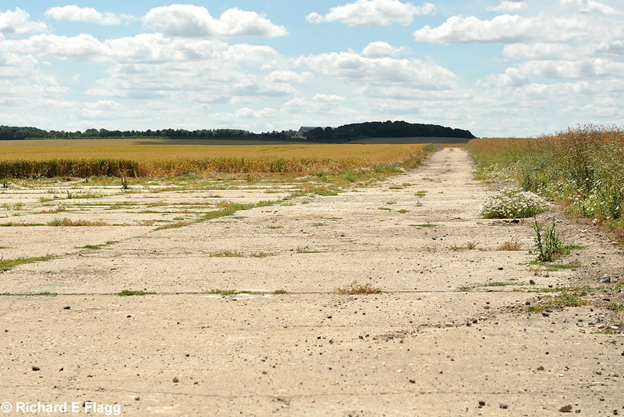
Large sections of runway, taxiway, and hardstand concrete were broken up, removed, covered, or incorporated into farm roads and storage areas. The domestic camps and technical buildings largely disappeared, making the former airfield increasingly difficult to recognize from ground level.
RAF Steeple Morden Today
Today, RAF Steeple Morden is among the less immediately recognizable former Eighth Air Force airfields in England. Much of the site has returned to farmland, and nearly all the wartime buildings have disappeared.
Surviving evidence of the airfield includes:
Although the physical remains are limited, the scale of the wartime station can still be appreciated from surviving roads, field boundaries, concrete surfaces, and aerial views. Visitors should remember that much of the former airfield is privately owned and remains in active agricultural use.
The Steeple Morden Memorial
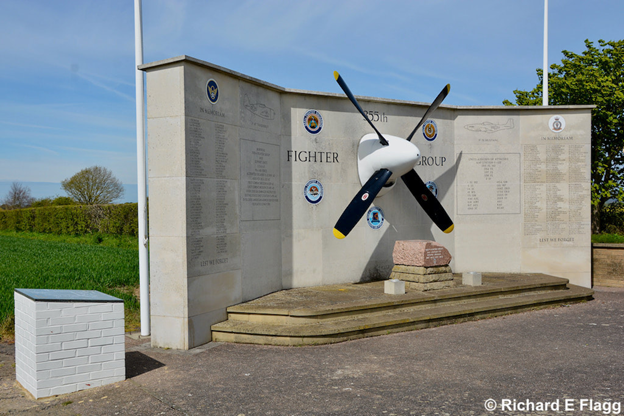
A memorial at the entrance to the former airfield honors the 355th Fighter Group, its three fighter squadrons, attached and supporting units, and the American personnel who served at Station 122. It ensures that the wartime association between the airfield, the surrounding communities, and the American fighter group will not be forgotten.
The memorial also represents the friendship that developed between American servicemen and the people of Steeple Morden and the surrounding villages. Decades after the war, veterans, family members, local residents, and historians have continued working to preserve the history of the airfield and the men who served there.
Legacy of RAF Steeple Morden and the 355th Fighter Group
The wartime history of RAF Steeple Morden cannot be separated from the history of the 355th Fighter Group. The station's runways, dispersals, maintenance shops, operations rooms, and living sites supported nearly two years of continuous fighter operations, while the group's achievements gave the airfield an enduring place in the history of the Eighth Air Force.
From Steeple Morden, the group's P-47 Thunderbolts and P-51 Mustangs escorted American bombers, fought German aircraft, protected the Normandy invasion, supported Allied ground forces, and attacked the transportation and airfield systems upon which the German military depended.
The pilots who flew the missions represented only part of the organization. Mechanics, armorers, communications personnel, intelligence officers, medical staff, drivers, cooks, clerks, engineers, firefighters, and many other specialists kept the fighter group operational. Their combined service transformed a rural Cambridgeshire airfield into one of the most effective American fighter stations of World War II.
Although most of the physical airfield has disappeared, the courage and sacrifice of the men who served at Station 122 remain permanently associated with the name Steeple Morden and with the enduring legacy of the “Steeple Morden Strafers.”
Squadrons
354th Fighter Squadron — 1942–1945
357th Fighter Squadron — 1942–1945
358th Fighter Squadron — 1942–1945
Principal Wartime Aircraft
Republic P-47 Thunderbolt
North American P-51 Mustang
Stations
Orlando Army Air Base, Florida — November 1942
Richmond Army Air Base, Virginia — February 1943
Philadelphia Municipal Airport, Pennsylvania — March 1943
RAF Steeple Morden, England — July 1943 to July 1945
Commanding Officers
Col. William J. Cummings Jr. — November 1942
Lt. Col. Everett W. Stewart — November 1944
Lt. Col. Claiborne H. Kinnard Jr. — February 1945

355th Fighter Group Roll of Honor: Roll of Honor
Oversea Burials 355th Fighter Group Oversea Burials