
FIGHTER AND BOMB GROUP HISTORIES
The histories of the Bomb/Fighter groups were assembled from Artificial Intelligence (AI) queries and publicly available material searched from selected internet sites related to the 8th US Army Air Force and 2nd Air Division groups. These histories were developed to provide an overview of the operational period of the bomb/fighter groups of the 2nd Air Division from the time of entry into the European Theatre of Operations (ETO) through Victory in Europe (VE) Day.
Each history contains an overview of the group missions, the squadrons which make up the group, the stations (bases) used initially in the USA and up to VE Day in the ETO, identification of commanding officers, the campaigns in which the group participated, unit/group citations and awards, and a link to currently known websites of the group memorial associations.
My father never talked much about his time in the service. I've only relatively recently come to understand he was part of the 2nd Air Division of the 8th US Army Air Force during 1944. I've always felt somewhat of a void in me because I had never served my country in the armed forces. I very much appreciated this opportunity to do something (even as small as it is) to perpetuate and honor those who served from the Greatest Generation.
I feel we certainly owe a debt of grateful remembrance to all those who served, but most of all to those who made the ultimate sacrifice. My father returned to the USA after completing 35 combat missions and went on to live a blessed and fulfilled life. Those honored in this book did not have that opportunity.
John Jurczak
Pittsburgh, Pennsylvania
FIGHTER AND BOMB GROUP HONOR ROLLS
The foundation for updating the American Library's Second Air Division Roll of Honor began with the digitization of the Roll of Honor housed at St. Paul's Cathedral in London. This remarkable memorial was commissioned by President Dwight D. Eisenhower, who appointed sculptor Trygve Rovelstad to lead a collaborative team of British and American artists in its creation. The completed Roll of Honor was formally presented on July 4, 1951.
The digitization project originated in early 2007 when Belton Wolf, a member of the Eighth Air Force Historical Society (8th AFHS) Board of Directors, learned that St. Paul's Cathedral wished to preserve the Roll of Honor in digital form. Recognizing its historical importance, the Society voted to fund the initiative. Shortly afterward, when Wolf's term on the board concluded, I assumed responsibility for the project. My role included overseeing the financial administration of the digitization effort and serving as the primary liaison between the Eighth Air Force Historical Society and St. Paul's Cathedral throughout the project.
In 2008, I discovered that the St. Paul's Cathedral Roll of Honor had not, in fact, been digitized. Instead, the pages had merely been scanned and saved as JPG image files, making them neither searchable nor suitable for accurate data verification. I also found that numerous names from other branches of the U.S. Armed Forces had been intermingled with those of the Eighth Army Air Force.
To determine the sources and documentation used in compiling the original St. Paul's Cathedral Roll of Honor, members of the 392nd Bomb Group Memorial Association undertook a comprehensive archival research project that spanned more than a year. The investigation included examination of records at the Eisenhower Presidential Library, as well as the Trygve Rovelstad Papers preserved in the University of Illinois Archives. This research established the documentary foundation of the original Roll of Honor.
Eventually, through one of our group’s connections at the Pentagon, we were able to obtain paper copies of St. Paul’s Roll of Honor from the National Army Museum in Carlisle, Pennsylvania.
Through contacts I had with the chaplain at the state prison in Atmore, Alabama, arrangements were made for a team of carefully selected inmates to manually transcribe more than 22,000 names from the Eighth Army Air Force Roll of Honor into a digital database. To ensure the highest possible level of accuracy, a second group of inmates independently verified every entry before the completed data were compiled into a Microsoft Excel database.
Using this newly digitized roster, I published the Eighth Air Force Roll of Honor along with a custom-designed display stand. The Eighth Air Force Historical Society distributed these Honor Rolls to more than twenty-five libraries and museums across the United States and Europe, making the names readily accessible to veterans, families, historians, and the public.
The digitized roster also became the primary source used by the National Museum of the Mighty Eighth Air Force in Pooler, Georgia, when creating its original Roll of Honor. In the years since, the museum has expanded its roster with names identified through additional research sources, of which have also been incorporated into my continuing work.
Following the rededication of the American Library's Second Air Division Roll of Honor in Norwich, England, on September 28, 2021, I conducted a comprehensive audit of the 392nd Bomb Group roster and discovered that the names of 62 fallen airmen had been omitted. Determined to ensure that every individual who made the ultimate sacrifice received proper recognition, I expanded the review to include the rosters of the remaining bomb and fighter groups of the Second Air Division. This systematic examination revealed similar omissions throughout the division, as well as numerous misspelled names, and other clerical errors. These findings underscored the need for a complete reassessment and verification of the Roll of Honor to ensure that it accurately commemorates every member of the Second Air Division who gave his life in service.
With the encouragement of several friends from the Second Air Division, I set out to update the records—cataloging 755 missing names, fixing misspellings, and adding crucial details like group affiliations and dates of death. My research began with foundational information from St. Paul's Cathedral's Roll, the American Library in Norwich, and the Mighty Eighth Museum. The sources used for obtaining, comparing, correcting, and documenting this information include:
St. Paul's Roll of Honor, London, England
American Library in Norwich, England
Mighty Eighth Museum in Pooler, GA
Bomber and fighter group associations
American Air Museum in Britain
National Archives, Washington, D.C.
Fold3.com casualty listings and MACRs
Findagrave.com website
Bits and Pieces Combat Chronology
Bits and Pieces Roll of Honor
HonorStates.org website
Several 2nd AD Researchers
Special thanks go to Riccard Parsonson, Vivian Rogers-Price, John McCarnish, James Clarey, Chris Clark, Bill Curtis, Skye James, Harold Jansen, Tim McCann, Marjorie Shiers, Mara Truslow, and many others who helped identify names and complete the Eighth Army Air Force Second Air Division Roll of Honor.
The completed listings identify an additional 755 individuals who made the ultimate sacrifice while serving with the Second Air Division, but whose names are not currently included on the Norwich American Library's Roll of Honor. For each individual, I have also included the recorded date of death and the bomb or fighter group with which he served.
Standards for compiling Rolls of Honor vary widely. Some include only combat-related deaths, while others also recognize accidental deaths, or limit inclusion to those who died while stationed in England or assigned to a particular unit. This Roll of Honor includes all deaths in the line of duty—combat-related or otherwise—that occurred while the individual was serving with a Second Air Division bomb or fighter group during World War II.
I have exhausted every available resource in an effort to make this Honor Roll as complete and accurate as possible. However, as with all World War II Rolls of Honor and the records from which these names were gathered, no source is entirely free from errors or omissions.
The list presented here may still contain mistakes or missing names. It is my hope that future researchers will continue this work by identifying and correcting any remaining errors so that these individuals may receive the remembrance they deserve.
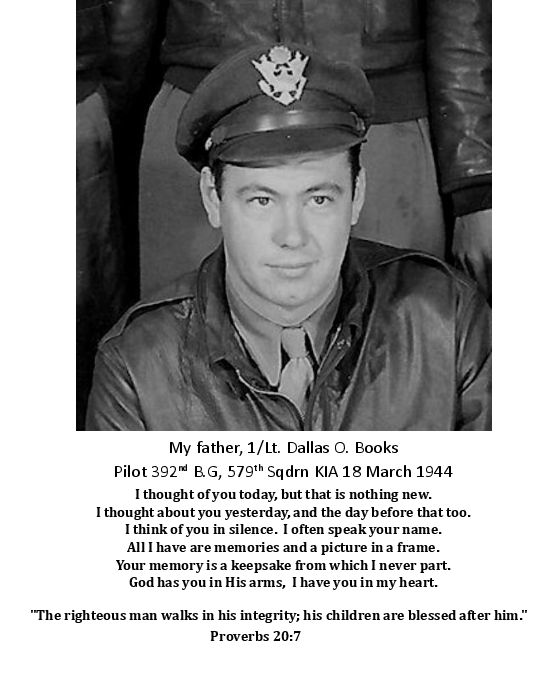
I dedicate this research, and my continued efforts to preserve the history of the Second Air Division, to my father, 1st Lt. Dallas O. Books, who was killed in action on March 18, 1944, while serving as a pilot with the Second Air Division, 392nd Bomb Group, 579th Squadron.
Endnote: This website would not exist without Chris Clark. For over twenty years, I collected Roll of Honor data, but it was Chris's relentless encouragement that finally pushed me to compile it.
In addition, Chris brought John Jurczak on board to help. John kept the project on track and provided the essential fighter and bomb group history that beautifully connects our Roll of Honor to the legacy of the Second Air Division.
If left entirely to me, this website project would likely never have crossed the finish line. It is a fact: Chris and John are the reason we have it today.
Bob Books
Pensacola, Florida