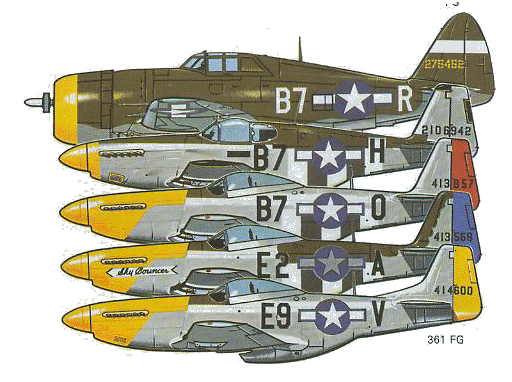
RAF Bottisham, designated USAAF Station 374, was a wartime fighter airfield near Cambridge in Cambridgeshire, England. Although it never possessed the extensive concrete facilities of the permanent heavy-bomber stations, Bottisham became one of the best-known American fighter bases in England. From this comparatively compact airfield, the 361st Fighter Group—known as the “Yellowjackets”—flew Republic P-47 Thunderbolts and North American P-51 Mustangs in defense of the Eighth Air Force’s bomber formations and in support of Allied ground forces in Europe.
The history of Bottisham and the 361st Fighter Group became inseparably linked during 1944. The airfield provided the operational setting in which the group entered combat, converted to the long-range P-51 Mustang, participated in the air offensive against Germany, supported the Normandy invasion, and earned recognition as an effective escort and ground-attack organization.
Origins and Early RAF Use
Bottisham was constructed in 1940 as a grass satellite airfield for RAF Waterbeach. It initially served as a relief landing ground and later accommodated Royal Air Force Army Cooperation units. Aircraft associated with the station’s early wartime service included Westland Lysanders, Curtiss Tomahawks, Taylorcraft Austers, and early Allison-powered Mustangs. Unlike the large Class A airfields later built for heavy bombers, Bottisham began as a relatively small and lightly developed station whose grass flying field reflected its auxiliary role.
Its location in East Anglia, however, placed it within the region that became the center of American air operations from Britain. As the Eighth Air Force expanded during 1943, Bottisham was selected for development as a United States Army Air Forces fighter station.
Development for American Fighter Operations
During the second half of 1943, the Air Ministry enlarged and improved Bottisham for the arrival of an American fighter group. The work included:
The airfield’s grass surfaces proved unsuitable for sustained operations by the heavy P-47 Thunderbolt, particularly during wet winter weather. In January 1944, American engineers laid a 1,470-yard Pierced Steel Planking runway in only three days. The new surface allowed the 361st Fighter Group to begin combat operations while retaining the compact character of Bottisham’s original grass-airfield layout.
Formation and Arrival of the 361st Fighter Group
The 361st Fighter Group was activated in the United States on 1 December 1942 as part of the rapid wartime expansion of the Army Air Forces. Its three component units were the 374th, 375th, and 376th Fighter Squadrons. During 1943, the group trained at several American stations in formation flying, aerial gunnery, navigation, bomber escort, aircraft recognition, and air-to-ground attack. Ground personnel learned to maintain, arm, fuel, and rapidly service the group’s high-performance fighters under operational conditions.
The group deployed to England during November 1943 and established its headquarters at Bottisham. On 3 January 1944, the station officially became USAAF Station 374, with the 361st assuming operational control. After completing theater familiarization and final operational training, the group flew its first combat mission on 21 January 1944, escorting heavy bombers attacking aircraft-industry targets at Oschersleben, Germany.
The group became known as the “Yellowjackets,” a name associated with the conspicuous yellow recognition markings carried by its fighters. These markings made the aircraft of the 361st readily identifiable in the skies over England and continental Europe.
Early Combat with the P-47 Thunderbolt
The 361st entered combat during a critical period in the Eighth Air Force’s strategic bombing campaign. Flying the Republic P-47 Thunderbolt, its pilots escorted B-17 Flying Fortresses and B-24 Liberators attacking aircraft factories, industrial centers, transportation networks, military airfields, and other targets in Germany and occupied Europe.
During Big Week, 20–25 February 1944, the group helped protect bomber formations striking the German aircraft industry. These missions were intended both to damage fighter production and to force the Luftwaffe into combat with increasingly powerful formations of American escort fighters. The 361st’s early operations from Bottisham formed part of the larger campaign that gradually weakened German fighter opposition before the invasion of France.
Conversion to the P-51 Mustang
In May 1944, the 361st Fighter Group converted from the P-47 Thunderbolt to the North American P-51 Mustang, initially operating P-51B and P-51C aircraft and later the P-51D. The Mustang’s range, speed, maneuverability, and high-altitude performance allowed the group to accompany the Eighth Air Force’s bombers much farther into Germany than had been practical with earlier fighters.
With the P-51, the Yellowjackets could protect bomber formations during the most dangerous portions of deep-penetration missions while also seeking out German fighters in the air and attacking enemy aircraft on their airfields. This combination of long-range escort and offensive fighter operations contributed to the achievement of Allied air superiority during 1944.
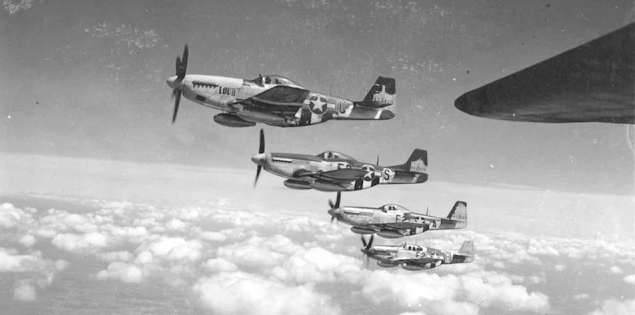
“The Bottisham Four”
One of the airfield’s most enduring visual legacies is the famous July 1944 color photograph known as “The Bottisham Four.” It shows four P-51 Mustangs of the 375th Fighter Squadron in flight, led by Colonel Thomas J. J. Christian Jr.’s aircraft, Lou IV. The image, with the Mustangs’ distinctive yellow noses and colorful identification markings, became one of the most widely recognized photographs of the American fighter campaign in Europe.
Normandy and the Campaign in France
Before and during the Normandy invasion, the 361st flew bomber escort, fighter cover, armed reconnaissance, and ground-attack missions. On and around D-Day, 6 June 1944, its pilots helped protect the invasion area and attacked transportation routes, bridges, military vehicles, troop movements, and other targets that could be used to reinforce German defenses.
As Allied forces fought their way inland, the group increasingly struck railroads, locomotives, supply depots, convoys, and communications centers. During the breakout from Saint-Lô, these operations helped isolate the battlefield and hinder the movement of German troops and equipment toward the front.
Physical Configuration of Bottisham in 1944
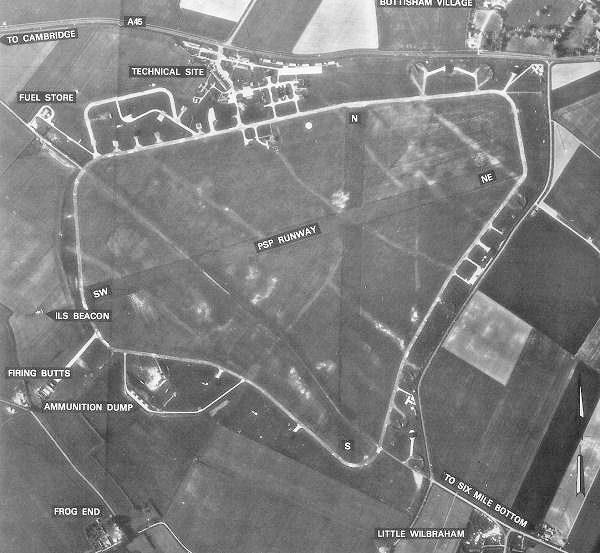
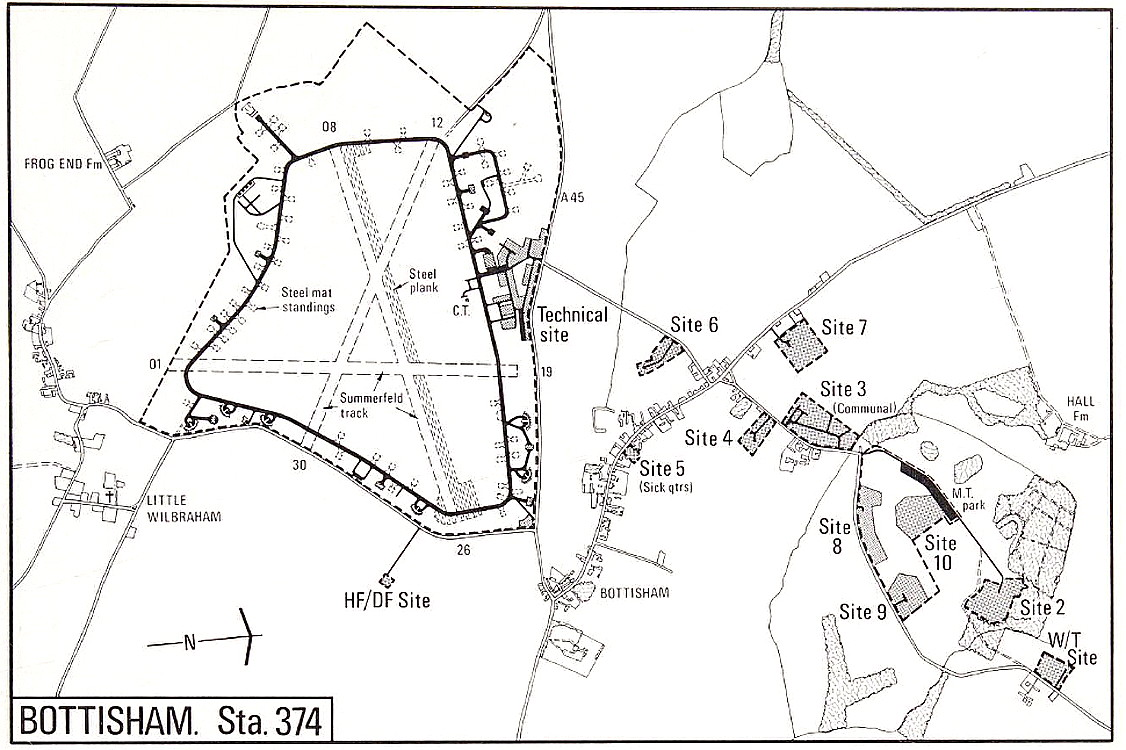
Although enlarged for American use, Bottisham retained many characteristics of its origins as a grass satellite airfield. It occupied relatively level farmland southwest of the village of Bottisham and was designed for fighter operations rather than heavy bombers.
Runways and Taxiways
By the spring of 1944, flight operations relied principally upon Pierced Steel Planking surfaces rather than permanent concrete runways. The main PSP runway was approximately 4,410 feet, or 1,470 yards, in length. A secondary steel-plank runway, steel taxiways, and extensive surrounding grass areas provided the additional space needed to assemble, launch, recover, and disperse fighter formations.
A compact system of taxiways connected the runways with aircraft dispersals, maintenance areas, and the technical site. This arrangement reduced taxiing time and made it possible to launch formations quickly when escort missions were scheduled or when aircraft needed to respond to changing operational requirements.
Aircraft Dispersals
Fighters were parked around the perimeter on dispersed hardstands, often arranged in loops or frying-pan patterns. Dispersal reduced the number of aircraft concentrated in one place and limited their vulnerability to enemy attack or accidental damage. The three squadrons occupied assigned areas where aircraft could be fueled, armed, inspected, and prepared for the next mission.
Technical and Maintenance Areas
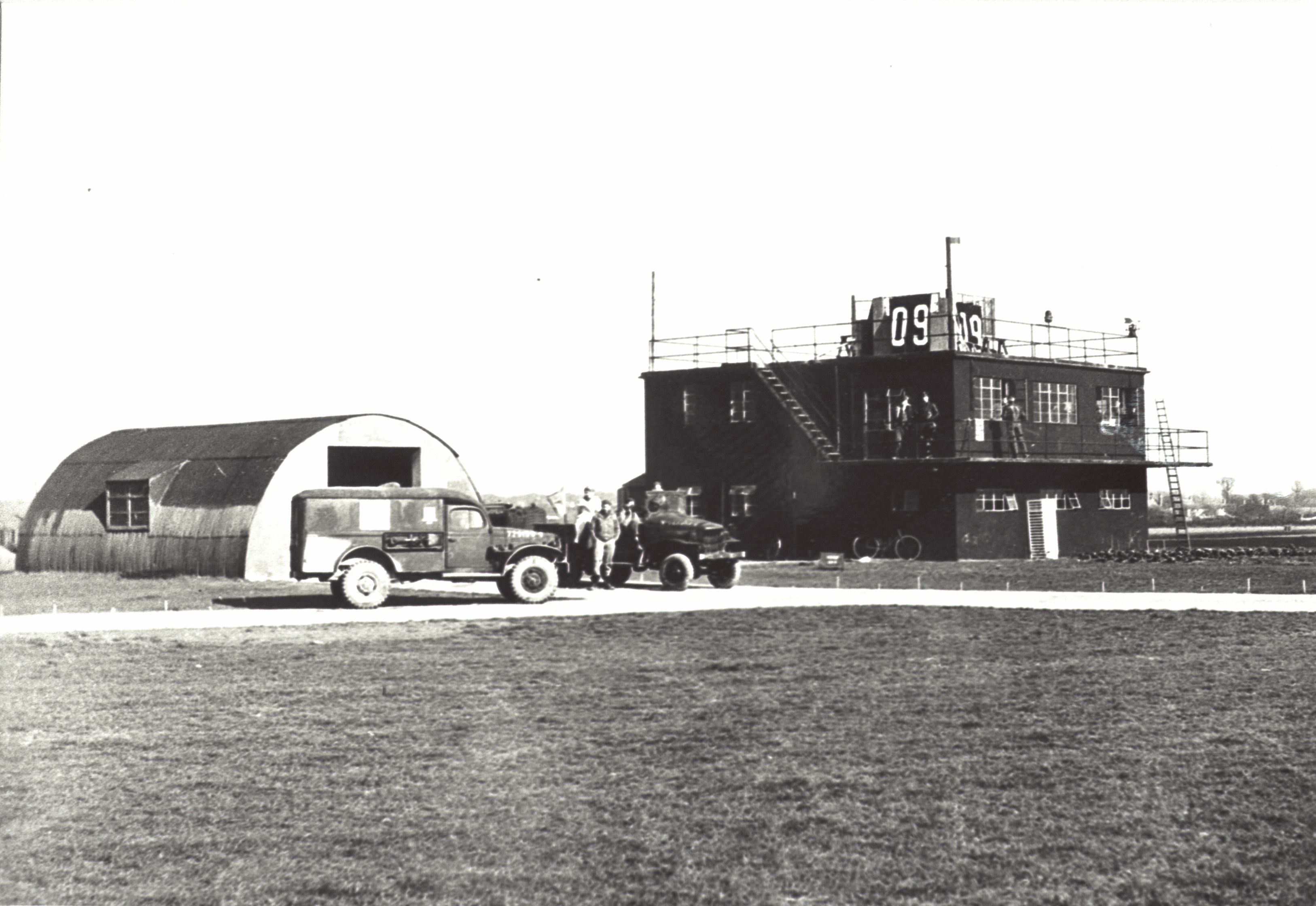
The technical site formed the operational center of the station. It included the watch office or control tower, operations and intelligence rooms, briefing facilities, engineering offices, radio and armament shops, firefighting facilities, and stores. Bottisham did not have the extensive hangar complex of a permanent bomber station. A T2 hangar and smaller workshops supported major maintenance, while much routine servicing was performed outdoors at the dispersals.
From these facilities, ground crews worked in all weather to inspect engines, repair battle damage, service oxygen and radio equipment, load .50-caliber ammunition, and prepare the fighters for operations. Their ability to keep aircraft serviceable was essential to the group’s combat effectiveness.
Domestic, Fuel, and Ammunition Sites
Officers and enlisted personnel lived in dispersed camps connected to the airfield by service roads. Nissen huts and other temporary buildings provided sleeping quarters, mess halls, recreation rooms, medical facilities, headquarters offices, and motor-transport services. Trees and existing landscape features were used wherever possible to screen the camps and buildings.
Fuel and ammunition were stored in separated, dispersed sites to reduce the danger of fire and explosion. Facilities supported the storage and delivery of aviation gasoline, .50-caliber ammunition, and the bombs and rockets used during fighter-bomber and ground-attack missions.
Departure from Bottisham and the Distinguished Unit Citation
The 361st Fighter Group left Bottisham for RAF Little Walden, USAAF Station 165, in September 1944. The move brought the group to a larger airfield better suited to its continuing escort and tactical responsibilities. Although its occupation of Bottisham lasted less than a year, the station remained central to the group’s identity because it was there that the Yellowjackets entered combat, converted to the Mustang, and established their reputation.
On 11 September 1944, shortly after the move from Bottisham, the group escorted bombers to targets in the Berlin area under severe weather conditions and intense enemy opposition. Its determination in protecting the bomber force and engaging German fighters brought the 361st Fighter Group a Distinguished Unit Citation.
Little Walden, Belgium, and the Final Campaigns
From Little Walden, the 361st continued long-range escort operations and expanded its tactical work against airfields, railways, bridges, locomotives, motor transport, fuel depots, and military columns. During the Battle of the Bulge, the group flew escort and ground-attack missions in support of the Allied response to the German offensive.
In February 1945, the group moved to Chièvres, Belgium, bringing its Mustangs closer to the advancing Allied armies. From the continent, it attacked German transportation and communications while supporting the final drive into Germany. The group returned to Little Walden in April 1945 and flew its last combat mission on 20 April. By the end of the war, it had completed 441 combat missions and had participated in the Air Offensive, Europe; Normandy; Northern France; Rhineland; Ardennes-Alsace; and Central Europe campaigns.
Squadrons, Stations, and Command
Squadrons
Principal Stations
Commanding Officers
Decoration
Distinguished Unit Citation for the Berlin escort mission of 11 September 1944.
Bottisham After the Departure of the 361st
Following the departure of the American fighter group, Bottisham remained available for military use but saw comparatively little activity. In June 1945, it became a relief landing ground for the RAF (Belgian) Initial Training School based at nearby RAF Snailwell. On 1 October 1945, Bottisham officially became a satellite of Snailwell. Belgian training continued until early 1946 as Belgium rebuilt its postwar military aviation capability.
Belgian personnel departed in March 1946, and Bottisham closed as an operational airfield on 1 May 1946. Its active flying life had lasted only about six years, but during that brief period it had served the Royal Air Force, the United States Army Air Forces, and Belgian personnel.
Civilian Use and Return to Agriculture
Some former station buildings found new uses after military flying ended. Beginning in 1948, portions of the domestic site were used by the National Coal Board as a training center for European Volunteer Workers. Many of these men had been displaced from Eastern Europe by the war and received instruction before taking employment in Britain’s coal mines.
The airfield property was eventually sold for agricultural use in 1958. Much of the land returned to farming, temporary buildings disappeared, and sections of the runways, taxiways, and dispersals were removed, buried, or incorporated into later roads and farm tracks.
Bottisham Airfield Today
Although much of the wartime airfield has vanished, portions of the perimeter track and taxiway system, several original buildings, Nissen huts, and traces of the flying field remain visible. Memorials and preserved structures commemorate the British, American, and Belgian personnel who served at Bottisham.
The Bottisham Airfield Museum, established in surviving wartime buildings on the former station, preserves the history of the Royal Air Force, the 361st Fighter Group, and the Belgian personnel associated with the airfield. Its displays of photographs, uniforms, aircraft equipment, artifacts, and personal histories ensure that the story of RAF Bottisham and the Yellowjackets remains accessible to future generations.

RAF Bottisham Roll of Honor: Roll of Honor
Oversea Burials 361st Fighter Group Oversea Burials