Formation of the 389th Bombardment Group
The 389th Bombardment Group (Heavy), known as the “Sky Scorpions,” was one of the principal B-24 Liberator groups of the United States Army Air Forces during World War II. From RAF Hethel in Norfolk, England, the group served with the Eighth Air Force and its Second Air Division, carrying the strategic air war across occupied Europe and into Germany. Its crews attacked enemy aircraft production, oil installations, shipyards, railways, bridges, airfields, military depots, V-weapon sites, and industrial centers. The group also supported Allied armies in Sicily, Italy, Normandy, the Ardennes, and during the crossing of the Rhine.
The group was constituted on 19 December 1942 and activated at Davis-Monthan Field, Arizona, on 24 December 1942. Its four original squadrons were the 564th, 565th, 566th, and 567th Bombardment Squadrons. Colonel David B. Lancaster became the first commanding officer. During early 1943, the organization moved to Biggs Field, Texas, and then to Lowry Field, Colorado, where its flying and ground echelons completed the demanding preparation required for overseass combat.
Training brought together thousands of specialists whose combined labor was necessary to place a formation of heavy bombers over a distant target. Pilots and copilots mastered formation flying and instrument procedures; navigators learned long-range dead reckoning and celestial navigation; bombardiers practiced precision bombing; and gunners trained to defend the aircraft from every direction. Radio operators, engineers, armorers, mechanics, clerks, cooks, medics, intelligence personnel, and many others learned the duties that sustained the group. The B-24’s range and bomb-carrying capacity made it a formidable weapon, but its complexity demanded constant maintenance and close coordination between air and ground crews.
In May 1943, President Franklin D. Roosevelt visited the group at Lowry Field shortly before its departure overseass. Colonel Jack W. Wood assumed command on 16 May. The aircrews began their movement across the North Atlantic by way of staging fields in the United States, Canada, Labrador, Greenland, and Iceland. Much of the ground echelon crossed the Atlantic by ship. By June and July 1943, the organization had assembled at RAF Hethel, designated USAAF Station 114, southwest of Norwich in Norfolk.
RAF Hethel and the Second Air Division
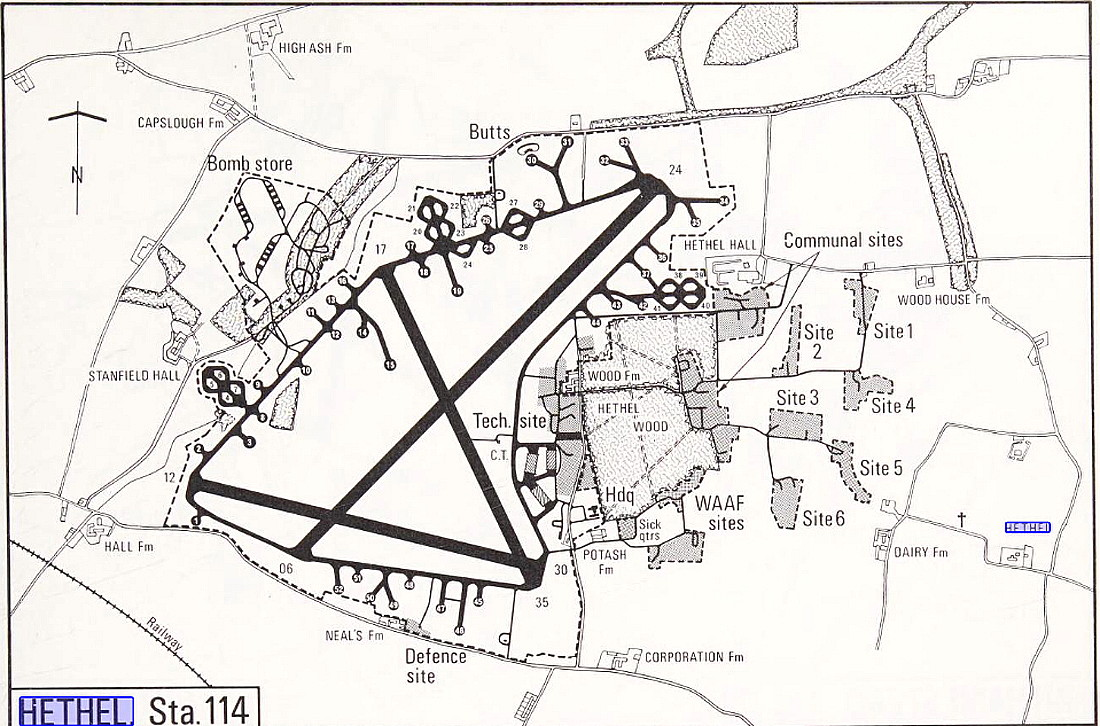
Hethel became the 389th Bomb Group’s permanent combat home. Built as a Class A heavy-bomber station, the airfield contained three concrete runways, perimeter tracks, dispersed aircraft hardstands, hangars, workshops, fuel and ammunition facilities, administrative buildings, and living sites scattered through the surrounding countryside. From this station, the group operated as part of the growing American B-24 force that became the Second Bombardment Division in September 1943 and was renamed the Second Air Division at the beginning of 1945.
Daily life at Hethel alternated between long periods of preparation and moments of intense urgency. A combat day began well before dawn with briefings on the target, route, weather, enemy defenses, and emergency procedures. Ground crews worked through darkness, cold, rain, and fog to fuel, arm, inspect, and repair the Liberators. On return, damaged aircraft required immediate attention while intelligence officers debriefed the crews and medical personnel treated the wounded. Empty parking places and vacant bunks were constant reminders of aircraft and men who had failed to return.
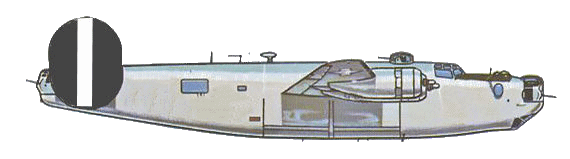
The group’s identifying Eighth Air Force tail marking was a black letter C within a white circle. Squadron aircraft carried the fuselage codes YO for the 564th, EE for the 565th, RR for the 566th, and HP for the 567th Bomb Squadron. These markings helped crews recognize and assemble with their formations amid crowded wartime skies.
Construction and Physical Configuration of RAF Hethel
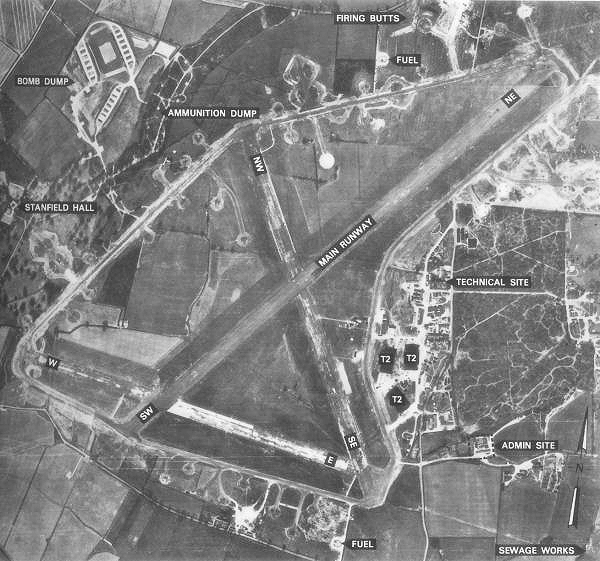
Construction of RAF Hethel began in 1942 on former agricultural land southwest of Norwich, near the villages of Hethel and Wymondham. Planned as one of Britain’s permanent Class “A” heavy-bomber stations, the airfield was transferred to the United States Army Air Forces before it became operational. The completed station was designated USAAF Station 114 and was designed to accommodate four-engine bombers and the thousands of people required to maintain continuous combat operations.
The flying field followed the standard triangular Class “A” arrangement. Its main concrete runway was approximately 2,000 yards (6,000 feet) long, while the two intersecting secondary runways were approximately 1,400 yards (4,200 feet) long. This arrangement allowed takeoffs and landings to be made into the prevailing wind. A complete perimeter track connected the runways, technical area, maintenance facilities, and aircraft dispersals. Approximately fifty hardstands around the perimeter enabled the Liberators to be parked separately, reducing congestion and limiting the danger from enemy attack, accidental explosions, or aircraft crashes.
The Technical Site
The technical site stood beside the flying field and formed the operational center of the station. T-2 hangars and engineering shops provided space for inspections, engine changes, structural repairs, and modifications to the group’s B-24s. The area also included the control tower, operations building, weather office, communications center, intelligence rooms, parachute section, machine shops, fire station, and other specialized facilities. Here, mission plans were prepared, crews received their target and route briefings, and returning airmen were questioned about enemy defenses, weather, and bombing results.
Fuel and ammunition installations were deliberately separated from the main technical and living areas. High-octane aviation gasoline was kept in protected storage compounds and distributed to aircraft before each mission. The bomb dump, connected by dedicated service roads, held general-purpose, incendiary, fragmentation, armor-piercing, and other types of ordnance. Armorers transported the assigned bomb loads to the dispersals, where each Liberator was armed under carefully controlled conditions.
Domestic Sites and Station Life
The domestic and communal buildings were distributed among several sites in the surrounding countryside rather than concentrated beside the runways. Nissen huts and other temporary buildings housed officers and enlisted personnel, while mess halls, a hospital and dispensary, dental clinic, chapel, recreation hall, theater, Post Exchange, Red Cross club, motor pool, laundry, and athletic areas supported the large wartime community. Dispersal reduced vulnerability to attack but required personnel to travel between widely separated living and working areas.
Life at Hethel was governed by the flying schedule. On mission days, weather specialists, intelligence officers, armorers, fuel crews, mechanics, and aircrews began work hours before sunrise. Engines were tested at the dispersals, aircraft taxied onto the perimeter track, and Liberators departed at carefully spaced intervals before assembling with larger formations over East Anglia. Several hours later, the tower coordinated their return, giving priority to aircraft with wounded men, damaged landing gear, failing engines, or little fuel. Medical teams met emergencies while ground crews immediately began inspecting, unloading, and repairing the bombers for the next operation.
Deployment to North Africa and the First Combat Mission
Before it could begin sustained operations from England, most of the group’s air echelon was ordered to North Africa. On 30 June 1943, its Liberators departed for the Benghazi area of Libya, where the 389th joined other B-24 groups operating under the Ninth Air Force. The detachment’s immediate tasks were to support the invasion of Sicily and prepare for a secret, exceptionally hazardous attack against Romanian oil production.
The 389th flew its first combat mission on 9 July 1943 against the German airfield at Maleme on Crete. The mission revealed the dangers the new group would face. Flying without fighter escort, the formation encountered enemy fighters after leaving the target, and a B-24 of the 567th Bomb Squadron was shot down off Crete. Further missions struck objectives connected with the campaign in Sicily and southern Italy, including Messina, Reggio di Calabria, Bari, and railway facilities near Rome.
Operation Tidal Wave and Ploesti
The most famous mission in the history of the 389th occurred on 1 August 1943 during Operation Tidal Wave, the low-level attack on the Romanian oil-refining complex around Ploesti. Five B-24 groups—the Eighth Air Force’s 44th, 93rd, and 389th Bomb Groups and the Ninth Air Force’s 98th and 376th Bomb Groups—were assembled in Libya for the operation. Because Romanian petroleum was vital to the Axis war economy, the refineries ranked among the most important targets within range of Allied bombers.
The plan required the Liberators to fly approximately 1,200 miles from Libya, cross the Mediterranean and the mountains of the Balkans, and approach the targets at extremely low altitude. Low-level flight was intended to preserve surprise, complicate enemy radar detection, and permit precise attacks against individual refineries. Navigation errors, broken formations, and the loss of surprise disrupted the plan. By the time the 389th approached its objective, defenses throughout the area had been alerted and smoke from earlier attacks obscured parts of the refinery district.
The 389th was assigned the Steaua Româna refinery at Câmpina, north of Ploesti. Although separated from leading elements of the force, the group maintained its course and delivered a disciplined low-level attack through fighters, barrage balloons, small-arms fire, and intense antiaircraft defenses. Four of its aircraft were lost. The refinery was heavily damaged and temporarily put out of operation. For the courage, skill, and determination displayed in the attack, the 389th Bombardment Group received the Distinguished Unit Citation.
Second Lieutenant Lloyd H. Hughes, pilot of a B-24 in the 564th Bomb Squadron, performed the group’s best-known act of individual heroism. Antiaircraft fire punctured his aircraft’s fuel tanks before the bomb run, and gasoline streamed from the Liberator as it approached a refinery already surrounded by flames. Hughes could have attempted to leave the formation, but he continued at low altitude, held the aircraft on course, and bombed the assigned objective. His B-24 caught fire and crashed while he attempted a forced landing after clearing the target. Hughes was mortally injured, and several members of his crew died. He was posthumously awarded the Medal of Honor.
After additional missions from Libya, including an exceptionally long attack against the Messerschmitt aircraft works at Wiener Neustadt, Austria, the air echelon returned to Hethel on 27 August 1943. The Ploesti mission had given the 389th a place in aviation history, but it also demonstrated the terrible cost of sending heavy bombers against a distant, heavily defended target at low altitude.
Return to the Mediterranean
The group’s Mediterranean service was not yet finished. During September and October 1943, elements operated temporarily from Tunisia to support Allied operations in Italy. Missions attacked airfields, ports, communications, and other targets in Corsica, Italy, and Austria and supported the landings and fighting around Salerno. The assignment required the group to operate far from its permanent base with limited facilities, once again demonstrating the B-24’s long range and the adaptability of its personnel.
After returning to England in October, the 389th concentrated primarily on the Eighth Air Force’s strategic campaign. Its Mediterranean detachments had already fought over Crete, Sicily, Italy, Austria, and Romania before the group had completed a full season of operations from Hethel.
Autumn and Winter Operations, 1943–1944
During the autumn of 1943, the 389th attacked targets in France, the Netherlands, Norway, and Germany. Among its most difficult early missions were attacks on Vegesack on 8 October, Münster on 5 November, Solingen on 1 December, and Ludwigshafen on 30 December. Enemy fighters and concentrated flak were only part of the danger. Cloud cover frequently concealed targets, icing affected aircraft at altitude, and violent winds scattered formations or pushed them away from planned routes.
At this stage of the air war, fighter escort could not always accompany bombers deep into Germany. B-24 formations depended upon tight defensive boxes that allowed their gunners to combine fire against attacking fighters. A single damaged aircraft that fell behind could quickly become vulnerable. The arrival of longer-ranged P-47 Thunderbolts and especially P-51 Mustangs gradually transformed the campaign by enabling American fighters to escort the bombers farther into enemy territory and aggressively engage the Luftwaffe.
The group also adapted to changing bombing methods. Radar-equipped lead aircraft made it possible to attack through solid cloud when visual bombing was impossible, though results varied according to weather and the nature of the target. Replacement B-24H and B-24J aircraft arrived with powered nose turrets that improved forward defense, replacing or supplementing many of the earlier B-24D models used during the Mediterranean missions.
Big Week and the Offensive Against German Industry
From 20 through 25 February 1944, the 389th participated in Big Week, the concentrated Allied offensive against the German aircraft industry. American and British bombers struck aircraft assembly plants, airframe works, engine factories, and component manufacturers in an effort to weaken the Luftwaffe before the invasion of France. These missions forced German fighter units into combat against increasingly powerful American escorts and accelerated the struggle for control of the air over Europe.
Throughout 1944 and early 1945, the group repeatedly penetrated German airspace to strike industrial and transportation objectives. Its targets included the shipbuilding yards at Vegesack, industrial areas of Berlin, oil facilities at Merseburg, factories at Münster, railway yards at Sangerhausen, and numerous airfields, bridges, depots, and communications centers. The group also attacked V-weapon installations in the Pas-de-Calais as the Allies sought to disrupt the German flying-bomb and rocket offensive against Britain.
The strategic campaign became increasingly focused on two systems essential to Germany’s ability to continue the war: petroleum and transportation. Attacks on refineries, synthetic-fuel plants, storage facilities, railway yards, bridges, and junctions restricted the movement of fuel, troops, raw materials, and finished weapons. The results of any single raid might be obscured by weather or rapidly repaired, but repeated attacks placed mounting strain on the German war economy.
Preparation for D-Day
In the spring of 1944, the 389th joined the air offensive preparing the way for the invasion of Normandy. Strategic bombers were temporarily assigned many tactical targets, including coastal batteries, airfields, bridges, and transportation centers. These attacks were intended to isolate the invasion area, reduce enemy air activity, and prevent German reinforcements from reaching the beaches quickly.
On and after 6 June 1944, the group continued missions supporting the Allied lodgment in France. Tactical bombing posed challenges different from attacks on large industrial complexes. Targets could be smaller, closer to friendly troops, and more dependent on precise timing and identification. Weather over the Channel and Normandy frequently complicated the work of both aircrews and planners.
Saint-Lô and the Liberation of Western Europe
In July 1944, the 389th attacked German positions in support of the American breakthrough near Saint-Lô. The great aerial bombardment associated with Operation Cobra helped rupture the defensive front and opened the way for the rapid Allied advance across France. The group then struck bridges, rail centers, supply depots, and troop concentrations to hinder the enemy’s retreat and prevent the formation of new defensive lines.
As Allied armies liberated France and Belgium, the bombers’ operating radius extended over a rapidly changing battlefield. The 389th alternated between strategic attacks deep inside Germany and interdictory missions intended to isolate German forces from fuel, ammunition, and reinforcements.
The Battle of the Bulge
Germany’s surprise offensive in the Ardennes in December 1944 created an urgent need for air support, but winter weather initially grounded much of the Allied air force. When the skies cleared, the 389th and other heavy-bomber groups attacked marshalling yards, storage depots, bridges, road and rail junctions, and communications centers supporting the German advance. By disrupting the transportation network behind the battlefield, these missions helped restrict the movement and supply of German forces during the Battle of the Bulge.
The Ardennes fighting illustrated how the strategic bomber force could be redirected when the needs of the ground campaign demanded it. The B-24 was not designed as a close-support aircraft, yet its bomb load and range allowed it to strike supply systems well beyond the immediate front and magnify the pressure placed on the German offensive.
Operation Varsity and the Rhine Crossing
On 24 March 1945, during Operation Varsity, the 389th participated in an aerial resupply mission for airborne troops landing east of the Rhine. Instead of conventional bombs, Liberators carried bundles containing ammunition, food, gasoline, medical supplies, and other essential equipment. Flying at comparatively low altitude exposed the large bombers to intense light antiaircraft and small-arms fire.
The supply mission was costly for the participating B-24 units, but it demonstrated the willingness of heavy-bomber crews to accept an unfamiliar and dangerous assignment in direct support of ground forces. The Rhine crossing opened the final Allied drive into the heart of Germany.
Final Combat Operations
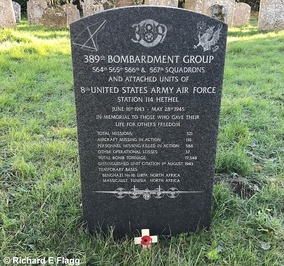
During April 1945, the 389th continued attacking transportation, military, and industrial objectives as German resistance collapsed. The group flew its final combat mission late in April. By the end of its combat service, it had completed 321 missions, including 14 flown during its detachments to North Africa. The group had lost 116 B-24 Liberators in action. Many additional aircraft returned to Hethel with severe battle damage, and others were lost in training or operational accidents.
The record represented far more than aircraft and mission totals. Each operation depended upon the combined effort of aircrews and the much larger body of ground personnel who kept the group functioning. Hundreds of men were killed, wounded, captured, or reported missing, while survivors carried the physical and emotional consequences of combat long after the war had ended.
Return to the United States and Inactivation
With the end of the war in Europe, the 389th prepared to leave Hethel. Personnel and aircraft began returning to the United States during May and June 1945. The group moved to Charleston Army Air Field, South Carolina, where it remained until it was inactivated on 13 September 1945. Its wartime organization had existed for less than three years, yet in that time it had operated from England, Libya, and Tunisia and had fought from the Mediterranean to central Germany.
The 389th’s designation later became part of United States Air Force history. Its lineage was consolidated with that of the 389th Strategic Missile Wing, a Strategic Air Command organization that operated Atlas intercontinental ballistic missiles at Francis E. Warren Air Force Base, Wyoming, during the early 1960s. Although the mission and technology were entirely different, the later unit carried forward the numerical heritage of the wartime group.
Legacy and Remembrance
The 389th Bomb Group earned campaign credit for Air Combat in the European-African-Middle Eastern Theater, the Air Offensive over Europe, Sicily, Naples-Foggia, Normandy, Northern France, Rhineland, Ardennes-Alsace, and Central Europe. Its Distinguished Unit Citation for Ploesti and the Medal of Honor awarded to Lloyd H. Hughes remain the most prominent official recognitions of its service, but the group’s larger legacy rests upon nearly two years of sustained operations.
At Hethel, surviving buildings, memorials, museum exhibits, photographs, documents, and the memories preserved by veterans and their families continue to tell the story of the Sky Scorpions. The wartime airfield later became closely associated with Lotus Cars, but evidence of USAAF Station 114 remains in the landscape. The 389th Bomb Group Memorial Exhibition and regional archival collections help preserve the experiences of the Americans who served there and the British communities that lived beside the base.
The history of the 389th Bombardment Group is inseparable from the people behind its mission statistics: the crews who flew through flak, fighters, cloud, and fire; the ground personnel who worked through the night to return damaged Liberators to service; and the families who endured uncertainty and loss at home. Their service at Ploesti, over Germany, in support of the Normandy invasion, during the Battle of the Bulge, and across the Rhine secured the Sky Scorpions an enduring place in the history of the Eighth Air Force and the Second Air Division.
Hethel Airbase After World War II
After the 389th Bomb Group departed, Hethel was returned to the Royal Air Force. The station was used briefly by RAF Fighter Command and later by Technical Training Command; Polish-manned RAF Mustang squadrons were among the postwar units associated with the field. Hethel also served for a time as a personnel transit center, but the rapid contraction of Britain’s wartime air establishment made the large bomber station unnecessary. The RAF closed the airfield in 1948. During the years that followed, parts of the former station were used for local-authority storage, while some of its Nissen huts provided temporary housing for families awaiting permanent postwar homes. Many dispersed buildings were removed, abandoned, or gradually reclaimed by farmland and vegetation.
Hethel Airfield Today
The former airfield began a remarkable new chapter when Lotus Cars acquired the site in 1966. Colin Chapman recognized that Hethel’s runways, hangars, workshops, and open surroundings were well suited to automobile engineering and testing. Lotus established its factory on the old technical site and incorporated portions of the wartime runways and perimeter track into a vehicle-development circuit. Today, Hethel remains the global headquarters and principal British sports-car manufacturing center of Lotus Cars. The company’s modern production, design, and engineering facilities stand alongside a 2.2-mile test track whose shape still reflects the wartime runway system, allowing the former bomber station to remain a center of advanced engineering more than eighty years after its construction.
Although much of RAF Hethel has disappeared or been absorbed into the Lotus complex and surrounding farmland, important reminders of Station 114 survive. The restored wartime gymnasium and chapel at Potash Farm houses the 389th Bomb Group Memorial Exhibition, including photographs, uniforms, documents, artifacts, and murals painted by Sergeant “Bud” Doyle during the war. Sections of pavement, shelters, foundations, the former control tower, memorials, and traces of the dispersed living sites also preserve the outline of the old base. Together, the museum, surviving structures, and active Lotus test track make Hethel an unusual place where the histories of American air power, British wartime life, automobile manufacturing, and motor racing occupy the same landscape.
Squadrons
564th Bombardment Squadron, 1942–1945 — Code YO
565th Bombardment Squadron, 1942–1945 — Code EE
566th Bombardment Squadron, 1942–1945 — Code RR
567th Bombardment Squadron, 1942–1945 — Code HP
Stations
Davis-Monthan Field, Arizona, 24 December 1942
Biggs Field, Texas, 1 February 1943
Lowry Field, Colorado, 19 April–8 June 1943
RAF Hethel (USAAF Station 114), England, 11 June 1943–30 May 1945
Charleston Army Air Field, South Carolina, 12 June–13 September 1945
Commanding Officers
Col. David B. Lancaster, 24 December 1942
Col. Jack W. Wood, 16 May 1943
Col. Milton W. Arnold, 30 December 1943
Col. Robert B. Miller, 29 March 1944
Col. Ramsay D. Potts Jr., 17 August 1944
Col. John B. Herboth Jr., 4 December 1944
Lt. Col. Jack G. Merrell, 14 April 1945
Campaigns
Air Combat—EAME Theater; Air Offensive—Europe; Sicily; Naples-Foggia; Normandy; Northern France; Rhineland; Ardennes-Alsace; Central Europe.
Decorations
Distinguished Unit Citation: Ploesti, Romania, 1 August 1943.

38th Bomb Group Roll of Honor: Roll of Honor
Oversea Burials 389th Bomb Group Oversea Burials
Group Web Site https://389thbg.com