
Formation of the 445th Bombardment Group
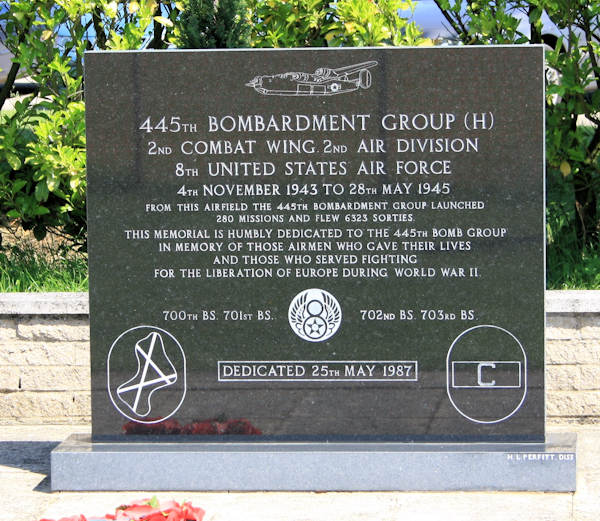
The 445th Bombardment Group (Heavy) was a B-24 Liberator unit of the Eighth Air Force assigned to the Second Air Division during World War II. From December 1943 until April 1945, the group carried out strategic daylight bombing operations against Germany and German-occupied Europe while operating from RAF Tibenham (USAAF Station 124) in Norfolk, England. Known throughout the Eighth Air Force as the "Vagabonds," the group earned a distinguished combat record through nearly eighteen months of continuous operations against some of the most heavily defended targets in Nazi Germany.
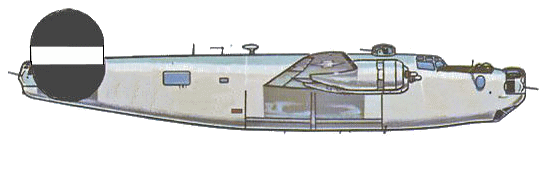
Flying the Consolidated B-24 Liberator, one of the most capable long-range heavy bombers of the war, the 445th Bombardment Group participated in virtually every major phase of the Allied strategic air offensive. Its crews attacked aircraft factories, oil refineries, marshaling yards, submarine installations, bridges, transportation networks, military airfields, and industrial centers that formed the backbone of Germany's war economy. In addition to strategic bombing, the group supported Allied ground forces during the Normandy invasion, Operation Market Garden, the Battle of the Bulge, and the final drive into Germany.
Although the 445th achieved numerous operational successes and received the Distinguished Unit Citation for extraordinary heroism during the attack on Gotha in February 1944, it is perhaps best remembered for the tragic Kassel Mission of 27 September 1944, one of the greatest single-mission losses suffered by any heavy bomber group of the United States Army Air Forces during World War II. The courage displayed by the officers and enlisted men of the group throughout both triumph and tragedy established the "Vagabonds" among the most respected B-24 organizations of the Second Air Division.
The history of the 445th Bombardment Group cannot be separated from the history of RAF Tibenham. The airfield became home to thousands of American airmen and support personnel whose combined efforts transformed a quiet Norfolk farming community into one of the Eighth Air Force's important heavy bomber stations. Every mission began and ended at Tibenham, making the station an essential part of the group's wartime story.
Organization and Training in the United States
The 445th Bombardment Group was activated on 1 April 1943 at Gowen Field, Idaho, under the command of Colonel Robert H. Terrill. Organized as a Heavy Bombardment Group equipped with Consolidated B-24 Liberators, the unit consisted of four flying squadrons:
Following activation, the group underwent intensive training designed to prepare both aircrews and ground personnel for the demanding strategic bombing campaign being waged over Europe. Pilots learned formation flying, instrument navigation, high-altitude bombing techniques, and long-range operations, while navigators, bombardiers, engineers, radio operators, and gunners practiced the specialized skills required aboard the B-24 Liberator.
Ground personnel trained simultaneously in aircraft maintenance, engine repair, armament, communications, logistics, transportation, medical support, and administrative operations. The success of every combat mission depended not only upon the aircrews but also upon the thousands of specialists responsible for keeping the aircraft combat ready.
Training continued at Wendover Field, Utah, one of the Army Air Forces' principal heavy bomber training bases. There the group refined formation tactics, practiced bombing and gunnery exercises, and conducted increasingly realistic combat simulations. During the summer of 1943 the 445th moved to Sioux City Army Air Base, Iowa, for final preparation before deployment overseass.
By the autumn of 1943 the officers and enlisted men of the 445th had developed into an effective combat organization capable of conducting long-range strategic bombing operations under some of the most demanding conditions of aerial warfare.
Deployment to England
Like other Eighth Air Force bomber groups, the 445th crossed the Atlantic by both air and sea. Aircraft were ferried through the northern trans-Atlantic route while many personnel traveled aboard troopships. After arriving in England during October and November 1943, the various elements of the group assembled at RAF Tibenham in Norfolk.
There the men received final orientation concerning European weather conditions, German fighter tactics, anti-aircraft defenses, emergency procedures over occupied territory, and the operational methods of the Eighth Air Force. Aircraft were modified for combat service, equipment was issued, and newly arrived crews became familiar with the station that would serve as their home for the remainder of the war.
RAF Tibenham — Home of the 445th Bombardment Group
RAF Tibenham, designated USAAF Station 124, was one of the permanent Class "A" heavy bomber airfields constructed in Norfolk as part of Britain's massive wartime expansion of Bomber Command. Although the location had previously been used as a Royal Flying Corps landing ground during the First World War, the modern wartime airfield was almost entirely rebuilt between 1941 and 1942 to accommodate the large four-engine bombers that would soon dominate the Allied strategic air offensive.
Before the station became operational, responsibility for the airfield was transferred to the United States Army Air Forces as American heavy bomber forces rapidly expanded throughout East Anglia. RAF Tibenham became one of dozens of bomber stations forming the extensive network from which the Eighth Air Force launched its daylight attacks against Nazi Germany.
Situated approximately ten miles south of Norwich amid the gently rolling farmland of Norfolk, Tibenham occupied an ideal location for assembling bomber formations over East Anglia before crossing the North Sea toward continental Europe. Its position allowed Liberator groups from throughout the Second Air Division to rendezvous efficiently before beginning the long flights into enemy territory.
The airfield was designed as a completely self-contained military installation capable of supporting more than 2,500 officers and enlisted personnel. In addition to flying operations, the station contained engineering facilities, communications centers, medical services, administrative offices, storage depots, transportation sections, recreational facilities, chapels, dining halls, and living accommodations. In many respects RAF Tibenham functioned as a small American town built almost overnight in the Norfolk countryside.
Construction and Airfield Layout
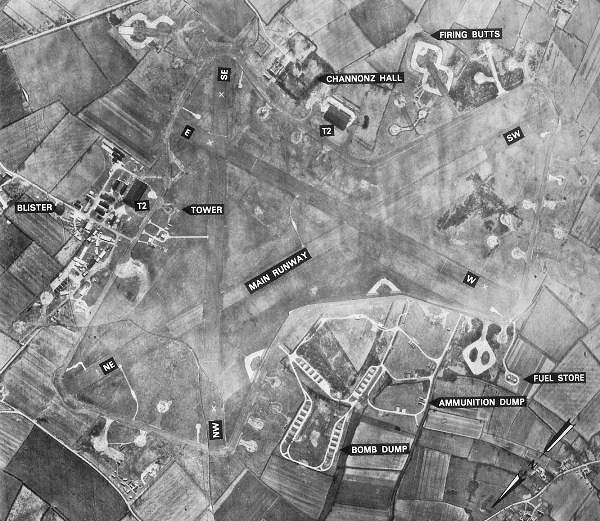
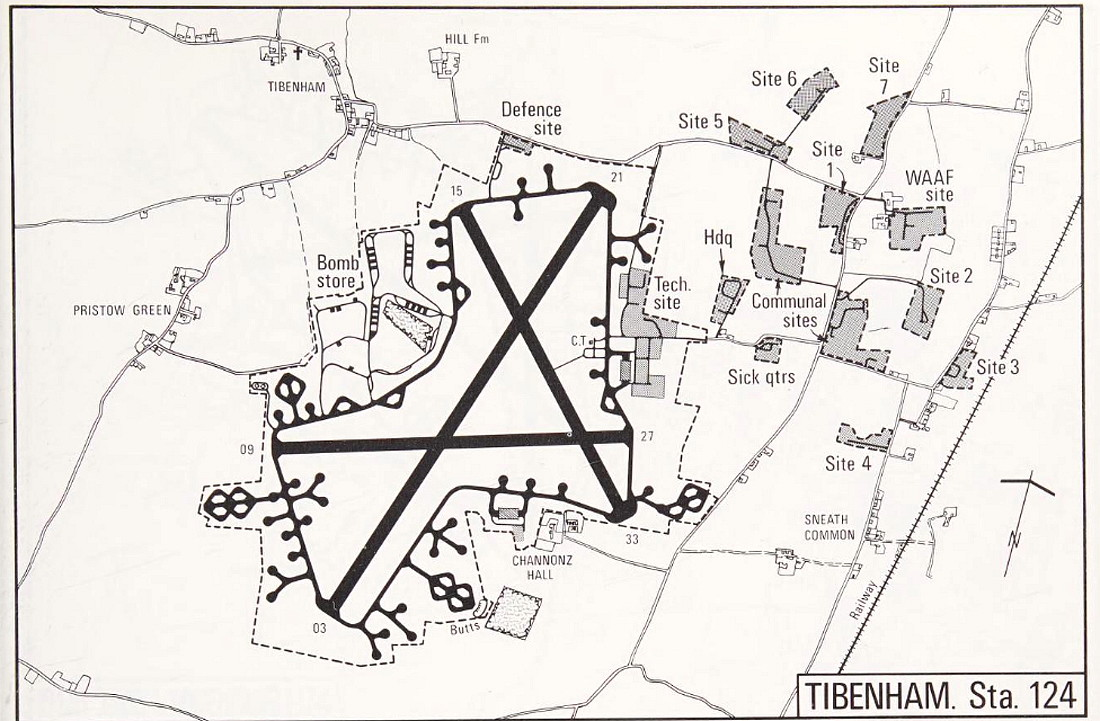
Like most permanent heavy bomber stations built for the Royal Air Force and later transferred to the USAAF, RAF Tibenham featured the standard Class "A" triangular runway layout. The principal runway measured approximately 6,000 feet in length, while two intersecting secondary runways each measured approximately 4,200 feet. This configuration allowed safe operations regardless of changing wind conditions while providing sufficient length for fully loaded B-24 Liberators carrying maximum bomb loads and fuel for missions lasting eight to ten hours or more.
Surrounding the flying field was a continuous perimeter taxiway that linked every dispersal area with the runways and technical site. Thirty-six frying-pan hardstands and fourteen loop dispersals were constructed around the perimeter, allowing dozens of bombers to be parked safely apart from one another. Earth revetments and natural tree cover reduced the danger of damage from enemy attack or accidental explosions while also providing maintenance crews room to service aircraft simultaneously.
Two large T-2 hangars dominated the technical area on the eastern side of the station. Here mechanics repaired battle damage, replaced engines, performed inspections, installed modifications, and prepared aircraft for their next combat missions. Nearby stood the control tower, operations building, communications center, engineering shops, armament sections, and supply warehouses that formed the operational heart of the airfield.
Bomb dumps and fuel storage installations were deliberately positioned away from the technical and domestic areas for safety. Thousands of bombs passed through these storage areas during the war before being transported to aircraft loading points adjacent to the dispersal hardstands. Aviation gasoline was likewise distributed throughout the station by protected refueling installations capable of servicing dozens of Liberators before each mission.
The domestic camps surrounding the airfield consisted primarily of Nissen huts and temporary wartime buildings housing officers and enlisted personnel. The camps contained mess halls, chapels, Red Cross clubs, Post Exchange facilities, recreation buildings, athletic fields, medical stations, and administrative offices. Although accommodations were often Spartan, these facilities provided welcome relief from the pressures of continuous combat operations.
By late 1943 RAF Tibenham had become a fully operational heavy bomber station, prepared to support one of the newest B-24 groups arriving in England. Within weeks, the quiet Norfolk countryside echoed daily with the roar of four-engine Liberators departing for occupied Europe, beginning a chapter in the history of RAF Tibenham that would continue until victory in Europe nearly eighteen months later.
Daily Life at RAF Tibenham
Life at RAF Tibenham quickly settled into the demanding rhythm common to every heavy bomber station of the Eighth Air Force. Although combat missions occupied only a portion of any given week, preparation for those missions never ceased. The station functioned around the clock as hundreds of specialists worked together to ensure that every B-24 Liberator was ready for combat. Pilots, navigators, bombardiers, engineers, radio operators, and gunners depended upon an equally dedicated force of mechanics, armorers, communications personnel, weather forecasters, transportation crews, intelligence officers, medical staff, cooks, clerks, and countless other support personnel whose work often went unnoticed but proved essential to every successful mission.
Mission days usually began long before sunrise. Aircrews were awakened in the early morning hours and gathered for breakfast before reporting to the operations building. There they received weather forecasts, intelligence briefings, route maps, target photographs, recognition information, and the latest reports concerning German fighter activity and anti-aircraft defenses. Only at these briefings did most crews learn the destination of the day's mission.
Following the briefing, crews collected parachutes, Mae West life preservers, heated flying suits, oxygen masks, emergency escape equipment, and classified navigation materials before climbing aboard their assigned aircraft. Meanwhile, thousands of pounds of bombs had already been loaded into the bomb bays while aviation gasoline, oxygen systems, ammunition, hydraulic systems, and engines were carefully inspected by maintenance crews.
As engines roared to life across the dispersal hardstands, RAF Tibenham became a scene of controlled activity. Ground crews completed final inspections, crew chiefs exchanged last-minute instructions with pilots, and aircraft taxied one after another onto the perimeter track before moving toward the active runway. Fully loaded B-24 Liberators, often weighing more than thirty tons, accelerated down the six-thousand-foot runway before lifting into the Norfolk sky. After takeoff, aircraft circled East Anglia while assembling into combat formations with other groups of the Second Air Division before beginning the long flight across the North Sea toward enemy territory.
The Arrival of Combat Operations
The 445th Bombardment Group officially entered combat on 13 December 1943 when it attacked the heavily defended German naval facilities and U-boat installations at Kiel. Like many newly arrived Eighth Air Force units, the group initially flew missions against targets in occupied Europe and northern Germany while crews gained valuable combat experience under the guidance of more seasoned organizations.
The first operations introduced the men of the 445th to the harsh realities of daylight strategic bombing. Long hours spent flying in freezing temperatures above 20,000 feet, constant vigilance against enemy fighters, heavy anti-aircraft fire, and the ever-present possibility of mechanical failure tested both the physical endurance and emotional resilience of every crew member.
Losses began almost immediately. Aircraft returned riddled with flak damage, engines destroyed, control surfaces damaged, and crew positions pierced by cannon shells and machine-gun fire. Other aircraft failed to return altogether. Empty hardstands around RAF Tibenham became painful reminders that friends who had departed together only hours earlier would never again taxi back onto the perimeter track.
James Stewart and the 703rd Bomb Squadron
Among the officers serving with the 445th Bombardment Group during its early combat operations was Major James M. Stewart, already internationally known as one of Hollywood's most successful actors. Unlike many celebrities whose wartime service remained largely stateside, Stewart insisted upon qualifying for combat duty and earning his place within the operational Eighth Air Force.
Assigned to the 703rd Bomb Squadron, Stewart initially served as Operations Officer before assuming command of the squadron. He participated in numerous combat missions over occupied Europe and Germany, demonstrating exceptional professionalism, calm leadership, and genuine concern for the men under his command. Fellow officers and enlisted personnel soon came to respect Stewart not because of his fame but because he willingly shared the same dangers faced by every combat aircrew member.
In March 1944 Stewart transferred to the 453rd Bombardment Group, where he continued flying combat missions and eventually rose to higher command within the Eighth Air Force. His service with the 445th nevertheless formed an important chapter in both his distinguished military career and the history of the "Vagabonds."
The Combined Bomber Offensive
Throughout the winter of 1943-1944 the 445th Bombardment Group became fully integrated into the Combined Bomber Offensive, the joint American and British strategic air campaign designed to destroy Germany's industrial capacity and undermine its ability to continue the war. While the Royal Air Force generally attacked by night, the Eighth Air Force struck by daylight, allowing greater bombing accuracy against carefully selected industrial objectives.
Flying from RAF Tibenham, the Liberators of the 445th attacked a wide variety of strategic targets throughout Germany and occupied Europe. Aircraft factories producing Messerschmitt and Focke-Wulf fighters became frequent objectives, as did synthetic oil plants, chemical works, ball-bearing factories, locomotive repair shops, marshalling yards, canals, bridges, power stations, and military airfields.
Major industrial centers such as Berlin, Bremen, Brunswick, Hamm, Kassel, Kiel, Ludwigshafen, Munich, Münster, Osnabrück, and numerous transportation hubs repeatedly appeared on mission schedules. Every successful bombing mission reduced Germany's ability to manufacture aircraft, transport troops, refine fuel, or supply front-line armies.
The missions themselves demanded extraordinary discipline. Formations often remained airborne for eight to ten hours while flying hundreds of miles into enemy territory. Crews endured temperatures reaching forty degrees below zero, relied upon oxygen equipment to remain conscious at high altitude, and remained constantly alert for attacks from German fighters approaching from every direction.
German Defenses
By early 1944 German air defenses had become increasingly sophisticated. Long before bomber formations reached their targets, radar stations tracked their progress while fighter controllers directed intercepting aircraft into position. Experienced Luftwaffe pilots attacked from the front, rear, above, and below, frequently using heavily armed Messerschmitt Bf 109s, Focke-Wulf Fw 190s, and twin-engine Messerschmitt Bf 110 destroyers equipped with rockets and heavy cannon.
Equally dangerous was Germany's extensive anti-aircraft artillery system. Heavy flak batteries defended nearly every important industrial center, filling the skies with accurately aimed bursts of exploding shells. Pilots often described flying through solid walls of black smoke as hundreds of shells burst simultaneously around tightly packed bomber formations. Even aircraft escaping direct hits frequently suffered damage from shell fragments capable of piercing engines, fuel tanks, hydraulic lines, or flight controls.
Despite these dangers, formation discipline remained one of the bomber crews' greatest defenses. Individual aircraft relied upon overlapping fields of machine-gun fire from neighboring bombers to discourage fighter attacks. Every crew understood that remaining in formation offered the greatest chance of survival, even when aircraft sustained serious battle damage.
Big Week
During 20-25 February 1944, the Eighth Air Force launched one of the most significant air offensives of the European war. Known as Big Week, the operation concentrated hundreds of heavy bombers against Germany's aircraft manufacturing industry in an effort to destroy both production facilities and the Luftwaffe itself.
The 445th Bombardment Group participated in these historic operations only weeks after entering combat. On 24 February 1944 the group attacked the Messerschmitt Bf 110 aircraft assembly plant at Gotha despite intense anti-aircraft fire and determined attacks by large numbers of German fighters.
The cost proved devastating. Of the twenty-five B-24 Liberators dispatched against the target, thirteen failed to return. More than one hundred twenty officers and enlisted men were killed, wounded, or captured. Despite suffering one of the highest loss rates experienced by any Eighth Air Force bomber group on a single mission, the surviving crews maintained formation, pressed through overwhelming opposition, and accurately bombed their assigned objective.
For its extraordinary courage, determination, and devotion to duty under exceptionally hazardous conditions, the 445th Bombardment Group received the Distinguished Unit Citation. The award recognized not simply successful bombing accuracy but the willingness of the crews to continue the attack despite losses that might easily have caused less experienced organizations to abandon the mission.
The Gotha mission became one of the defining moments in the history of the 445th Bombardment Group. It demonstrated that the relatively new organization had matured into one of the Eighth Air Force's capable combat units and established a reputation for determination that would remain with the "Vagabonds" throughout the remainder of the war.
Replacement B-24 Liberators soon arrived at RAF Tibenham together with newly trained aircrews from the United States. Veteran personnel who had survived Kassel assumed the responsibility of helping these newcomers prepare for combat while preserving the operational experience that the group had accumulated during nearly a year of continuous warfare.
Although rebuilding required time, the 445th quickly resumed strategic bombing missions against Germany. The determination displayed by the officers and enlisted men following Kassel reflected the professionalism that had characterized the group since its arrival in England.
The Battle of the Bulge
During December 1944 Germany launched its final major offensive in the Ardennes Forest, creating the Battle of the Bulge. Once weather conditions improved, the Eighth Air Force shifted many of its heavy bombers toward tactical operations supporting Allied ground forces.
The 445th Bombardment Group attacked bridges, transportation centers, supply depots, rail junctions, ammunition dumps, and troop concentrations behind German lines. These strikes disrupted enemy logistics, slowed reinforcements, and contributed significantly to the eventual defeat of the German offensive.
The Final Air Offensive
During the closing months of the European war the Liberators of the 445th returned increasingly to strategic targets throughout Germany. Oil refineries, synthetic fuel plants, railroad centers, bridges, marshalling yards, communications facilities, and military industries remained principal objectives as Allied armies crossed the Rhine and advanced deep into the German heartland.
By early 1945 the Luftwaffe had been largely defeated, although anti-aircraft artillery continued to present a significant danger. Increasing numbers of missions encountered relatively little fighter opposition, reflecting Germany's rapidly declining military capability and the overwhelming Allied control of the skies.
As the Third Reich collapsed, the group also participated in humanitarian and logistical operations. These included Operation Chowhound, during which food supplies were dropped to starving civilians in the occupied Netherlands, as well as ammunition deliveries to airborne forces, transportation of aviation fuel, and leaflet missions encouraging German surrender.
The 445th Bombardment Group flew its final combat mission on 25 April 1945 against railroad marshalling yards at Salzburg, Austria. Less than two weeks later, Germany surrendered unconditionally on 8 May 1945, bringing the European air war to its successful conclusion.
Victory in Europe
When Germany surrendered on 8 May 1945, the men of the 445th Bombardment Group had completed nearly eighteen months of continuous combat operations from RAF Tibenham. The victory came at an enormous cost. Hundreds of officers and enlisted men who had trained together in the United States never returned home, while many others carried the physical and emotional scars of aerial combat for the remainder of their lives. Nevertheless, the group had fulfilled every assignment given to it and contributed significantly to the Allied victory in Europe.
During the final weeks of the war, flying operations at RAF Tibenham rapidly declined. Aircraft that had departed almost daily for Germany now remained parked on the dispersal hardstands while crews completed administrative duties, packed equipment, and prepared for the long journey home. The atmosphere around the station changed dramatically. The tension that had dominated daily life since December 1943 gave way to anticipation as men looked forward to seeing their families after years of military service.
Combat Record
From its first combat mission on 13 December 1943 until its final operation on 25 April 1945, the 445th Bombardment Group established an impressive operational record. Flying approximately 280 combat missions, the group attacked strategic objectives throughout Germany and German-occupied Europe while participating in nearly every major phase of the Allied strategic bombing campaign.
The group's targets reflected the changing priorities of the Combined Bomber Offensive. During different phases of the war, Liberators from RAF Tibenham attacked:
Among the many cities attacked were Berlin, Bremen, Brunswick, Gotha, Hamm, Kassel, Kiel, Ludwigshafen, Munich, Münster, Osnabrück, Politz, Rostock, Salzburg, and numerous industrial centers throughout Germany, France, Belgium, the Netherlands, and Austria.
The 445th also supported major Allied campaigns including the Normandy invasion, the liberation of France, Operation Market Garden, the Battle of the Bulge, the crossing of the Rhine, and the final advance into Germany. These operations demonstrated the remarkable flexibility of the Eighth Air Force, whose heavy bombers successfully shifted between strategic bombing and direct tactical support as battlefield conditions required.
Decorations and Honors
The courage and effectiveness of the 445th Bombardment Group received official recognition from both the United States and Allied governments.
The group earned the Distinguished Unit Citation (DUC) for extraordinary heroism during the attack against the Messerschmitt aircraft factory at Gotha on 24 February 1944. Despite overwhelming fighter opposition and intense anti-aircraft fire, the crews pressed their attack with exceptional determination, successfully bombing the target while suffering devastating losses.
In recognition of its contribution to the liberation of France, the French government awarded the group the Croix de Guerre with Palm. This decoration honored the sacrifices made by the officers and enlisted men who supported Allied ground operations during the liberation of Western Europe.
The group participated in the following officially recognized campaigns:
Return to the United States
Following Germany's surrender, preparations began for the return of the 445th Bombardment Group to the United States. Aircraft were inspected, equipment inventoried, and many of the B-24 Liberators were ferried back across the Atlantic or transferred to other organizations. Personnel who had served overseass for many months boarded troopships or military transport aircraft for the journey home.
The group assembled at Sioux Falls Army Air Field, South Dakota, where the rapid post-war demobilization of the United States Army Air Forces was already underway. Thousands of wartime personnel were released from military service as the nation shifted from wartime mobilization to peacetime recovery.
On 12 September 1945, the 445th Bombardment Group was officially inactivated. Although its wartime service had ended, the achievements and sacrifices of the "Vagabonds" had secured the group's place among the distinguished heavy bombardment organizations of the Eighth Air Force.
RAF Tibenham After the War
Following the departure of American personnel during the summer of 1945, RAF Tibenham was returned to the Royal Air Force. Unlike several wartime bomber stations that later became active Cold War bases, Tibenham was no longer required for large-scale military flying operations. The station entered a period of care and maintenance before gradually being declared surplus to military requirements.
Many temporary wartime buildings were dismantled or sold, while others found new civilian uses. Barracks, workshops, and storage buildings were adapted for agriculture or local industry. As the years passed, much of the surrounding land returned to farming, restoring the peaceful Norfolk countryside that had existed before the arrival of thousands of American servicemen.
Although much of the station disappeared, substantial portions of the wartime infrastructure survived. Long stretches of concrete runway, sections of the perimeter taxiway, aircraft dispersal hardstands, access roads, and foundations remain visible today. These surviving features provide an excellent example of a World War II Class "A" heavy bomber station and allow visitors to appreciate the immense scale of Eighth Air Force operations.
Parts of the former airfield have since been adapted for light aviation, gliding activities, motor sports, and other civilian uses while preserving much of the wartime layout. Visitors can still trace the original runway system and visualize the countless B-24 Liberators that once departed from RAF Tibenham on missions over occupied Europe.
Remembering the Men of the 445th
Following the war, veterans of the 445th Bombardment Group established reunion organizations that brought together former pilots, navigators, bombardiers, engineers, radio operators, gunners, mechanics, and ground personnel. These reunions allowed old friends to renew friendships, remember fallen comrades, exchange photographs and documents, and preserve personal memories that otherwise might have been lost.
As the wartime generation grew older, families increasingly assumed responsibility for preserving the history of the group. Letters, diaries, mission logs, photographs, uniforms, medals, and personal artifacts were donated to museums, archives, and historical organizations, ensuring that future generations could better understand the experiences of the men who served with the "Vagabonds."
Historians have also benefited from the continued release and digitization of wartime records, including Missing Air Crew Reports (MACRs), Individual Deceased Personnel Files (IDPFs), loading lists, mission reports, combat narratives, and squadron records. These invaluable sources continue to provide new information regarding individual airmen, aircraft, and missions.
The Legacy of the Kassel Mission
No event has received more attention from historians than the Kassel Mission of 27 September 1944. Researchers in both the United States and Europe have spent decades identifying crash sites, interviewing survivors, documenting individual crews, and locating the resting places of those who lost their lives.
Numerous memorials now stand throughout Germany, Belgium, the Netherlands, France, and England honoring the crews who participated in that mission. Family members continue to visit former battlefields and cemeteries while local communities maintain memorials dedicated to the American airmen who sacrificed their lives in the cause of freedom.
Although Kassel remains the defining tragedy in the history of the 445th Bombardment Group, it should never overshadow the group's broader accomplishments. For nearly eighteen months the "Vagabonds" flew dangerous missions deep into enemy territory, helping destroy Germany's industrial capacity, reducing oil production, crippling transportation systems, and supporting the liberation of occupied Europe.
Preserving the History of RAF Tibenham and the 445th Bombardment Group
Today the history of RAF Tibenham and the 445th Bombardment Group continues to be preserved through the dedicated efforts of museums, archives, veterans' organizations, aviation historians, local preservation groups, and descendants of those who served. Memorial ceremonies held at the former airfield and throughout Norfolk ensure that the contributions of the American airmen remain an enduring part of the region's history.
The surviving runways and dispersal areas provide tangible reminders of one of the Second Air Division's important heavy bomber stations. Standing beside the remaining concrete, visitors can still imagine the early morning roar of four Pratt & Whitney engines as Liberators accelerated toward the runway and disappeared into the English sky bound for occupied Europe.
Equally important are the stories of the men themselves. The officers and enlisted personnel of the 445th Bombardment Group represented every region of the United States. Most were in their late teens or early twenties when they found themselves engaged in one of history's greatest aerial campaigns. Their courage, teamwork, professionalism, and willingness to place duty above personal safety became hallmarks of the Eighth Air Force.
Legacy of the "Vagabonds"
The history of the 445th Bombardment Group is one of extraordinary courage, sacrifice, and perseverance. From its activation in Idaho to its final mission over Austria, the group demonstrated the qualities that made the Eighth Air Force one of the decisive military forces of the Second World War. Flying from RAF Tibenham, the "Vagabonds" participated in the systematic destruction of Germany's military and industrial infrastructure while supporting Allied armies as they liberated Western Europe and advanced toward final victory.
The names of those who never returned remain forever linked with RAF Tibenham and the skies over Europe. Their sacrifice helped secure the freedoms enjoyed by subsequent generations and serves as a lasting reminder of the tremendous human cost of war.
Today, through continued research, education, preservation, and remembrance, the story of the 445th Bombardment Group lives on. The surviving records, memorials, museums, restored aircraft, and historic sites ensure that the achievements of the "Vagabonds" and the thousands of men who served at RAF Tibenham will never be forgotten. Their legacy remains an enduring chapter in the history of the Second Air Division, the Eighth Air Force, and the United States Army Air Forces during World War II.

445th Bomb Group Roll of Honor: Roll of Honor
Oversea Burials 445th Bomb Group Oversea Burials