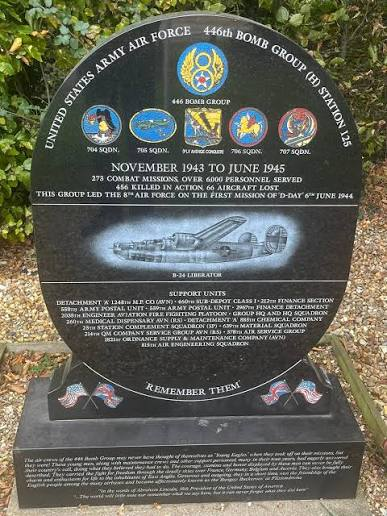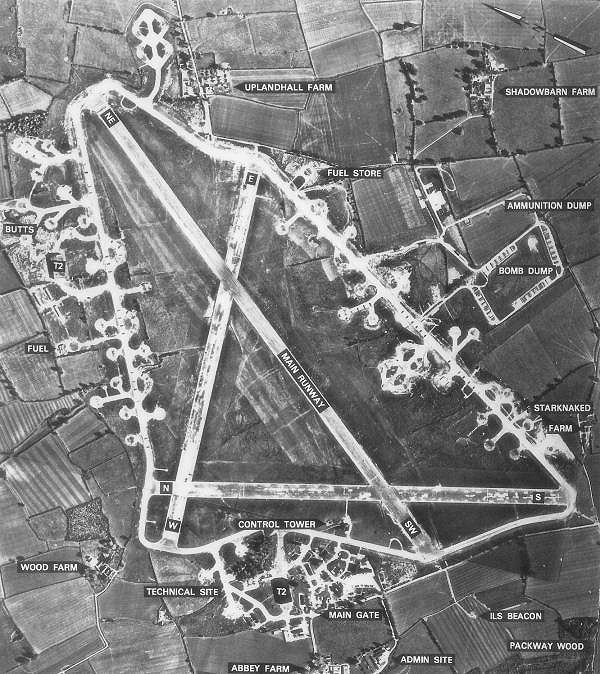

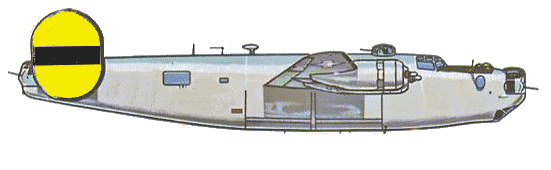
RAF Bungay, officially designated USAAF Station 125, was one of the principal B-24 Liberator bases operated by the United States Army Air Forces in eastern England during World War II. Although named for the nearby market town of Bungay, the airfield was situated closer to the village of Flixton, Suffolk, near the Norfolk border.
From late 1943 until the end of the war in Europe, RAF Bungay served as the home of the 446th Bombardment Group (Heavy), a unit of the Eighth Air Force assigned to the 20th Combat Bombardment Wing of the Second Bombardment Division, later renamed the Second Air Division. The group’s aircrews and ground personnel participated in the strategic bombing offensive against Germany, supported Allied ground operations, delivered supplies to airborne forces, and helped prepare the way for the liberation of Western Europe.
The 446th adopted the nickname “Bungay Buckaroos,” reflecting both its wartime home in Suffolk and the western American character associated with the group. The name came to symbolize the pride, determination, and close fellowship that developed among the thousands of men who served at Station 125.
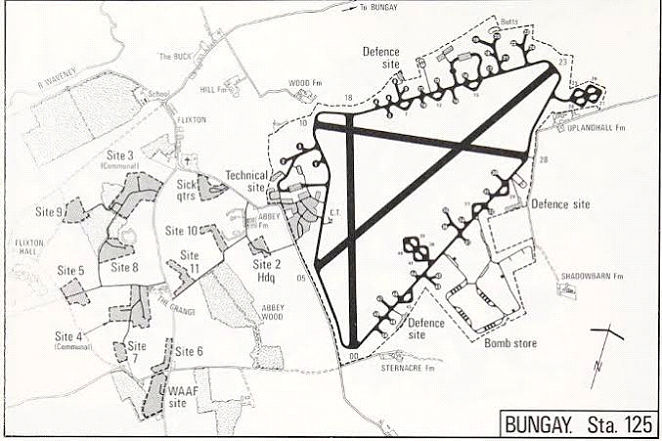
Location of the Airfield
RAF Bungay occupied a broad plateau overlooking the Waveney Valley along the Suffolk-Norfolk border. The airfield was located approximately two to three miles southwest of Bungay and immediately north of the village of Flixton.
The relatively level terrain provided suitable conditions for the construction of a heavy bomber station. Its position in East Anglia also allowed aircraft to join the large bomber assembly routes that formed over the English countryside before crossing the North Sea toward occupied Europe and Germany.
Although the official name “RAF Bungay” appeared in military records, the station was frequently called Flixton by local residents and by many of the American servicemen stationed there.
Construction and Early Development
Construction of RAF Bungay began in 1942 as part of the British Air Ministry’s wartime airfield expansion program. The principal contractor was Kirk & Kirk Ltd. The station was initially planned as a satellite airfield for nearby RAF Hardwick, but changing operational requirements resulted in its completion as an independent Class “A” heavy bomber station.
Class “A” airfields were designed to support sustained operations by four-engine heavy bombers. RAF Bungay therefore required long concrete runways, an extensive perimeter taxiway, dispersed aircraft parking areas, maintenance hangars, technical buildings, fuel installations, bomb-storage areas, communications facilities, and numerous domestic camps.
During its early development, portions of the unfinished station were reportedly used in connection with experimental American intruder operations involving B-25 Mitchells and B-24 Liberators. These low-level nighttime operations were sometimes called “Moleing” missions.
By late 1943, the airfield had been assigned to the United States Army Air Forces and designated Station 125. The quiet agricultural landscape around Flixton was transformed into a large military installation capable of accommodating dozens of heavy bombers and several thousand American personnel.
Runway System
RAF Bungay followed the standard triangular layout used for permanent British heavy bomber airfields. Three intersecting concrete runways allowed aircraft to take off and land under varying wind conditions.
The runways were built to withstand the weight of fully loaded B-24 Liberators carrying fuel, ammunition, bombs, and crews on missions that sometimes extended deep into Germany.
A continuous concrete perimeter track, approximately 50 feet wide, connected the runways with the aircraft dispersals, technical site, maintenance areas, fueling points, and bomb-loading facilities. This system allowed large numbers of aircraft to move around the station without interfering with takeoff and landing operations.
Aircraft Dispersals and Hangars
Approximately 50 concrete aircraft hardstands were distributed around the perimeter track. These included frying-pan and loop-type dispersals that allowed the Liberators to be parked separately rather than concentrated in one area.
The dispersed arrangement reduced the possibility that an enemy attack, fire, or accidental explosion could destroy several aircraft at once. Trees, hedgerows, camouflage, and earthen protective works helped conceal portions of the airfield and provided additional protection.
Two large prefabricated T-2 steel hangars were constructed for major inspections, structural repairs, engine changes, and aircraft modifications. Routine servicing was often performed outdoors at the dispersal sites, where ground crews worked in darkness, cold, rain, and snow to keep the bombers operational.
Technical and Domestic Sites
The technical site formed the operational center of Station 125. It contained the control tower, operations rooms, engineering shops, communications center, intelligence offices, weather station, parachute section, administrative offices, armament facilities, and other buildings necessary to direct flying operations.
The bomb-storage area and fuel installations were positioned away from the domestic camps for safety. Dedicated service roads connected these installations with the aircraft dispersals, allowing armorers and fuel crews to prepare numerous Liberators at the same time.
Because of the danger posed by bombs, ammunition, and aviation fuel, these areas were carefully separated and protected. Bombs were stored in specialized areas until they were transported to the aircraft and loaded before a mission.
The personnel stationed at RAF Bungay lived in several dispersed domestic sites surrounding the flying field. Officers and enlisted men were housed primarily in Nissen huts and other temporary wartime buildings.
The camps included mess halls, recreation buildings, chapels, medical facilities, bathhouses, workshops, athletic areas, administrative offices, and Post Exchange facilities. Separate accommodations were provided for Women’s Auxiliary Air Force personnel and other British staff assigned to the station.
Formation of the 446th Bombardment Group
The 446th Bombardment Group was activated in the United States during April 1943. Its early stations included Davis-Monthan Field, Arizona, and Lowry Field, Colorado, where personnel trained and prepared for overseass deployment.
The group consisted of four operational bombardment squadrons:
The air echelon traveled to England with its B-24 Liberators, while much of the ground echelon crossed the Atlantic by ship. The group reached England during October and November 1943 and began occupying RAF Bungay.
Once assembled at Station 125, the crews began local orientation flights, formation exercises, gunnery preparation, communications checks, and training in the procedures used by the Eighth Air Force. Ground personnel organized the maintenance, armament, transportation, supply, and administrative systems necessary to support combat operations.
First Combat Mission
The 446th Bomb Group flew its first combat mission on 16 December 1943, attacking Bremen, Germany. This marked the beginning of approximately sixteen months of sustained combat operations from RAF Bungay.
The early missions introduced the crews to the dangers of the air war over Europe. They faced heavy antiaircraft fire, enemy fighters, poor visibility, icing, mechanical failures, navigational problems, and the difficulty of maintaining tight formations at high altitude.
Missions frequently lasted eight hours or longer. Crews operated in extreme cold while breathing oxygen and wearing heated clothing. Ground crews then worked through the night to repair battle damage and prepare the aircraft for another mission.
The Strategic Bombing Campaign
The 446th operated primarily as a strategic bombardment organization. Its Liberators attacked military and industrial targets throughout Germany and German-occupied Europe.
Major targets included U-boat installations at Kiel, port facilities at Bremen, chemical works at Ludwigshafen, synthetic oil facilities at Politz, ball-bearing works in Berlin, aero-engine plants at Rostock, aircraft factories at Munich, motor works at Ulm, oil refineries at Hamburg, and marshaling yards at Coblenz.
The group also attacked military airfields, bridges, ammunition depots, railway centers, communications facilities, fuel-storage areas, and transportation networks supporting the German armed forces.
These missions formed part of the Combined Bomber Offensive. By striking aircraft production, petroleum facilities, transportation systems, and other military industries, the Allied air forces sought to weaken Germany’s ability to maintain its armed forces in the field.
Big Week and the Gotha Mission
From 20 through 25 February 1944, the Eighth Air Force conducted a concentrated series of attacks against the German aircraft industry known as Big Week. The objective was to reduce German aircraft production and force the Luftwaffe into combat with increasingly powerful formations of American fighters.
The 446th Bomb Group participated in this major offensive. On 24 February 1944, the group attacked the aircraft manufacturing facilities at Gotha, Germany.
The mission was flown under extremely difficult conditions and against determined enemy opposition. For its performance in the attack on Gotha, the 446th Bombardment Group received a Distinguished Unit Citation.
Big Week contributed to the gradual weakening of German fighter strength and helped the Allies gain the air superiority needed for the invasion of Western Europe.
Daily Operations at Station 125
On combat days, activity at RAF Bungay began many hours before takeoff. Intelligence and weather officers studied the assigned target, anticipated enemy defenses, forecast cloud conditions, and prepared maps and briefing materials.
Aircrews attended mission briefings where the target was revealed and the route, formation, altitude, defenses, weather, emergency procedures, and alternate targets were discussed.
Meanwhile, ground personnel fueled the aircraft, loaded bombs and ammunition, inspected engines, tested radios, checked oxygen systems, examined flight controls, and completed final maintenance work.
When preparations were complete, the Liberators moved from their dispersals onto the perimeter track. Aircraft took off at carefully timed intervals and climbed toward designated assembly areas over East Anglia.
After returning, the crews were transported to interrogation rooms where intelligence officers recorded information about the target, enemy fighters, antiaircraft fire, weather, bombing results, and missing aircraft.
Ground crews immediately inspected the bombers. Flak holes were patched, engines replaced, weapons serviced, hydraulic systems repaired, and damaged control surfaces restored. The coordinated work of aircrews and support personnel allowed the station to maintain an exceptionally demanding operational schedule.
Preparation for the Normandy Invasion
As the planned invasion of France approached, the 446th increasingly attacked targets connected with German transportation and coastal defenses. Bridges, railways, airfields, road junctions, gun positions, and communications centers were bombed to delay the movement of German reinforcements toward the invasion area.
These missions represented a change from the group’s earlier concentration on distant industrial objectives. Strategic bombing continued, but the Liberators were increasingly used to support the Allied armies preparing to return to continental Europe.
D-Day—6 June 1944
RAF Bungay occupies a particularly important place in Second Air Division history because the 446th Bomb Group led the division’s heavy bomber formations during the opening phase of the Normandy invasion on 6 June 1944.
During the early morning hours of D-Day, Liberators departed Station 125 to attack German coastal defenses and other military objectives near the invasion area. The bombers operated ahead of or in support of Allied forces approaching the Normandy beaches.
Poor visibility and extensive cloud cover complicated many of the bombing operations. Despite these difficulties, the missions formed part of the enormous combined air, land, and naval operation intended to suppress German positions and prevent the rapid movement of reinforcements.
The sight and sound of the 446th’s Liberators taking off from Bungay during the early hours of 6 June became one of the most remembered events in the history of the station.
Support of Allied Ground Forces
Following the invasion, the 446th continued attacking transportation centers, bridges, airfields, strongpoints, gun batteries, troop concentrations, and supply facilities throughout France.
During July 1944, the group supported Allied operations near Caen and St. Lô. These attacks were intended to weaken German defenses and assist the American breakout from the Normandy beachhead.
The group also participated in operations connected with the Allied advance across France, including attacks on rail lines and road networks used by retreating German forces.
Operation Market Garden
In September 1944, the 446th demonstrated the versatility of the B-24 by participating in supply operations connected with Operation Market Garden.
Rather than carrying bombs, the Liberators delivered urgently needed supplies to Allied airborne troops operating near Nijmegen in the Netherlands. These missions required the large bombers to fly at lower altitudes than those normally used during strategic bombing operations.
Low-altitude supply missions exposed the aircraft to concentrated ground fire and presented unusual hazards to crews accustomed to operating in high-altitude bomber formations.
Luftwaffe Attack on RAF Bungay
Although large German attacks against East Anglian airfields became less frequent during 1944, Station 125 did experience enemy action.
At approximately 2:14 a.m. on 28 June 1944, bombs dropped by a Luftwaffe aircraft exploded south of the station’s fuel-storage installation and between aircraft hardstands 30 and 31.
Later that morning, when the crew assigned to the B-24 Tail Wind arrived for its mission, ground personnel were still clearing mud and debris from the aircraft’s wings.
No casualties were reported and the damage was limited. Normal flying operations were able to continue.
The Battle of the Bulge
During December 1944 and January 1945, the 446th supported Allied forces during the Battle of the Bulge. Winter weather frequently restricted air operations, but when conditions improved, American bombers attacked German transportation and supply systems.
The group bombed marshaling yards, bridges, road junctions, rail networks, and transportation centers in an effort to slow the movement of German troops, fuel, ammunition, and equipment into the Ardennes battle area.
These missions helped disrupt the German counteroffensive and supported the Allied armies as they regained lost territory.
Operation Varsity and the Rhine Crossing
In March 1945, the 446th participated in operations supporting the Allied crossing of the Rhine and the airborne assault known as Operation Varsity.
The group again used its Liberators as supply aircraft, dropping food, ammunition, and equipment to Allied airborne and ground forces operating near Wesel, Germany.
At the same time, the group continued bombing German railways, bridges, industrial facilities, and transportation centers as Allied armies advanced deeper into Germany.
The Loss of Colonel Troy W. Crawford
One of the most unusual incidents in the group’s history occurred on 4 April 1945. Colonel Troy W. Crawford, the commanding officer of the 446th Bomb Group, was flying as an observer aboard a Royal Air Force de Havilland Mosquito piloted by Lieutenant Theodore B. Smith.
The Mosquito approached a formation of 446th Bomb Group B-24s and was mistakenly identified as a hostile aircraft. A Liberator opened fire and shot down the Mosquito.
The incident occurred during a period when bomber crews had been warned to remain alert for German aircraft using deceptive markings, unusual tactics, or aircraft silhouettes that could be confused with Allied types.
Colonel Crawford and Lieutenant Smith successfully bailed out but landed in German-held territory and were captured. Both became prisoners of war. Crawford remained in captivity until advancing Allied forces liberated the prison camp during the closing weeks of the war.
Final Combat Mission
The 446th Bomb Group flew its final combat mission on 25 April 1945, attacking a bridge near Salzburg, Austria. It was among the final strategic objectives attacked by the Eighth Air Force before the end of hostilities in Europe.
Germany surrendered in May 1945. After the fighting ended, the group remained at RAF Bungay for several weeks while personnel and aircraft were prepared for redeployment.
The group departed England during the summer of 1945 and returned to the United States, where it was inactivated later that year.
Combat Record
During its wartime service, the 446th Bombardment Group flew 273 combat missions. Its operations included strategic bombing, tactical support, interdiction, airborne resupply, and missions supporting major Allied ground campaigns.
The group was credited with destroying approximately 90 enemy aircraft in the air and on the ground. It lost 86 B-24 Liberators in combat and non-combat operations. Hundreds of its airmen were killed, wounded, missing, or taken prisoner.
The group participated in the following campaigns:
The 446th Bombardment Group received a Distinguished Unit Citation for its mission against Gotha, Germany, on 24 February 1944.
Commanding Officers
Postwar History of RAF Bungay
After the 446th Bomb Group left England, Station 125 was returned to British control. For a short period, the station was transferred to the Royal Navy and commissioned as HMS Europa II before reverting to Royal Air Force control.
As Britain reduced its military establishment following the war, RAF Bungay was placed under care and maintenance. Flying activity gradually declined, and many temporary buildings were removed during the late 1940s and early 1950s.
Parts of the domestic and technical sites were adapted for agricultural, industrial, or commercial use. The airfield officially closed in 1955, and much of the former flying field was eventually returned to farming.
Although many buildings disappeared, substantial sections of the concrete runways, perimeter track, service roads, and aircraft dispersals survived.
The Airfield Today
Today, much of the former RAF Bungay airfield is used for agriculture and commercial farming, including poultry and mushroom production. Nevertheless, the wartime outline of the station can still be identified across the landscape.
The nearby Norfolk and Suffolk Aviation Museum at Flixton preserves aircraft, vehicles, photographs, documents, artifacts, and displays associated with the airfield and the air war over Europe. Its collections help explain the history of RAF Bungay and the experiences of the American personnel stationed there.
A memorial near St. Mary’s Church honors the men of the 446th Bomb Group who served from RAF Bungay, particularly those who made the ultimate sacrifice.
Legacy of the Bungay Buckaroos
RAF Bungay and the 446th Bombardment Group made an important contribution to the Allied victory in Europe. From Station 125, the Bungay Buckaroos attacked German aircraft factories, petroleum facilities, ports, transportation systems, military installations, and industrial targets.
The group also supported the Normandy invasion, the Allied advance across France, Operation Market Garden, the Battle of the Bulge, the Rhine crossing, and the final campaign into Germany.
The history of RAF Bungay is not limited to the aircraft that flew from its runways. It is also the story of the pilots, navigators, bombardiers, radio operators, engineers, gunners, armorers, mechanics, medical personnel, intelligence officers, clerks, drivers, cooks, and countless other individuals whose combined efforts kept the station operating.
Veterans, families, local historians, museums, and preservation organizations continue to preserve the records, artifacts, surviving structures, and personal stories associated with RAF Bungay and the 446th Bombardment Group.
More than eighty years after the Second World War, the remaining airfield landscape, museum collections, memorials, photographs, and written records ensure that the service and sacrifice of the Bungay Buckaroos will continue to be remembered.

446th Bomb Group Roll of Honor: Roll of Honor
Oversea Burials 446th Bomb Group Oversea Burials