
Formation of the 448th Bombardment Group
The 448th Bombardment Group (Heavy) was one of the B-24 Liberator groups of the United States Army Air Forces' Eighth Air Force and Second Air Division during World War II. Operating from RAF Seething in Norfolk, England, the group flew daylight bombing missions against Germany and German-occupied Europe from December 1943 until April 1945. Its crews attacked aircraft factories, oil refineries, submarine facilities, transportation centers, military airfields, chemical works, V-weapon installations, and many other targets essential to the German war effort.
The group was constituted on 6 April 1943 and activated on 1 May 1943 at Gowen Field near Boise, Idaho. Colonel James McK. Thompson became its first commanding officer. The original combat organization consisted of the 712th, 713th, 714th, and 715th Bombardment Squadrons. Each squadron brought together flight crews, maintenance specialists, armorers, radio technicians, clerks, cooks, medical personnel, and the many other men required to keep a heavy bombardment unit operating.
Initial cadres and aircrews passed through the Army Air Forces School of Applied Tactics at Orlando, Florida, and then assembled at Gowen Field. The group moved to Wendover Field, Utah, during July 1943 for further operational training and later to Sioux City Army Air Base, Iowa, for its final phase of preparation. Training included formation flying, long-range navigation, aerial gunnery, high-altitude bombing, radio procedure, aircraft recognition, emergency drills, and the maintenance of the Consolidated B-24 Liberator under field conditions.
The B-24 was a powerful but demanding four-engine heavy bomber. It could carry a substantial bomb load over long distances and was well suited to the strategic campaign being conducted from England. Its crew normally included a pilot, copilot, navigator, bombardier, radio operator, engineer, and several aerial gunners. Success depended upon every member of the crew performing his duties under extreme cold, low oxygen, enemy fighter attack, anti-aircraft fire, and the physical and mental strain of missions lasting many hours.
Construction of RAF Seething, 1942–1943
While the 448th was being organized and trained in the United States, its future combat base was taking shape in the Norfolk countryside. RAF Seething was constructed during 1942 and 1943 across farmland within the parishes of Seething, Mundham, and Hedenham, approximately ten miles southeast of Norwich. John Laing & Son Ltd. served as the principal construction contractor. Fields, hedgerows, drainage ditches, and rural lanes were transformed into a major military installation designed to accommodate four-engine heavy bombers.
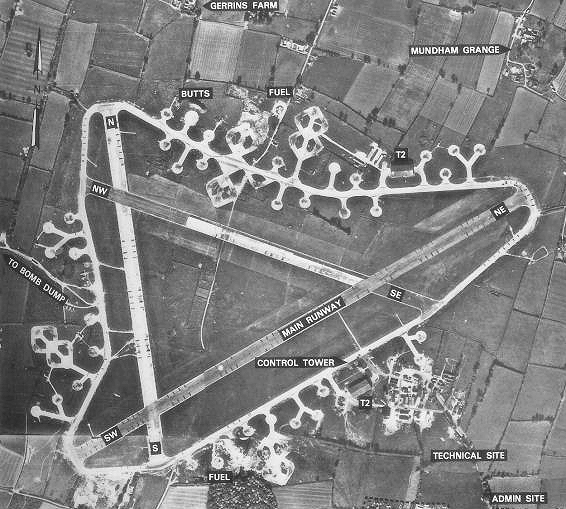
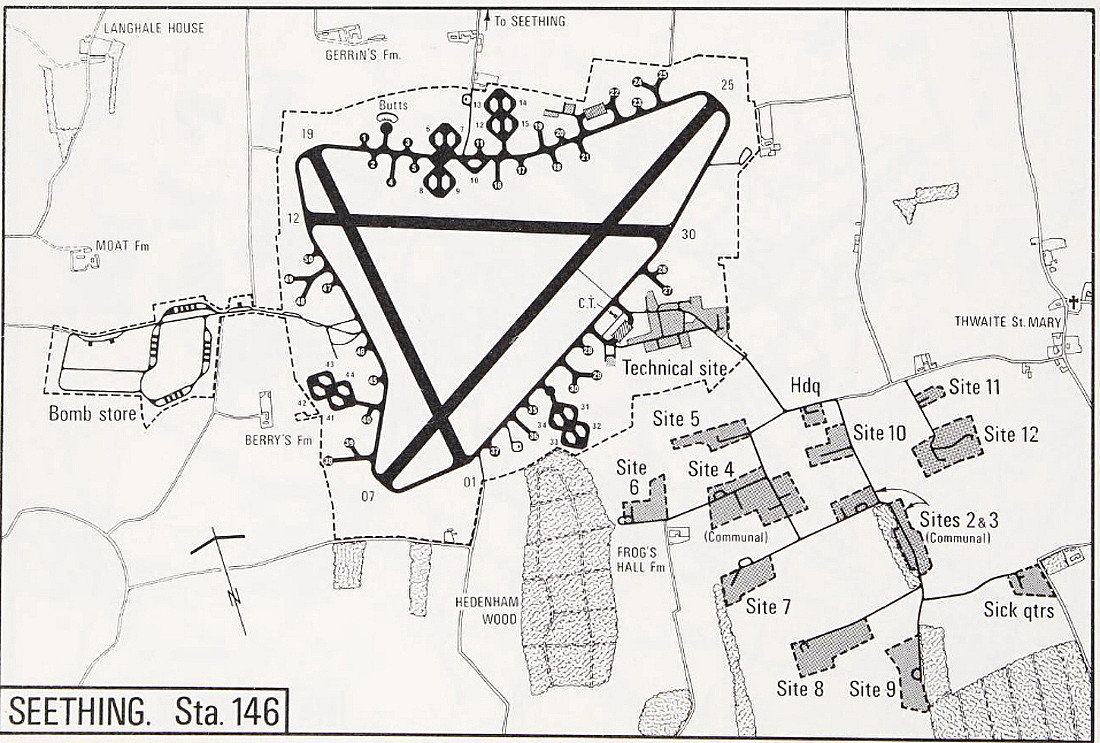
The airfield followed the standard wartime Class A plan. Its concrete main runway was approximately 6,000 feet long and 150 feet wide, aligned southwest to northeast. Two intersecting secondary runways were each approximately 4,200 feet long. A perimeter track of about three miles connected the runways with 51 loop and frying-pan aircraft hardstands. Two large T-2 steel hangars stood on opposite sides of the flying field, with the southern hangar near the principal technical area.
Construction required an immense movement of men and material. Approximately 18,000 tons of dry cement and 96,000 tons of aggregate were used, while many miles of drainage channels, cables, and service pipes were installed. Effective drainage was especially important because the heavy Liberators had to operate throughout the wet English winter without runways, taxiways, and hardstands becoming unusable.
The completed station extended well beyond its three runways. Its technical site included workshops, engineering buildings, operations and communications facilities, weather offices, stores, motor transport sections, and areas for servicing aircraft. Bomb storage and fuel installations were placed away from the main operational buildings for safety. Dispersed domestic sites to the south contained barracks, mess halls, medical facilities, administrative offices, recreation buildings, a chapel, a Post Exchange, and the utility systems needed to support a community of nearly 3,000 men.
Dispersing these facilities across the countryside reduced their vulnerability to enemy attack and separated personnel from explosives and aviation fuel. It also meant that Seething functioned less like a single compact airfield than a network of flying, technical, storage, and living sites connected by roads and tracks.
Deployment to England
In November 1943 the 448th began its movement overseass. The ground echelon traveled by rail to the East Coast and crossed the Atlantic by troopship, while most aircrews took their B-24s through Herington, Kansas, and then followed the southern ferry route by way of Florida, the Caribbean, South America, Africa, and finally the United Kingdom. The transfer itself was dangerous. Aircraft were lost in accidents before the group entered combat, a reminder that weather, navigation, mechanical failure, and fatigue could be as deadly as enemy action.
The first 448th Bomb Group aircraft arrived at Seething on 25 November 1943, and the group's personnel assembled there during November and December. The station officially opened on 1 December and carried the United States Army Air Forces designation Station 146 and station code SE. Although constructed as a Royal Air Force station, it had been allocated for American use before becoming operational.
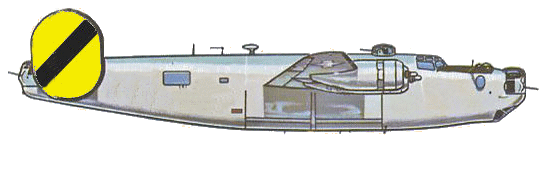
At Seething the 448th joined the 20th Combat Bombardment Wing of the Second Air Division. Together with the 93rd Bomb Group at Hardwick and the 446th Bomb Group at Bungay, it formed part of the B-24 striking force operating from eastern England. The group identification marking was a circle containing a black letter “I” on the vertical tail. Squadron fuselage codes were CT for the 712th, IG for the 713th, EI for the 714th, and IO for the 715th Bombardment Squadron.
Before beginning combat, newly arrived crews undertook local orientation flights and practiced assembly procedures. On mission mornings, individual aircraft took off at short intervals in darkness or poor weather, climbed through the crowded skies of East Anglia, and formed into squadrons, groups, combat wings, and divisions. Careful assembly was essential; a bomber that failed to join its formation could become dangerously exposed when it reached enemy territory.
First Combat Missions
The 448th flew its first combat mission on 22 December 1943 against Osnabrück, Germany. The new group immediately learned the realities of the air war. Enemy fighters, flak, icing, clouds, mechanical failures, and the difficulty of maintaining formation all challenged inexperienced crews. Losses during the opening weeks were painful, but the survivors rapidly gained experience and the group developed into a disciplined combat organization.
From its first mission through April 1945, the 448th served primarily as a strategic bombardment group. Among its targets were aircraft factories at Gotha, ball-bearing facilities in Berlin, the airfield at Hanau, U-boat installations at Kiel, chemical works at Ludwigshafen, synthetic-oil refineries at Pölitz, aircraft-engine plants at Rostock, marshalling yards at Cologne, and a V-1 flying-bomb assembly plant at Fallersleben. The group also attacked rail bridges, canals, depots, power facilities, ports, and other elements of the industrial and transportation network that sustained Germany's armed forces.
Strategic bombing demanded far more than simply reaching a target. Navigators had to guide formations over hundreds of miles while allowing for winds, clouds, and changes in routing. Bombardiers had only a short period during the final approach to identify the aiming point and calculate the release. Pilots had to hold a steady course through flak while maintaining position in formation. Gunners watched continuously for fighters, radio operators maintained communications, and engineers monitored fuel consumption and the condition of the aircraft's four engines.
Big Week and the Battle for Air Superiority
The 448th participated in “Big Week,” 20–25 February 1944, when the Eighth and Fifteenth Air Forces and RAF Bomber Command mounted a concentrated offensive against the German aircraft industry. Factories producing airframes, engines, and components were attacked repeatedly, while American escort fighters sought battle with the Luftwaffe. The operation was intended both to reduce German fighter production and to force the enemy air force into combat, weakening it before the invasion of western Europe.
For the bomber crews, Big Week meant repeated missions in severe winter conditions against heavily defended targets. The increased range and availability of P-47 and P-51 escort fighters greatly improved the bombers' protection, but no mission was safe. German fighters continued to exploit damaged formations and isolated aircraft, while radar-directed flak remained dangerous around industrial centers and transportation targets.
During this period Colonel Thompson was lost in action on 1 April 1944. Colonel Gerry L. Mason assumed command on 3 April and led the group through the preparations for the Normandy invasion and the difficult summer and autumn campaigns of 1944. Colonel Charles B. Westover succeeded him in November 1944.
Preparation for D-Day
As Operation Overlord approached, the 448th increasingly shifted from deep strategic targets to objectives connected with the invasion. Its Liberators bombed German airfields, coastal defenses, V-weapon sites, rail junctions, bridges, and transportation facilities. These attacks were intended to isolate the Normandy battlefield, reduce the Luftwaffe's ability to oppose the landings, and prevent German reinforcements from reaching the invasion coast quickly.
On 6 June 1944, D-Day, the group attacked coastal defenses and transportation choke points in support of the Allied landings. Operations over France continued after the invasion. The 448th struck enemy positions near Caen as British and Canadian forces fought to break out from the eastern side of the Normandy lodgment. In July it supported Operation Cobra, the American breakthrough near Saint-Lô, by bombing German defensive positions and communications.
These tactical assignments differed from attacks on large industrial targets. Bombing had to be coordinated closely with the movement of friendly ground forces, and crews were required to identify aiming points accurately through smoke, dust, and broken cloud. The missions demonstrated the flexibility of heavy bombers when used in direct support of the advancing Allied armies.
Operations During the Advance Across Europe
Following the breakout from Normandy, Allied armies advanced rapidly across France and Belgium. The 448th resumed attacks on German industry while continuing to strike bridges, railways, fuel installations, and military concentrations. Transportation targets became increasingly important because the German army depended upon an already strained rail network to move troops and supplies between the homeland and the front.
In September 1944 the group took part in the aerial resupply effort associated with Operation Market Garden. Its B-24s carried supplies to Allied airborne forces near Nijmegen in the Netherlands. Flying at lower altitude and at reduced speed for accurate delivery exposed the aircraft to small-arms fire and anti-aircraft weapons. The operation illustrated another use of the Liberator and another form of risk accepted by the group's crews.
During the autumn of 1944, missions increasingly emphasized oil production and transportation. Germany's synthetic-fuel plants and refineries were among the most important objectives of the strategic air campaign. Without adequate aviation gasoline and motor fuel, German aircraft, tanks, and trucks could not operate effectively. Repeated attacks forced the enemy to disperse production, devote scarce resources to repairs, and move diminishing fuel supplies over an increasingly damaged rail system.
The Battle of the Bulge
When German forces launched their Ardennes offensive on 16 December 1944, winter weather initially prevented the Allied air forces from intervening effectively. Once the skies cleared, the 448th joined the massive effort to disrupt the offensive. The group attacked rail centers, bridges, roads, communications facilities, and other targets used to move German reinforcements and supplies toward the battlefield.
Weather remained a serious obstacle during December 1944 and January 1945. Snow, fog, icing, and low cloud affected takeoffs, assembly, navigation, bombing, and recovery at English bases. Some missions required bombing with radar assistance when targets could not be seen. Even after returning from enemy territory, crews sometimes faced the danger of landing damaged aircraft at crowded or fog-covered airfields.
The Final Offensive, 1945
During the early months of 1945, the 448th continued to attack Germany's remaining oil, industrial, and transportation system. The Luftwaffe appeared less frequently in large formations, but flak remained intense and German jet fighters presented a new danger. As Allied armies closed on the Rhine, bombing missions were coordinated increasingly with the final ground offensive into Germany.
In March 1945 the group participated in the supply operation supporting Operation Varsity, the airborne assault across the Rhine near Wesel. B-24s carried supplies for troops who had landed east of the river. The low-level nature of the mission again exposed the heavy bombers to concentrated ground fire at a time when many might have expected the danger to be diminishing.
The 448th flew its last combat mission on 25 April 1945 against the marshalling yard at Salzburg, Austria. The long flight marked the conclusion of sixteen months of sustained combat operations from Seething. Germany surrendered unconditionally less than two weeks later.
Life and Work at RAF Seething
The combat record of the 448th was made possible by the combined efforts of its air and ground echelons. Crew chiefs, mechanics, armorers, electricians, instrument specialists, sheet-metal workers, and engine technicians labored outdoors in rain, snow, cold, and darkness to repair battle damage and prepare aircraft for the next mission. Bomb crews transported and loaded thousands of pounds of high explosive and incendiary bombs, while fuel crews serviced aircraft that might have returned with leaking tanks or damaged systems.
Operations personnel prepared routes and briefing materials; intelligence officers explained targets and enemy defenses; weather specialists forecast conditions across England and continental Europe; medical teams cared for wounded men; and communications personnel maintained the network connecting Seething with higher headquarters and other bases. Cooks, drivers, clerks, military police, firefighters, and supply personnel performed less celebrated but indispensable work.
For aircrews, life alternated between long periods of anticipation and hours of concentrated danger. A mission could begin with a predawn briefing and end late in the day after eight or ten hours in the air. Men returned physically exhausted, sometimes in damaged aircraft and often without friends whose empty parking places confirmed that they had not returned. Replacement crews arrived to fill the losses, and the cycle of briefing, takeoff, combat, interrogation, maintenance, and preparation began again.
The people of the surrounding Norfolk villages formed close relationships with the Americans stationed at Seething. Local homes, pubs, churches, dances, and community events offered relief from life on the base. Those wartime friendships became an important part of the group's history and helped sustain the continuing relationship between veterans, their families, and the Seething community after the war.
Combat Record and Sacrifice
The most consistently cited wartime summary credits the 448th Bomb Group with 262 combat missions, 6,774 credited combat sorties, and approximately 15,272 tons of bombs dropped between 22 December 1943 and 25 April 1945. The group is also credited with delivering roughly 140 tons of supplies during its special airborne-support missions. Published records differ on total sorties and aircraft losses because some tabulations count only aircraft missing in action, while others include operational and non-combat losses. The Seething Control Tower Museum records 101 aircraft missing in action; broader wartime summaries list a larger number of B-24s lost on operational flights.
Statistics alone cannot express the human cost. Hundreds of members of the 448th were killed, wounded, captured, interned, or forced to evade the enemy after their aircraft were shot down or crashed. Some died in training, ferrying, or other accidents away from combat. Each loss affected an entire ten-man crew, the ground personnel who cared for its aircraft, friends at Seething, and families waiting at home.
The group's official campaign credits included the Air Offensive—Europe, Normandy, Northern France, Rhineland, Ardennes-Alsace, and Central Europe. These honors reflect the breadth of its service, from the strategic bombing campaign over Germany to direct support of Allied troops in France, the Netherlands, Belgium, and across the Rhine.
Departure from Seething and Return to the United States
After V-E Day the 448th remained at Seething while plans were made for redeployment. Aircraft had to be prepared for movement, equipment inventoried, records completed, and the station transferred back to British control. The air echelon began returning aircraft and personnel to the United States during June 1945, and the ground echelon departed in early July. The group assembled at Sioux Falls Army Air Field, South Dakota, before moving to McCook Army Air Field, Nebraska, and later Fort Worth Army Air Field, Texas.
Redesignated the 448th Bombardment Group (Very Heavy) in August 1945, it began conversion to the B-29 Superfortress. The end of the Pacific war eliminated the need for the group to enter combat against Japan. It became part of the newly established Strategic Air Command in March 1946 and was inactivated on 4 August 1946. The 448th designation was later used by reserve and fighter-bomber organizations, but the World War II group and its service at Seething remained the foundation of its heritage.
RAF Seething After the War
As the 448th departed during the summer of 1945, Seething passed back to the Royal Air Force. The sudden end of combat left Britain with far more airfields than it required in peacetime. Seething did not acquire a lasting postwar flying role. No. 53 Maintenance Unit and later No. 94 Maintenance Unit used the station temporarily for the receipt, storage, maintenance, and disposal of surplus wartime equipment and munitions.
Military activity declined rapidly. Aircraft dispersals that had once held rows of Liberators stood empty, and buildings designed for thousands of men were no longer needed. Contemporary records differ slightly over the administrative date of final closure, but operational use had ended by the close of 1945 and the RAF had little continuing requirement for the station. The property remained under government control for a time before being declared surplus; the former airfield was sold in 1959.
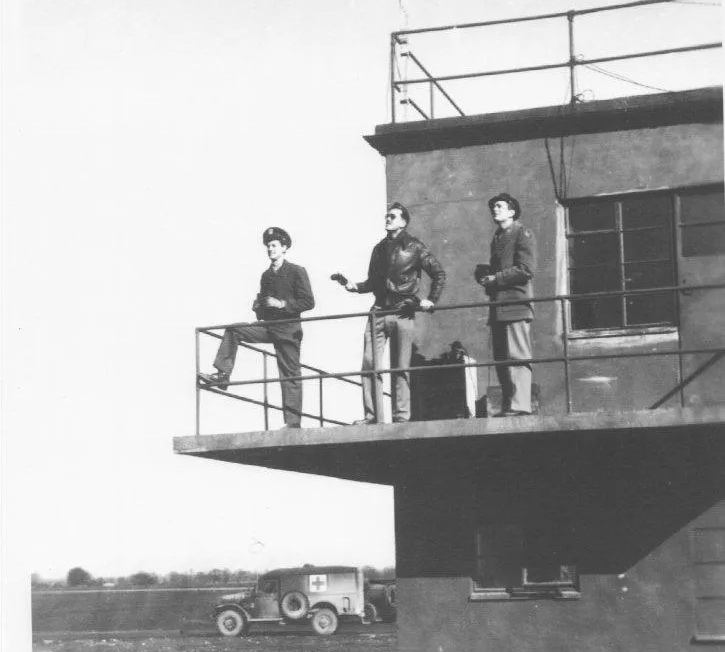
Most of the land then returned to agriculture. Many temporary barracks, mess halls, workshops, and other wartime buildings were demolished, dismantled, or adapted for civilian and farm use. Sections of concrete runway and perimeter track were broken up, and salvaged material was reused for roads and construction. Elsewhere, surviving pavement became farm access, storage areas, or gradually disappeared beneath crops and vegetation. The original control tower remained standing even as much of the vast military station around it vanished.
During the 1950s and 1960s, farming again dominated the former airfield and regular aviation activity was limited. Nevertheless, the wartime plan never disappeared completely. Fragments of runway, taxiways, hardstands, service roads, drainage works, and foundations continued to mark the landscape. From the air—and sometimes in the color and growth of crops—the triangular outline of the former bomber station remained visible.
The Return of Civilian Flying
Aviation returned to Seething in the early 1970s when local flying enthusiasts established the Waveney Flying Group on the eastern part of the former military station. A light-aircraft strip was developed along the general alignment of one of the wartime runways. The scale was far smaller than the wartime base, but aircraft engines once again sounded over the fields from which the B-24s had departed.
The flying organization gradually improved the site, adding hangars, a clubhouse, and facilities for privately owned light aircraft. The organization developed into today's Norfolk & Suffolk Flying Club, while the airfield itself continued to be widely identified as Seething Airfield. Recreational flying and flight training gave the surviving eastern portion of the old station a practical new life while preserving its connection with aviation.
Preservation of the Control Tower
By the 1980s, veterans of the 448th and residents of the Seething area recognized that the surviving control tower could become a permanent center for remembrance. Local volunteers and supporters formed the Station 146 Tower Association and began restoring the deteriorating wartime building. The work required years of fundraising, repair, research, and the gathering of objects and records from veterans and their families.
The restored tower became the Seething Control Tower Museum, also known as the 448th Bomb Group Memorial Museum. Its collection grew through the donation of uniforms, photographs, documents, aircraft parts, models, equipment, personal memorabilia, and accounts of life at the station. The exhibits interpret not only aerial combat but also maintenance, daily routines, local friendships, and the effect that the arrival of several thousand Americans had upon nearby Norfolk communities.
Memorials at the former station and in Seething village honor the men of the 448th Bomb Group, particularly those who did not return. Reunions and commemorative gatherings renewed the bonds formed during the war. Veterans and their descendants returned from the United States, while local residents continued to care for a history that had become part of their own community.
Seething Airfield Today
Today, only a fraction of the wartime base remains in active aviation use, but Seething is again a functioning private general-aviation airfield. The modern field occupies part of the eastern side of the former station and is operated in association with the Norfolk & Suffolk Flying Club. Light aircraft use the airfield for recreational flying and training, and modern hangars and a clubhouse stand near surviving elements of the wartime landscape.
Most of the former station is agricultural land. Even so, sections of the main runway, perimeter track, taxiways, aircraft hardstands, roads, and building foundations can still be traced. These remains help visitors understand the enormous size of a wartime heavy-bomber base, which extended far beyond the compact area used by today's light aircraft.
The restored control tower stands near the entrance to the active airfield and serves as both a museum and a memorial. Exhibits preserve the story of the approximately 3,000 American personnel who served at Station 146, the B-24s they flew and maintained, and the local people whose lives became intertwined with theirs. The museum is generally open on selected days during the warmer months, with current visiting arrangements published by the museum and airfield.
Seething therefore retains three connected identities: a productive part of the Norfolk countryside, an active center for general aviation, and a historic American heavy-bomber station. Modern aircraft flying from a surviving portion of the field ensure that aviation continues there, while the museum, memorials, surviving concrete, and work of volunteers keep the service and sacrifice of the 448th Bombardment Group visible to future generations.
Legacy and Remembrance
The men of the 448th Bombardment Group helped weaken the industrial, petroleum, and transportation systems that enabled Nazi Germany to continue the war. They also supported Allied ground forces during the Normandy invasion, the advance across France, Operation Market Garden, the Battle of the Bulge, and the crossing of the Rhine. Their accomplishments were achieved at great cost and through the combined courage and labor of aircrews and ground personnel alike.
At Seething, the continuing partnership among veterans' families, local residents, historians, pilots, and museum volunteers has preserved photographs, documents, aircraft records, personal recollections, and artifacts so that the group's story will not disappear with the passing of the wartime generation.
The enduring legacy of the 448th is found not only in mission totals and bomb tonnage, but in the individual stories of the young men who crossed the Atlantic, lived and worked in rural Norfolk, and repeatedly flew into danger. Their service forms an essential part of the history of the Second Air Division, the Eighth Air Force, and the Allied victory in Europe.
Squadrons
Principal World War II Stations
Commanding Officers
Campaigns
American Theater; Air Offensive—Europe; Normandy; Northern France; Rhineland; Ardennes-Alsace; Central Europe.

448th Bomb Group Roll of Honor: Roll of Honor
Oversea Burials 448th Bomb Group Oversea Burials
Group Web Site https://www.storiesofthe448th.com