
The 453rd Bombardment Group (Heavy) was constituted on 14 May 1943 and activated on 1 June 1943 at Wendover Field, Utah. Equipped with the Consolidated B-24 Liberator, the group consisted of the 732nd, 733rd, 734th, and 735th Bombardment Squadrons. Its officers, combat crews, and ground personnel trained at Wendover Field, Pocatello Army Air Field in Idaho, and March Field, California. Aircrews practiced long-range navigation, formation flying, precision bombing, aerial gunnery, and high-altitude operations, while ground personnel learned to maintain the complex four-engine Liberator under combat conditions.
After completing training, the ground echelon departed the United States in early December 1943. The group's personnel began arriving in England later that month, and the air echelon followed by the southern ferry route. The 453rd was assigned to the Eighth Air Force's Second Bombardment Division, later redesignated the Second Air Division, and became part of the 2nd Combat Bombardment Wing. Its permanent combat home was RAF Old Buckenham in Norfolk.
Construction of RAF Old Buckenham
RAF Old Buckenham was constructed during 1942–1943 specifically for use by the United States Army Air Forces. Situated approximately two miles southeast of Attleborough and near the Norfolk villages of Old Buckenham and New Buckenham, it was designated USAAF Station 144. Although it carried an RAF name, Old Buckenham was an American-operated heavy-bomber station built to support the daylight strategic bombing offensive from England.
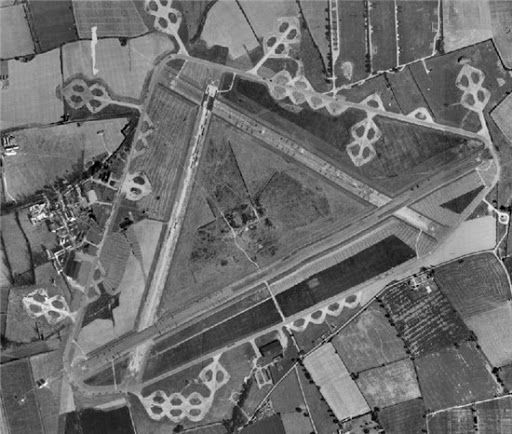
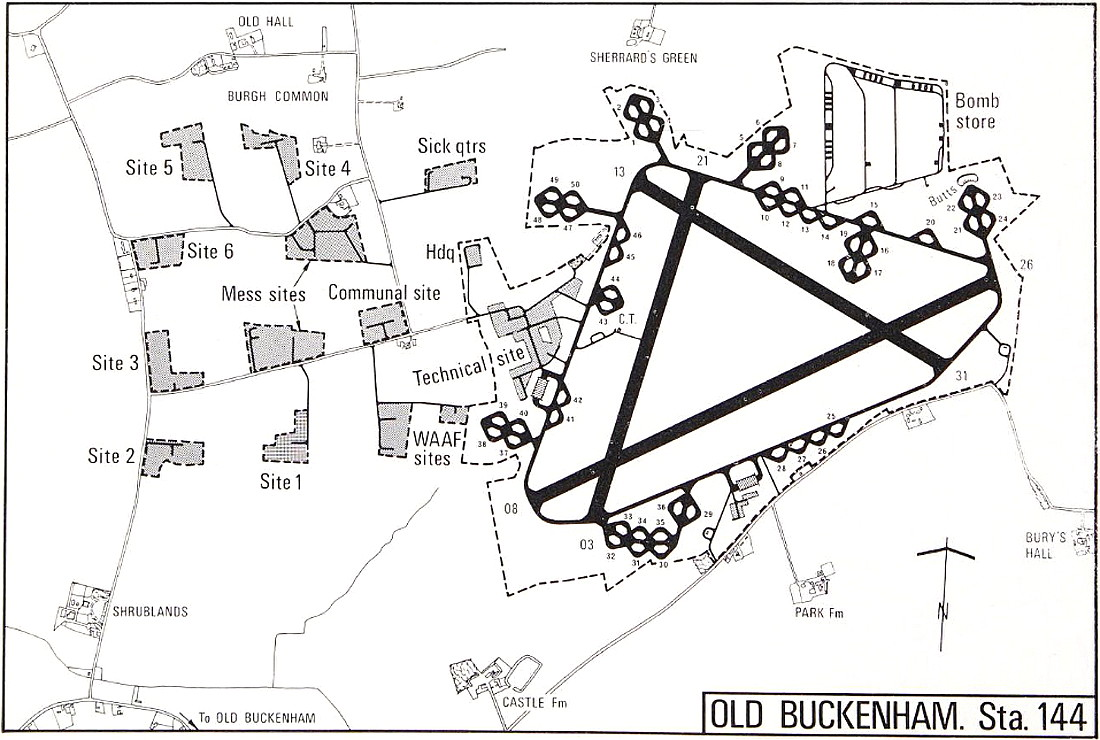
The airfield followed the standard wartime Class A pattern, with three intersecting concrete runways connected by a perimeter track. Dispersed around that track were numerous hardstands where B-24s could be parked apart to reduce their vulnerability to enemy attack. The technical site included hangars, workshops, stores, control facilities, fuel installations, and areas for loading ammunition and bombs. The bomb dump was placed away from the principal working and living areas for safety.
Communal and domestic sites were widely dispersed in the surrounding countryside. Nissen huts and other temporary buildings housed aircrews, maintenance men, headquarters staff, medical personnel, cooks, clerks, military police, and the many specialists required to operate a heavy-bomber base. Mud, winter cold, blackout regulations, and crowded quarters formed part of daily life, yet strong friendships developed between the Americans and residents of the nearby Norfolk communities.
Arrival at Old Buckenham
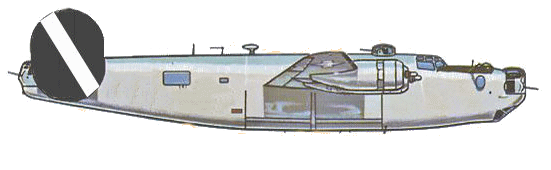
The 453rd's ground echelon reached Old Buckenham on 23 December 1943, and by January 1944 the arrival of the air echelon and its B-24s made the group ready for combat preparation. Old Buckenham remained the group's only operational station in England. The 453rd used the group marking Circle-J, later supplemented by a black tail with a diagonal white stripe. Its four squadrons and fuselage codes were:
Before dawn on a mission day, the station came alive. Crews attended intelligence and weather briefings while mechanics completed final inspections, armorers loaded bombs and ammunition, and fuel crews serviced the aircraft. One by one the Liberators taxied onto the runway and took off at carefully timed intervals, then assembled into squadron, group, and combat-wing formations over England before turning toward occupied Europe.
Beginning Combat Operations
The 453rd flew its first combat mission on 5 February 1944, attacking an airfield at Tours, France. Entering combat during the height of the Allied daylight bombing campaign, the group quickly became an important part of the Eighth Air Force's sustained offensive against German industrial and military power.
The group served chiefly as a strategic bombardment organization. Among its objectives were the fuel depot at Dülmen, marshalling yards at Paderborn, aircraft assembly plants at Gotha, railroad center at Hamm, ordnance depot at Glinde, oil refineries at Gelsenkirchen, chemical works at Leverkusen, airfield at Neumünster, canal at Minden, and railroad viaduct at Altenbeken. Other missions struck aircraft plants, oil facilities, bridges, communications centers, power installations, and transportation networks throughout occupied Europe and Germany.
These targets were essential to the German war economy. Aircraft factories sustained the Luftwaffe, refineries produced increasingly scarce fuel, and railways moved troops, weapons, and supplies. Repeated attacks by the 453rd and other Allied bomber groups gradually reduced Germany's ability to maintain an industrial war.
Big Week and the Strategic Air Offensive
The 453rd participated in Big Week, 20–25 February 1944, the concentrated Allied attack on the German aircraft industry. Heavy bombers struck assembly plants, engine factories, and component works while escort fighters challenged the Luftwaffe. The damage to aircraft production and the losses inflicted on German fighter forces helped the Allies gain the air superiority needed for the invasion of Normandy.
Deep-penetration missions carried the group hundreds of miles beyond the English coast. Crews often remained airborne for eight to ten hours at altitudes above 20,000 feet, where oxygen was essential and temperatures fell far below freezing. Flak, fighter attacks, icing, mechanical failures, cloud, and navigation problems threatened every formation. Aircraft returning to Old Buckenham were sometimes damaged, short of fuel, or carrying wounded crewmen, and emergency activity continued until the last Liberator had landed or was reported missing.
James Stewart at Old Buckenham
On 31 March 1944, Major James M. Stewart joined the 453rd as Group Operations Officer. Already famous as a motion-picture actor, Stewart was an experienced B-24 officer who wanted an operational assignment and did not seek special treatment. He helped plan and direct missions, flew combat sorties, and later served as Group Executive Officer. His professionalism, modest manner, and concern for the men earned widespread respect. Stewart continued his military service after the war and eventually retired from the United States Air Force Reserve as a Brigadier General.
Actor Walter Matthau also served with the 453rd as a radio operator-gunner. Their presence later brought public attention to the group, but the history of Old Buckenham was created by the combined service of thousands of airmen and ground personnel, most of whose names were never widely known.
Normandy and the Liberation of France
As the invasion of Western Europe approached, the 453rd increasingly attacked tactical targets. It bombed V-weapon sites, airfields, bridges, transportation centers, communications facilities, and coastal gun positions in France. On D-Day, 6 June 1944, the group attacked shore installations between Le Havre and Cherbourg and enemy positions farther inland.
During the following weeks, the 453rd struck troop concentrations, bridges, railway junctions, and supply routes. In July it attacked enemy forces in support of the American breakout at Saint-Lô. These missions helped delay German reinforcements and supported the Allied advance across France.
Supply Missions and the Final Campaigns
In September 1944, the group temporarily used its Liberators as transport aircraft, carrying gasoline, blankets, and rations to France for advancing Allied forces. This work demonstrated the flexibility of the B-24 groups and the importance of air transport after the rapid advance had stretched ground supply lines.
During the Battle of the Bulge in December 1944 and January 1945, the 453rd attacked German communications, railways, bridges, fuel facilities, and troop movements to help isolate the battlefield. In March 1945, during the airborne assault across the Rhine near Wesel, the group dropped ammunition, food, and medical supplies to Allied troops participating in Operation Varsity.
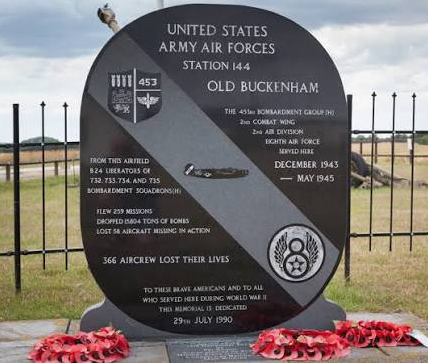
At the same time, strategic missions continued against Germany's remaining oil facilities, industries, transportation network, and military installations. The 453rd flew its final combat mission on 12 April 1945. It had completed 259 combat missions and 6,655 sorties, dropping approximately 15,804 tons of bombs. The 733rd Bombardment Squadron achieved a notable Eighth Air Force record by completing 82 consecutive missions without the loss of an aircraft.
Life and Work on the Station
Every mission depended upon the work performed at Old Buckenham. Maintenance crews repaired flak and fighter damage, changed engines, serviced hydraulic and electrical systems, and worked through the night to return aircraft to flying condition. Armorers loaded bombs and belts of machine-gun ammunition. Fuel crews, radio technicians, parachute riggers, photographers, meteorologists, medical staff, intelligence officers, cooks, drivers, clerks, and many others made sustained combat operations possible.
The control tower and operations buildings coordinated aircraft movements, while crash and rescue crews waited beside the runways for damaged bombers. For men not flying that day, the sound of returning engines brought anxious moments as aircraft were counted and empty places in the formation became apparent. The loss of an aircraft affected the entire station, from close friends and bunkmates to the mechanics and armorers who had prepared it for flight.
Departure from England
After being withdrawn from combat, the 453rd prepared for possible redeployment to the Pacific and conversion to the B-29 Superfortress. Personnel began leaving Old Buckenham in May 1945 and returned to the United States. The group assembled at New Castle Army Air Field, Delaware, and later moved to Fort Dix Army Air Base, New Jersey. Japan's surrender ended the need for redeployment, and the 453rd Bombardment Group was inactivated on 12 September 1945.
The group's achievements came at a severe cost. Fifty-eight B-24s were lost in combat, and 366 servicemen lost their lives while serving from Old Buckenham. Many others were wounded or became prisoners of war. Their sacrifice is inseparable from the history of the airfield.
Old Buckenham after World War II
Following the departure of the Americans in May 1945, Old Buckenham returned to British Air Ministry control. The station was used principally in support of RAF maintenance units rather than as an operational bomber base. No. 53, No. 94, and No. 231 Maintenance Units were associated with the station during its postwar years. Military use gradually declined, and RAF Old Buckenham closed on 20 June 1960.
After closure, much of the former station returned to agriculture. Sections of runway, perimeter track, and dispersal area were removed or broken up for aggregate, while many temporary wartime buildings disappeared. Nevertheless, surviving concrete, buildings, and the unmistakable airfield landscape continued to mark the site where the 453rd had served.
Old Buckenham Airfield Today
Part of the wartime station survives as Old Buckenham Airfield, an active general-aviation aerodrome. Modern flying continues from a smaller portion of the original base, linking today's airfield directly with its wartime past. Remaining structures and traces of the wartime runways and dispersals help visitors understand the scale of the former B-24 station.
A black-granite memorial, shaped to suggest the tail of a B-24 Liberator, honors the 366 American servicemen who died while serving from Old Buckenham. It stands in a memorial garden whose figure-eight path commemorates the Eighth Air Force. In 1983, the 453rd Bomb Group dedicated an extension to the Old Buckenham Village Hall as a memorial room containing wartime artifacts and a plaque honoring the fallen.
The 453rd Bombardment Group Museum opened at the airfield in 2015, followed by an Eighth Air Force Heritage Gallery in 2017. Through aircraft artifacts, photographs, personal possessions, documents, and continuing remembrance ceremonies, the museum and local community preserve the story of the Americans who lived and served there. Old Buckenham is therefore more than a surviving airfield: it is a place of memory connecting the Norfolk landscape with the courage, sacrifice, and achievements of the 453rd Bombardment Group.
An additional Eighth Air Force Heritage Gallery opened in 2017, placing the history of the 453rd within the larger story of the American air campaign from Britain. Together, the museums, memorial garden, Village Hall collection, surviving airfield remains, and active aerodrome form an important center of remembrance. They ensure that Old Buckenham is remembered not merely as a former military installation, but as the wartime home of the 453rd Bombardment Group and a place where American and British history remain closely joined.
Combat Record and Legacy
From Old Buckenham, the 453rd helped weaken Germany's aircraft production, petroleum industry, transportation network, and military infrastructure. It also supported the invasion of Normandy, the breakout from Saint-Lô, the Allied advance across France, the Battle of the Bulge, and the crossing of the Rhine. Its six recognized campaigns were Air Offensive—Europe, Normandy, Northern France, Rhineland, Ardennes-Alsace, and Central Europe.
The history of the 453rd Bombardment Group and RAF Old Buckenham is one story. The airfield gave the group its combat home, while the men of the group gave the station its lasting identity. Their shared legacy endures in the surviving airfield, the museum, the memorials, and the continuing work of historians, families, and residents on both sides of the Atlantic.
Squadrons
732nd Bombardment Squadron (E3), 1943–1945
733rd Bombardment Squadron (F8), 1943–1945
734th Bombardment Squadron (E8), 1943–1945
735th Bombardment Squadron (H6), 1943–1945
Stations
Wendover Field, Utah, June 1943
Pocatello Army Air Field, Idaho, July 1943
March Field, California, September 1943
RAF Old Buckenham, England, December 1943–May 1945
New Castle Army Air Field, Delaware, May 1945
Fort Dix Army Air Base, New Jersey, June–September 1945
Commanding Officers
Col. Joseph A. Miller, June 1943
Col. Ramsay D. Potts, Jr., March 1944
Col. Lawrence M. Thomas, July 1944
Lt. Col. Edward F. Hubbard, January 1945
Identification
Aircraft: Consolidated B-24 Liberator
Group marking: Circle-J
Airfield: RAF Old Buckenham
USAAF designation: Station 144
Campaigns
Air Offensive—Europe; Normandy; Northern France; Rhineland; Ardennes-Alsace; Central Europe.

453rd Bomb Group Roll of Honor: Roll of Honor
Overseas Burials: 453rd Bomb Group Overseas Burials
453rd Bomb Group Museum: Old Buckenham Airfield Museum