
RAF Horsham St. Faith was a major wartime airfield situated approximately four miles north of Norwich in Norfolk, England. Built during the expansion of the Royal Air Force immediately before the Second World War, it developed from a permanent RAF bomber station with a grass landing field into a large, fully paved American heavy-bomber base. The United States Army Air Forces designated it Station 123, while its station code was HF. The history of the airfield and the 458th Bombardment Group became inseparably linked during the final fourteen months of the air war in Europe.
Selection and Construction of RAF Horsham St. Faith
The location north of Norwich was selected during the late 1930s as Britain expanded its air defenses and bomber forces in anticipation of war. The surrounding countryside consisted largely of open, gently rolling farmland that could be cleared for flying operations. Its position also placed the station near Norwich's road and railway connections while providing room for hangars, workshops, barracks, and other supporting facilities.
Construction began in 1939. Unlike many airfields built rapidly later in the war with predominantly temporary structures, Horsham St. Faith was planned as a permanent RAF station. Its original facilities included substantial brick barrack blocks, administrative offices, messes, workshops, and five large C-type aircraft hangars. The station officially opened on 1 June 1940, when aircraft operated from a broad grass flying field rather than paved runways.
The Original Grass Airfield
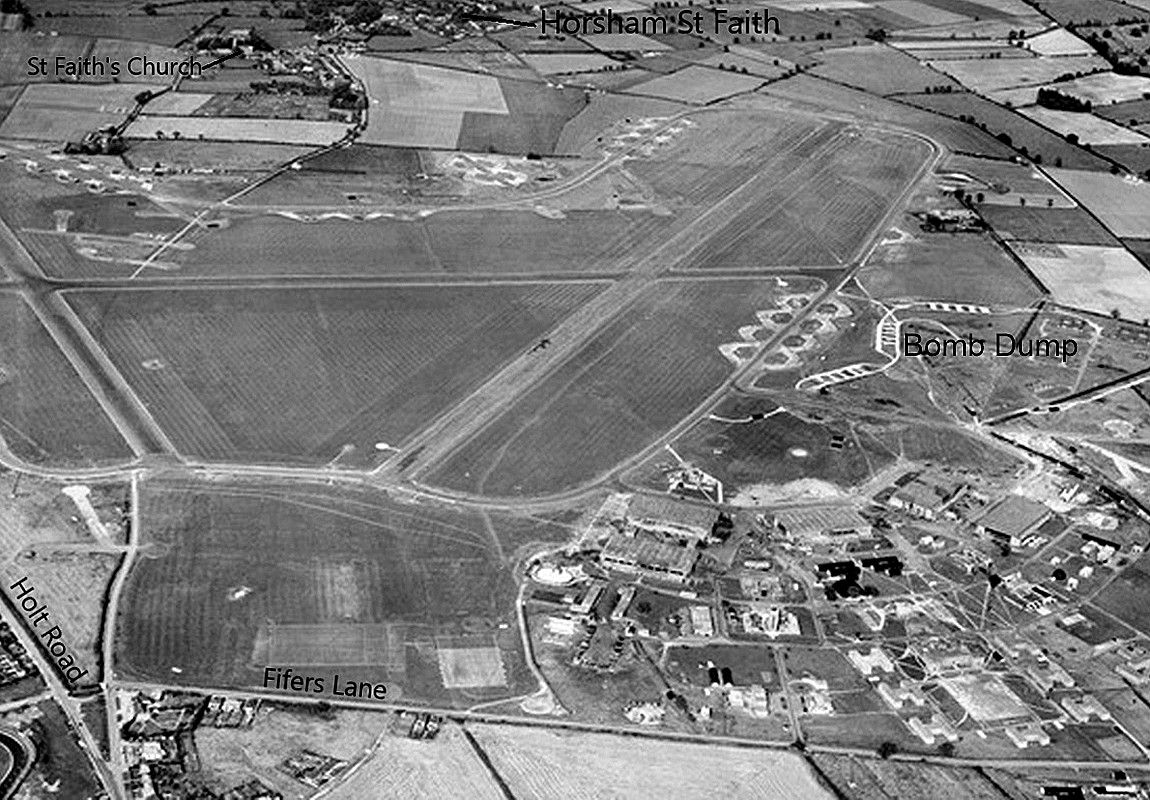
The early airfield lacked the triangular concrete runway system visible in later aerial photographs. Aircraft took off and landed across the grass according to the wind direction. Although this arrangement offered flexibility for relatively light aircraft, prolonged rain could soften the ground, bog down aircraft, and restrict operations. The landing area was bordered by the station's technical and domestic facilities, where aircraft were housed, serviced, and repaired.
The technical site contained the five C-type hangars, maintenance shops, stores, administrative offices, and motor-transport facilities. Specialist sections maintained engines, electrical equipment, radios, instruments, hydraulic systems, armament, and airframes. Elsewhere, permanent and dispersed domestic sites provided barracks, messes, kitchens, washrooms, medical services, a chapel, recreation rooms, stores, and sports facilities. Together these areas made the station a military community as well as an airfield.
Early Wartime Operations
Before the arrival of the 458th, Horsham St. Faith served a succession of British and American flying units. RAF bomber units used the station during the early war years, and the airfield suffered enemy attack because of its operational importance. In September 1942, it was made available to the United States Army Air Forces and became USAAF Station 123. American medium bombers and fighters operated from the station before it was rebuilt for four-engine heavy bombers.
The 319th Bombardment Group flew Martin B-26 Marauders from Horsham St. Faith before deploying to North Africa. The 56th Fighter Group, later famous as “Zemke's Wolfpack,” arrived in April 1943 and flew Republic P-47 Thunderbolts from the station. In July, the 56th moved to RAF Halesworth so that extensive construction could begin at Horsham St. Faith.
Conversion Into a Heavy-Bomber Station
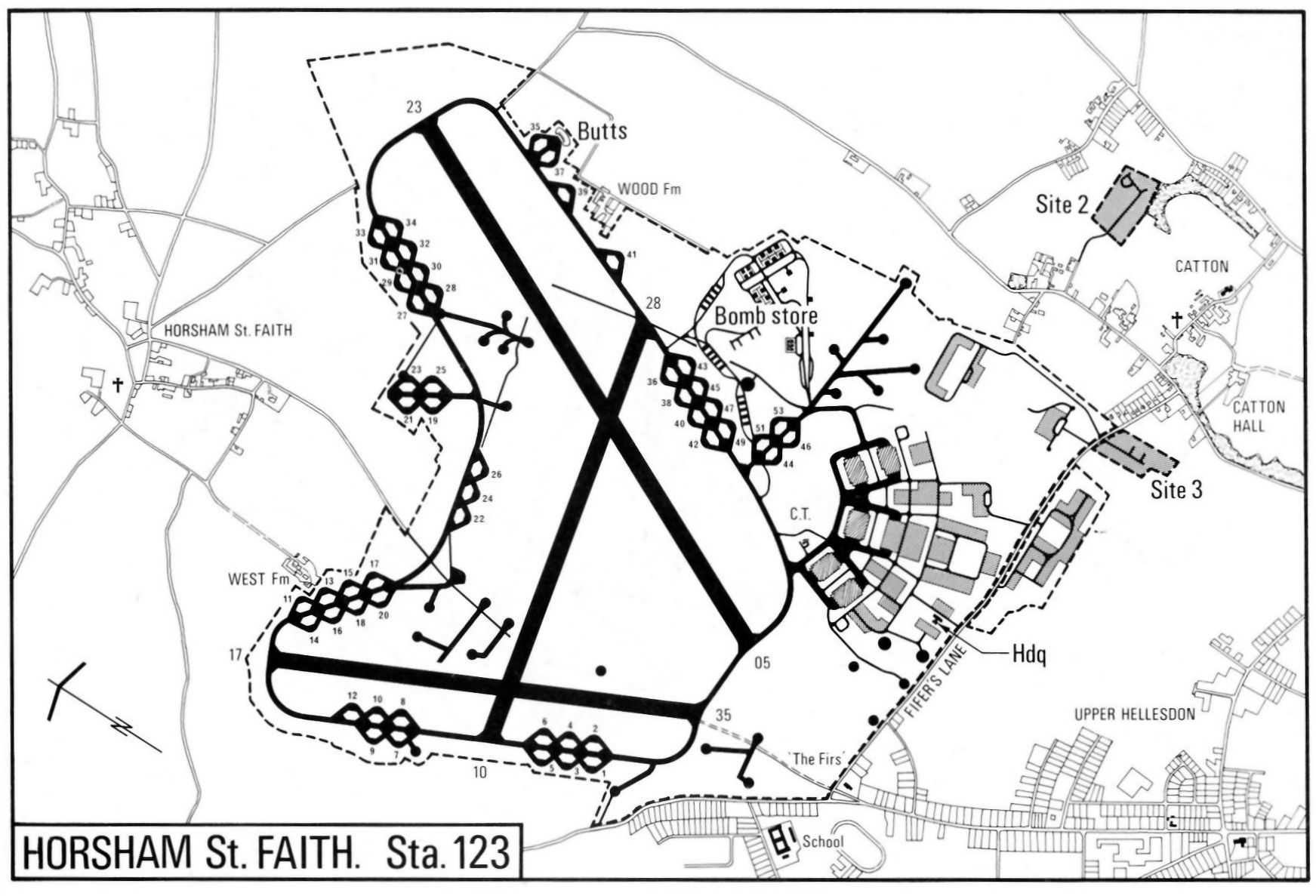
During 1943, major construction transformed Horsham St. Faith into a base suitable for heavily loaded B-24 Liberators. Three intersecting concrete runways were laid out in the standard triangular pattern. The main runway was approximately 2,000 yards long, while the two secondary runways were approximately 1,400 yards. A paved perimeter track connected the runways with the technical site and the aircraft parking areas.
The work required extensive earthmoving and drainage. Fields were cleared, hedgerows removed, roads altered, and great quantities of concrete laid. Hardstandings were distributed around the perimeter track so that aircraft would not be concentrated in one vulnerable area. Bomb and ammunition storage, fuel installations, taxiways, communications equipment, and other support facilities were added or expanded. By the beginning of 1944, the former grass bomber station had become a modern American heavy-bomber base.
Formation of the 458th Bombardment Group
The 458th Bombardment Group (Heavy) was a Consolidated B-24 Liberator unit of the United States Army Air Forces' Eighth Air Force and Second Air Division. From its combat base at RAF Horsham St. Faith in Norfolk, England, the group took part in the strategic air offensive against Nazi Germany and in direct support of Allied armies from early 1944 until the final weeks of the war in Europe. Although it was among the later heavy bombardment groups to join the Eighth Air Force, the 458th compiled an extensive combat record over Germany, France, Belgium, and the Netherlands.
The group was activated at Gowen Field, Idaho, on 28 July 1943. Its four operational squadrons were the 752nd, 753rd, 754th, and 755th Bomb Squadrons. Aircrews and ground personnel were brought together from many stations and specialties to form a self-contained combat organization capable of launching, maintaining, and supporting a force of four-engine bombers overseass.
After its initial organization, the group moved through training stations in Utah and Nevada, including Kearns, Wendover Field, and Tonopah Army Air Field. At Wendover and Tonopah, crews learned formation flying, high-altitude navigation, precision bombing, aerial gunnery, radio procedure, emergency operations, and the demanding teamwork required aboard the B-24. Ground personnel trained in engine and airframe maintenance, armament, communications, transportation, supply, and the many other duties needed to keep a heavy bomber group operational.
Lieutenant Colonel James H. Isbell assumed command during the final training period and led the group through most of its combat tour. Under Isbell, the 458th prepared for movement to the European Theater late in 1943. The air echelon traveled by the southern ferry route, while much of the ground echelon crossed the Atlantic by troopship.
Arrival at RAF Horsham St. Faith
The first elements arrived at RAF Horsham St. Faith, designated USAAF Station 123, late in January 1944. The station stood just north of Norwich and had been enlarged with concrete runways, perimeter tracks, hardstands, maintenance areas, bomb storage facilities, and dispersed living sites suitable for American heavy bomber operations. Its proximity to Norwich created a lasting relationship between the American servicemen and the surrounding Norfolk communities.
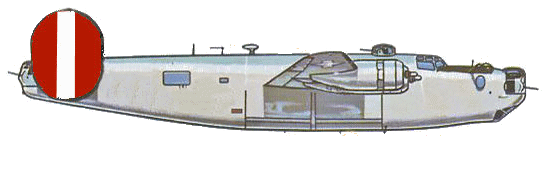
The 458th was assigned to the 96th Combat Bombardment Wing of the Second Air Division, alongside the 466th and 467th Bomb Groups. Its B-24s carried a black-and-white diagonal tail marking that made the group's aircraft recognizable within the great bomber formations assembling over East Anglia. Before entering combat, crews flew local training and practice missions, tested unfamiliar aircraft, and learned the assembly routes, radio beacons, weather patterns, and operational procedures of the Eighth Air Force.
The Airfield in Daily Operation
The rebuilt airfield's triangular runway arrangement allowed aircraft to take off and land into the prevailing wind under varied conditions. Taxiways and turning points connected each runway to the perimeter track. Before a mission, Liberators emerged from widely separated hardstandings and formed a carefully controlled procession around the airfield. At recovery time, returning aircraft left the runway as quickly as possible so that the next bomber—sometimes damaged, low on fuel, or carrying wounded crewmen—could land.
Each hardstanding functioned as an outdoor servicing station. Ground crews inspected engines, repaired minor faults, loaded ammunition and bombs, supplied oxygen, and refueled aircraft where they were parked. The dispersal system reduced the risk that an enemy attack or accidental explosion would destroy many aircraft at once, but it also forced personnel and vehicles to cover considerable distances around the base.
The bomb-storage area stood apart from the technical and domestic sites. Earthworks and separation distances reduced the effects of a possible explosion. Bombs were assembled and fuzed under controlled conditions, then hauled by specialist vehicles to the dispersals. Machine-gun ammunition, flares, and pyrotechnics were likewise stored in protected and guarded areas.
A heavy-bomber group consumed enormous quantities of aviation gasoline. Tankers carried fuel from protected storage installations to aircraft around the perimeter. Refueling dozens of B-24s was slow and hazardous work, particularly when combined with bomb loading, oxygen servicing, engine testing, and electrical work. Strict precautions controlled sparks and open flames, while fire crews remained ready to respond.
Flying Control, Communications, and Weather
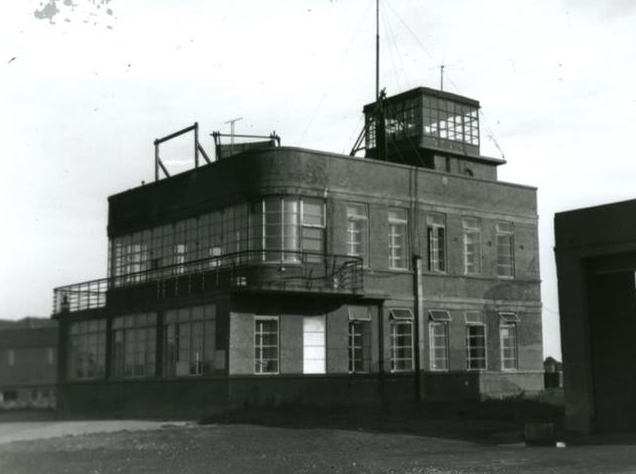
The control tower, or watch office, supervised runway and taxiway movements. Controllers monitored wind, visibility, cloud, and runway conditions while coordinating aircraft by radio, signal lamps, and ground procedures. Mass departures and recoveries placed intense pressure on flying-control personnel, particularly when bad weather closed nearby bases or damaged bombers requested priority landings.
Radio rooms, telephone lines, direction-finding equipment, and messenger services connected the tower with operations, meteorology, maintenance, fire, medical, and other departments. Weather observers were essential in East Anglia, where fog, low cloud, strong winds, icing, and rapidly changing conditions could delay a mission or make the return especially dangerous.
Security, Fire, Rescue, and Medical Services
Guards, military police, patrols, and defensive positions protected the airfield against air attack, sabotage, and unauthorized entry. Bomb stores, fuel installations, aircraft, and communications sites received particular attention. Blackout restrictions, camouflage, dispersed construction, air-raid shelters, and blast protection reduced vulnerability.
Fire and rescue crews stood alert during takeoffs and landings, when heavily loaded aircraft were most vulnerable. A B-24 could suffer engine failure, tire damage, brake failure, or loss of control during its takeoff run; returning bombers might have damaged landing gear, wounded crewmen, or almost empty fuel tanks. Fire tenders, ambulances, and medical teams had to reach an accident rapidly and clear the runway for other returning aircraft.
A Self-Contained Wartime Community
At its wartime peak, Horsham St. Faith functioned much like a small town. Thousands of men required food, water, electricity, heating, sanitation, medical care, postal services, transportation, and recreation. Engineers maintained roads, buildings, drainage, and runway surfaces. Clerks handled records and supplies; cooks prepared thousands of meals; and tailors, barbers, drivers, chaplains, medics, and military police supported daily life.
An extensive road system carried buses, jeeps, ambulances, bomb tractors, fuel tankers, and maintenance vehicles among the technical area, domestic sites, stores, and dispersals. Supplies arrived from depots and railheads, while American personnel frequently traveled into Norwich for leave and recreation. Wartime service created many enduring friendships between members of the 458th and local families.
Big Week and the First Missions
On 24 and 25 February 1944, during Big Week, the 458th flew diversionary operations toward the Dutch coast. These missions helped draw German attention from the principal bomber forces attacking the enemy aircraft industry and served as the group's final preparation for combat. The 458th flew its first bombing mission on 2 March 1944, striking the Frankfurt area.
Only four days later, on 6 March, the group joined the Eighth Air Force's first major daylight assault on Berlin. The force fought through poor weather, heavy antiaircraft fire, and determined fighter opposition. Five of the 458th's B-24s failed to return, the greatest aircraft loss the group suffered on a single mission. For a newly operational unit, the Berlin raid was a severe introduction to the price of the daylight bombing campaign.
During the spring of 1944, the 458th attacked aircraft plants, airfields, rail centers, industrial installations, and other objectives in Germany and occupied Europe. Targets included major centers such as Berlin, Brunswick, Frankfurt, Hamburg, Kiel, Magdeburg, and other heavily defended areas. Missions could last eight to ten hours. At altitudes above 20,000 feet, crews endured subzero cold, oxygen-mask difficulties, icing, mechanical trouble, flak, and fighter attacks while holding the close formations on which their mutual defense depended.
Preparation for the Invasion of France
As Operation Overlord approached, the group's emphasis shifted increasingly toward targets that could interfere with the invasion. The 458th bombed airfields, coastal defenses, bridges, railway junctions, marshalling yards, and transportation routes in France and the Low Countries. These attacks formed part of the Allied effort to isolate the future battlefield and restrict German reinforcement of the Normandy coast.
By the eve of D-Day, the 458th had developed a strong reputation for bombing accuracy. On 6 June 1944, its Liberators attacked coastal defenses in support of the landings. Bad weather and extensive cloud often concealed the battlefield, making careful navigation and timing essential to reduce the danger to Allied troops below. In the days that followed, the group continued to strike roads, railways, bridges, airfields, and enemy positions behind the beachhead.
Normandy, Saint-Lô, and the Advance Across France
During June and July, the 458th balanced strategic missions with direct support of the armies in Normandy. It attacked communications centers and rail lines used to move German troops and supplies toward the front. In late July, the group participated in the aerial operations supporting Operation Cobra, the American breakout near Saint-Lô. Heavy bombers were used to strike German defensive positions immediately before the ground assault, demonstrating how the Eighth Air Force's mission had expanded beyond strategic bombing to include close support of the Allied advance.
After the breakout, Allied forces moved rapidly across France. The 458th continued attacking bridges, railroads, fuel facilities, troop concentrations, and supply routes, helping impede an organized German withdrawal. The speed of the advance soon created a serious logistical problem, however: fuel consumption at the front exceeded the ability of trucks and pipelines to deliver gasoline from the Normandy ports.
AZON Guided-Bomb Operations
The 458th also took part in experimental attacks using AZON, a radio-controlled bomb whose name came from “azimuth only.” After release, an operator aboard the bomber could guide the weapon to the left or right by radio while observing a flare in its tail. AZON was intended especially for narrow targets such as bridges, which were difficult to destroy with conventional high-altitude bombing.
Specially equipped aircraft and trained crews flew a series of AZON operations against bridges and related transportation targets in occupied Europe. Weather, cloud, equipment limitations, enemy defenses, and the difficulty of tracking the descending weapon made these missions challenging. Although the technology was primitive by later standards, the 458th's AZON program represented an important early step in the development of guided aerial weapons.
Operation Truckin'
In September 1944, the 96th Combat Bombardment Wing temporarily suspended normal bombing operations to transport aviation gasoline to advanced Allied airfields in France. Bomb-bay equipment was modified so that the B-24s could carry fuel containers instead of bombs. These flights became known within the group as the “Truckin' Missions.”
The 458th flew 456 sorties and delivered approximately 767,000 gallons of fuel during the operation. The gasoline helped sustain tactical aircraft supporting the advancing armies. Though not conducted as bombing missions, the flights were hazardous: heavily loaded Liberators operated from forward fields under difficult weather and runway conditions, while crews faced navigation problems, mechanical failures, and the ever-present danger of fire.
The operation also came at a human cost. Aircraft and personnel were lost during the fuel-hauling period, demonstrating that logistical flying could be as unforgiving as combat. When the emergency transport assignment ended, the 458th returned to bombing operations in October 1944.
Autumn 1944 and the Battle of the Bulge
During the autumn, the group again struck German oil facilities, industrial targets, rail centers, bridges, and airfields. The Allied priority increasingly centered on petroleum and transportation: without fuel and a functioning rail network, Germany could neither operate its aircraft and armored forces effectively nor move men and material to threatened fronts.
When Germany launched its Ardennes counteroffensive in December 1944, winter weather initially restricted Allied air operations. As the skies cleared, the 458th joined the attacks on rail junctions, bridges, communications centers, supply facilities, and troop movements supporting the German offensive. These missions helped isolate the battlefield and weaken the enemy's ability to maintain the Battle of the Bulge.
The Final Offensive Into Germany
In early 1945, the 458th continued long-range attacks against Germany's remaining transportation, oil, and industrial systems. The Luftwaffe appeared less frequently in large formations, but antiaircraft fire remained deadly. Rail yards and bridges became especially important as German forces attempted to shift reserves and supplies under increasing pressure from the east and west.
The group supported the Allied crossing of the Rhine and the advance into central Germany. In connection with Operation Varsity in March 1945, the great airborne assault across the lower Rhine, Eighth Air Force bombers struck airfields and other objectives that might threaten the airborne and ground forces. By April, the shrinking target list and rapid Allied advance made clear that the European war was nearing its end.
The Royan Mission and Napalm
On 15 April 1945, the 458th participated in an unusual operation against German defenses in the Royan pocket near the Gironde estuary on France's Atlantic coast. German garrisons in several isolated coastal fortresses had remained behind after the liberation of most of France. French forces sought heavy air support to reduce the fortified positions and open the approaches to the port area.
The attacking force used jellied-gasoline incendiary weapons, commonly called napalm, together with conventional incendiaries. The Royan operation was the Eighth Air Force's first operational use of napalm in Europe. The mission remains historically significant but also controversial because the wider bombing of the Royan area caused extensive destruction in and around the French city.
The 458th flew its final combat mission on 25 April 1945 against railroad facilities at Bad Reichenhall, Germany. After fourteen months of operations from Horsham St. Faith, the group's combat tour had ended only days before Germany's surrender.
Victory, Trolley Missions, and Return Home
Following V-E Day, the 458th flew “Trolley Missions” that carried ground personnel over parts of the Continent. These flights allowed men who had repaired aircraft, loaded bombs, maintained vehicles, handled supplies, and performed countless other duties to see some of the targets and battle areas to which their work had contributed.
Redeployment began during the summer of 1945. The group's aircraft started leaving England on 14 June, while members of the ground echelon returned by sea, many aboard the Queen Mary in July. After returning to the United States, the organization was inactivated on 17 October 1945 as the Army Air Forces rapidly reduced its wartime strength.
Combat Record and Sacrifice
From February 1944 through April 1945, the 458th completed 240 credited combat missions and flew thousands of combat sorties. Its operational record encompassed diversionary flights, conventional bombing, specialized AZON attacks, gasoline-transport sorties, and direct support of Allied ground operations. The group dropped more than 13,000 tons of bombs and its gunners were credited with destroying 28 enemy aircraft.
The cost was severe. Forty-seven B-24s were lost directly in combat and additional aircraft were destroyed through combat-related incidents and accidents. The group's records list 256 aircrew members killed in action, 193 taken prisoner, 34 who evaded capture, and others interned in neutral countries after damaged aircraft were forced down. Noncombat flying and operational accidents claimed still more aircraft and lives.
The 458th received Second Air Division citations recognizing the completion of its first 100 missions, the destruction of the Blois–Saint-Denis bridge, and the completion of its 200th mission. Its broader campaign credits included Air Offensive, Europe; Normandy; Northern France; Rhineland; Ardennes-Alsace; and Central Europe.
Return to Royal Air Force Control
As the 458th departed during the summer of 1945, Horsham St. Faith returned to RAF control and entered a new phase under Fighter Command. Postwar units operated increasingly advanced aircraft from the station, including the Gloster Meteor, Britain's first operational jet fighter. The airfield's permanent buildings and long concrete runways made it better suited to continued military use than many temporary wartime stations.
The RAF further developed the airfield for faster and heavier aircraft. The east-west runway was extended, and postwar improvements altered portions of the wartime layout. The station served during the transition from piston-engine fighters to jets and remained an active part of Britain's postwar air-defense system.
From RAF Station to Norwich Airport
Front-line RAF flying ended in 1963, although a military presence continued for several more years. The RAF finally left in 1967, after which Norwich City Council and Norfolk County Council acquired much of the site for civil aviation. Commercial operations expanded and the former military station developed into Norwich Airport.
The extended east-west runway became the airport's principal operational runway. Other wartime runways and taxiways were adapted, abandoned, or absorbed into later construction. Industrial and commercial development spread across parts of the former station, while the growth of Norwich brought new buildings and roads closer to the airfield.
Surviving Wartime Features and Memorials
Despite extensive redevelopment, portions of the wartime landscape remained recognizable. Several original hangars survived in aviation or commercial use, and the wartime control-tower building remained standing even after modern air-traffic-control facilities were constructed. Sections of former runways, perimeter track, dispersal areas, and other structures can still be identified on the ground or in aerial imagery.
Memorials at and near the modern airport honor the British and American personnel who served at Horsham St. Faith. These physical reminders connect present-day Norwich Airport with the RAF units that first occupied the station and with the aircrews and ground personnel of the 458th Bombardment Group who operated there during 1944 and 1945.
Legacy
The history of the 458th Bombardment Group was created not only by the crews who flew over enemy territory, but also by the mechanics, armorers, clerks, cooks, medics, drivers, engineers, communications specialists, and other personnel who kept the group operating from Horsham St. Faith. Their combined work enabled aircraft to be repaired, armed, fueled, and launched in the difficult weather and demanding tempo of the European air war.
Surviving buildings, memorials, photographs, documents, and personal recollections preserve the American presence at Horsham St. Faith. Veterans, families, local residents, and historical organizations have continued to honor the men of the 458th and to document the aircraft and crews that did not return. The combined history of the group and its Norfolk airfield remains an enduring part of the story of the Second Air Division, the Eighth Air Force, and the Allied victory in Europe.
Squadrons
752nd Bomb Squadron, 1943–1945
753rd Bomb Squadron, 1943–1945
754th Bomb Squadron, 1943–1945
755th Bomb Squadron, 1943–1945
Principal Stations
Gowen Field, Idaho, July 1943
Kearns, Utah, September 1943
Wendover Field, Utah, September 1943
Tonopah Army Air Field, Nevada, late 1943–January 1944
RAF Horsham St. Faith, England, January 1944–June 1945
Sioux Falls Army Air Field, South Dakota, 1945
Commanding Officers
Lt. Col. Robert F. Hardy, 1943
Col. James H. Isbell, December 1943–March 1945
Col. Allen F. Herzberg, March 1945
Campaigns
Air Offensive, Europe
Normandy
Northern France
Rhineland
Ardennes-Alsace
Central Europe

458th Bomb Group Roll of Honor: Roll of Honor
Overseas Burials: 458th Bomb Group Overseas Burials
Group Website: 458th Bombardment Group (H)