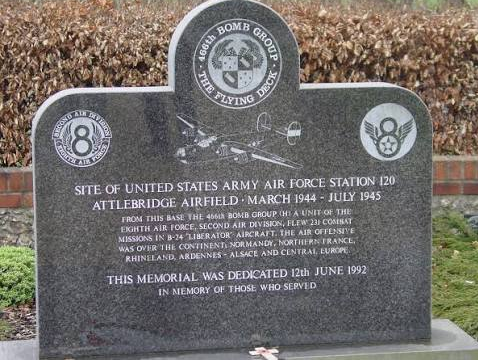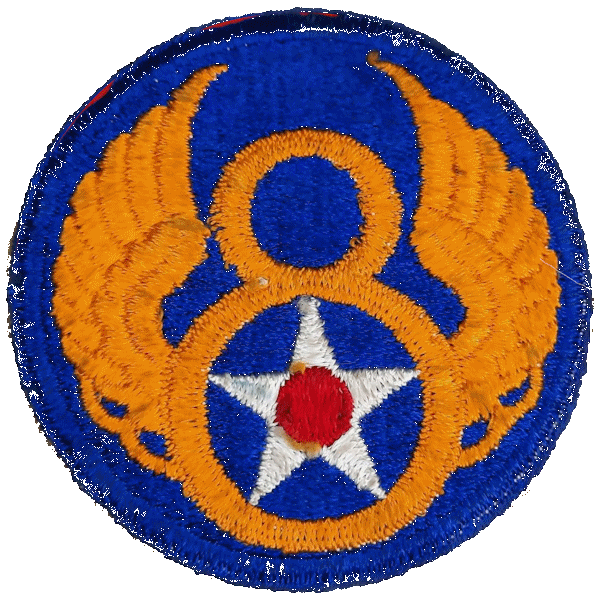
RAF Attlebridge, designated United States Army Air Forces Station 120, was a wartime airfield in Norfolk approximately eight miles northwest of Norwich. Although first constructed for the Royal Air Force, the station became best known as the combat home of the 466th Bombardment Group (Heavy), one of the B-24 Liberator groups of the Eighth Air Force's Second Air Division. From this Norfolk base, the men of the 466th carried the air war to Germany and occupied Europe from March 1944 until the final weeks of World War II in Europe.
Early RAF Service, 1940–1942
No. 88 (Hong Kong) Squadron was the principal early RAF unit at Attlebridge. Flying Bristol Blenheim light bombers and later Douglas Bostons, the squadron operated from the station between August 1941 and September 1942. No. 320 (Netherlands) Squadron, composed largely of Dutch personnel serving with the RAF, also used Attlebridge with North American B-25 Mitchells during part of the war. These RAF and Allied airmen established Attlebridge as an operational bomber station before its conversion into an American heavy-bomber base.
A Standard Class "A" Heavy Bomber Airfield
Construction of Attlebridge began during 1940 on farmland near the villages of Attlebridge and Weston Longville. Richard Costain Ltd. built the station as a satellite airfield for RAF Swanton Morley and No. 2 Group, RAF Bomber Command. The field opened during 1941 and initially had three concrete runways, a perimeter track, aircraft dispersals, hangars, technical buildings, and living sites distributed through the surrounding countryside.
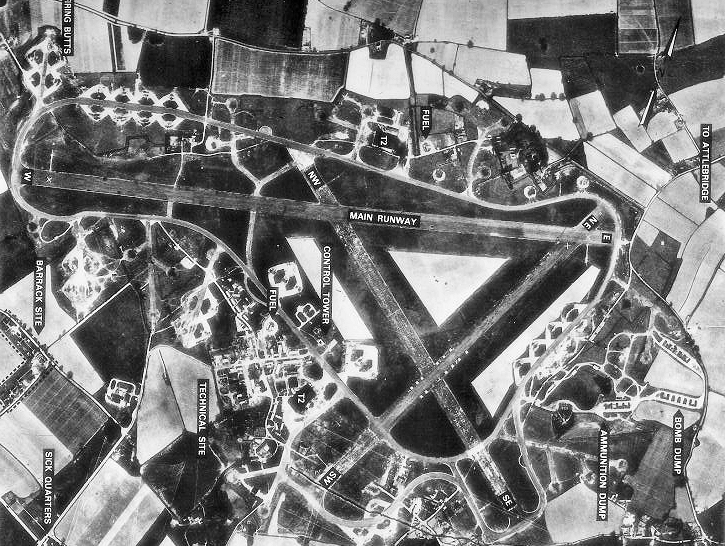
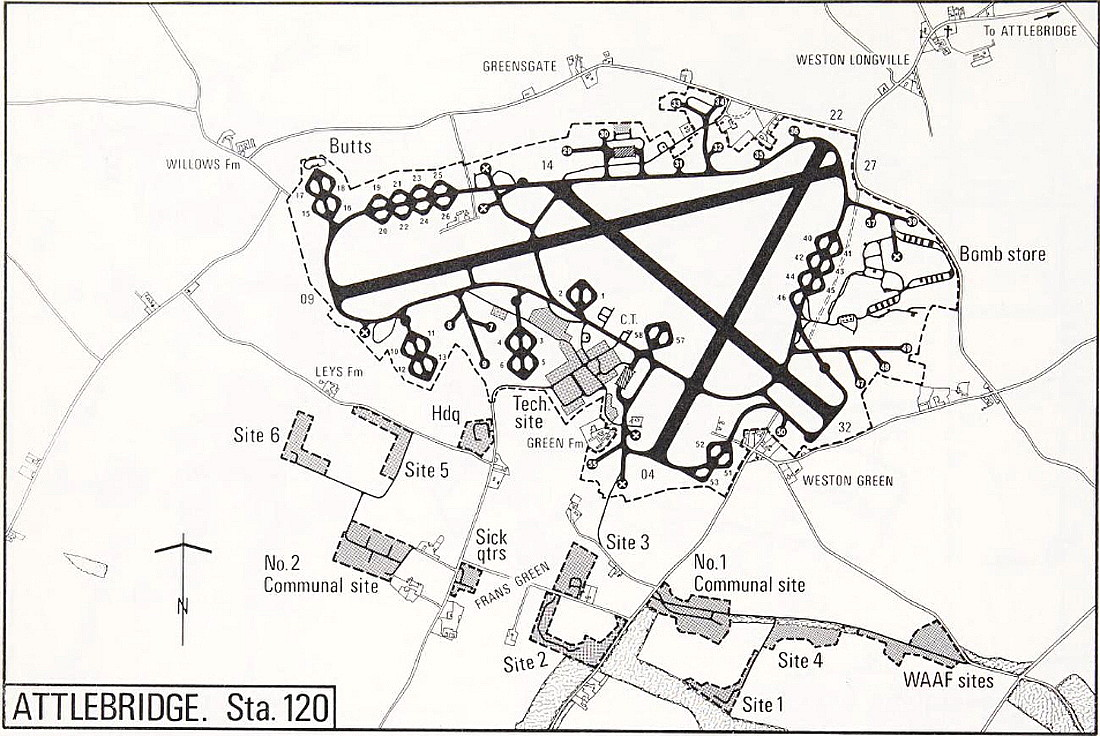
Originally built with relatively short concrete runways suitable for light and medium bombers, Attlebridge underwent extensive reconstruction in late 1942 and 1943 after being selected for use by the United States Army Air Forces. Engineers enlarged the entire station to meet the demanding requirements of B-24 Liberator operations. The principal east-west runway was extended to approximately 2,000 yards, while the two intersecting runways were lengthened to about 1,400 yards each. New taxiways, perimeter tracks, dispersal hardstands, maintenance facilities, and expanded technical and administrative areas transformed Attlebridge into a modern heavy bomber station capable of supporting sustained strategic bombing operations. These improvements required the closure of several country lanes and significantly altered the surrounding agricultural landscape.
Like many American airfields in Norfolk, Attlebridge developed into a self-contained military community. The base included barracks for more than 2,500 personnel, operations buildings, briefing rooms, engineering shops, ammunition storage areas, fuel facilities, medical stations, mess halls, recreation buildings, and a control tower overlooking the three-runway airfield. A network of Nissen huts housed both aircrews and ground personnel, while numerous aircraft dispersal areas around the perimeter allowed Liberators to be serviced and armed before missions.
First American Use and Expansion, 1942–1943
Attlebridge was allocated to the Eighth Air Force on September 30, 1942, and received the American designation Station 120. Squadrons of the 319th Bombardment Group (Medium), equipped with B-26 Marauders, arrived in September 1942. The airfield then operated in association with nearby Horsham St. Faith, where the group's headquarters and other personnel were based. The 319th left England later that year for service with the Twelfth Air Force in North Africa.
After the departure of the 319th, Attlebridge was used for training and by several temporary units. To prepare the station for four-engine heavy bombers, the airfield was substantially enlarged. The principal east-west runway was extended to approximately 2,000 yards, while the two secondary runways were lengthened to approximately 1,400 yards. The perimeter track was expanded, the number of aircraft hardstands was increased to about fifty, and additional technical, maintenance, storage, and accommodation facilities were constructed. Several local roads were closed or rerouted as the airfield spread across the parish of Weston Longville.
Formation of the 466th Bombardment Group
Operating from RAF Attlebridge in Norfolk, England, the group participated in the strategic bombing offensive against Germany and German-occupied Europe from March 1944 until April 1945. In addition to attacking industrial, transportation, petroleum, and military targets, the 466th supported Allied ground forces during the invasion of Normandy, the liberation of France, the Battle of the Bulge, and the crossing of the Rhine.
The group was constituted as the 466th Bombardment Group (Heavy) on 19 May 1943 and activated on 1 August 1943 at Alamogordo Army Air Field, New Mexico. Its four bombardment squadrons were the 784th, 785th, 786th, and 787th Bomb Squadrons. Colonel Leland T. Johnson became the group's first commanding officer and guided the organization through its training and early combat operations.
Initial organization required the assembly of thousands of officers and enlisted men representing the many specialties needed to operate a heavy bombardment group. In addition to pilots, copilots, navigators, bombardiers, radio operators, flight engineers, and aerial gunners, the group depended upon aircraft mechanics, armorers, electricians, radio technicians, clerks, cooks, medical personnel, transportation crews, intelligence officers, and many other specialists. Every combat mission rested upon the coordinated work of the entire organization.
Personnel began training with the B-24 Liberator at Kearns Army Air Field, Utah, before returning to Alamogordo later in 1943. Aircrews practiced formation flying, navigation, high-altitude bombing, aerial gunnery, instrument flying, emergency procedures, and long-distance operations. Ground personnel learned to maintain the Liberator's four Pratt & Whitney engines and its complicated fuel, hydraulic, electrical, radio, and defensive armament systems.
The Flying Deck
The 466th became known as the Flying Deck because its four squadrons were associated with the four suits of a deck of playing cards. The 784th, identified as the Red Squadron, represented Clubs; the 785th, or Gold Squadron, represented Diamonds; the 786th, or Blue Squadron, represented Hearts; and the 787th, or White Squadron, represented Spades. This distinctive theme became an important part of the group's identity and helped create a strong sense of unity among its personnel.
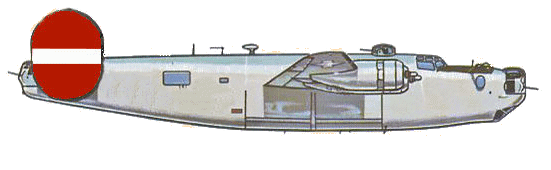
The group identification marking was a Circle-L. Later in the war, the Liberators of the 466th carried a distinctive tail design consisting of a white horizontal band across a red vertical tail surface. These markings allowed aircraft to recognize and assemble with their group during the frequently crowded and difficult formation process over England.
Movement to England
After completing its stateside preparation, the 466th moved through Topeka Army Air Field, Kansas, before beginning its overseass deployment in February 1944. The air echelon ferried its B-24s to Britain by way of the southern Atlantic route, while the ground echelon traveled by troopship. Personnel and aircraft assembled at RAF Attlebridge during February and March 1944.
RAF Attlebridge, designated USAAF Station 120, was situated northwest of Norwich in Norfolk. Originally developed as a Royal Air Force bomber station, it was enlarged and adapted for American heavy bomber operations. The airfield contained three concrete runways, perimeter tracks, aircraft dispersal areas, maintenance facilities, bomb storage sites, fuel installations, hangars, control facilities, and numerous accommodations dispersed across the surrounding countryside.
At Attlebridge the group became part of the 96th Combat Bombardment Wing of the Second Air Division. The station would remain the 466th's combat home for the remainder of the war in Europe. From its runways, the group's Liberators departed on missions ranging from occupied France and the Low Countries to targets deep inside Germany.
First Combat Mission—Berlin
The 466th flew its first combat mission on 22 March 1944, participating in a major daylight attack on Berlin. Sending an inexperienced group against the German capital on its first operation was an extraordinary introduction to aerial combat. Berlin was one of the most distant and heavily defended targets regularly attacked by the Eighth Air Force.
The mission required hours of flight over enemy territory and exposed the crews to anti-aircraft fire, extreme cold, mechanical difficulties, and the possibility of interception by German fighters. Two of the group's Liberators, Terry and the Pirates and Rebel Yell, collided after one of the aircraft was damaged by flak. Both bombers were lost, together with 13 members of their crews.
Despite this tragic beginning, the group reached the Berlin area and demonstrated its ability to operate as part of the Eighth Air Force's heavy bomber formations. Lieutenant General James H. Doolittle, commander of the Eighth Air Force, officially commended the 466th for its performance. At the time, it was one of the longest initial combat missions undertaken by a newly arrived American bombardment group in the European Theater.
The Strategic Bombing Campaign
Following its first mission, the 466th entered the sustained strategic air offensive against Nazi Germany. Its principal task was to attack the industries, transportation systems, petroleum facilities, airfields, and military installations that supported the German war effort. Missions required the group to assemble in the often-clouded skies over England, join other formations of the Second Air Division, cross the North Sea or English Channel, penetrate enemy territory, bomb the assigned target, and then make the long return flight to Attlebridge.
Among the targets attacked by the group were marshalling yards at Liège and Saarbrücken; airfields at St. Trond, Chartres, and Nordhorn; repair and assembly facilities at Reims; factories at Brunswick; petroleum installations at Böhlen, Misburg, and Dülmen; aircraft plants at Kempten; mineral and industrial works at Hamburg; and aero-engine facilities at Eisenach.
Railway marshalling yards, bridges, and transportation centers became especially important targets because Germany depended upon its rail network to move troops, weapons, fuel, and raw materials. Attacks against these facilities were intended to delay military movements, disrupt production, and prevent supplies from reaching the fighting fronts.
The petroleum campaign became another major priority during 1944 and 1945. Synthetic-oil plants, refineries, storage depots, and fuel-processing facilities were among the most heavily defended targets in Germany. By striking installations at places such as Böhlen, Misburg, and Dülmen, the 466th helped reduce the fuel available to German aircraft, armored units, and military transportation.
Many missions were flown through clouds, storms, icing conditions, and powerful winds. When targets could not be observed visually, crews relied upon radar bombing techniques or attacked designated secondary targets. German anti-aircraft batteries surrounded many important objectives, creating concentrated bursts of flak that could damage engines, puncture fuel tanks, sever control cables, and wound or kill crewmen. German fighter resistance declined as the war progressed, but enemy aircraft remained a serious threat during much of the group's combat tour.
Support of the Normandy Invasion
As the Allied invasion of Western Europe approached, the 466th increasingly attacked targets in France and the Low Countries. Airfields, bridges, rail lines, coastal defenses, and military installations were bombed to isolate the intended invasion area and restrict the movement of German reinforcements.
On D-Day, 6 June 1944, the group attacked pillboxes and defensive positions along the Normandy coast in support of Allied troops landing on the beaches. The bombing was carefully coordinated with the invasion timetable. Heavy bombers had to release their bombs under difficult weather conditions while avoiding the danger of striking Allied ships or troops.
During the weeks following the invasion, the 466th continued attacking transportation routes, bridges, rail centers, troop concentrations, and other targets behind the German lines. These missions helped prevent the enemy from rapidly reinforcing its forces in Normandy.
In July 1944, the group bombed German positions near Saint-Lô in preparation for the American breakout from the Normandy beachhead. The operation helped open the way for Allied armored forces to advance into the interior of France. These missions represented a departure from conventional strategic bombing because the targets were located close to friendly ground troops and required particularly careful navigation and bombing.
The Group's 100th Mission and Glenn Miller
On 18 August 1944, the 466th celebrated the completion of its 100th combat mission. The occasion became one of the best-remembered social events in the group's history when Major Glenn Miller and the Army Air Forces Band visited Attlebridge.
B-24s from the 466th first transported Miller and members of his band from Twinwood Farm to Steeple Morden, where they performed for personnel of the 355th Fighter Group and visitors from the 91st Bomb Group at nearby Bassingbourn. The musicians and their equipment were then flown to Attlebridge for the evening celebration.
Between approximately 8:00 and 9:00 that evening, Miller and his orchestra performed in the northern hangar before an estimated audience of 10,000 servicemen and local residents. Rudy Starita's All-Girl Orchestra also appeared, and Colonel James Stewart, the Hollywood actor then serving as a combat officer with the Second Air Division, was among the special guests.
One of the evening's most unusual stories involved Captain John Woolnough of the 466th, who asked Miller for a photograph to send to his brother. Hoping to avoid a crowd of additional requests, Miller agreed to have the picture taken somewhere private. The only unlocked room available was reportedly a toilet. Sergeant Russell Clements photographed Miller and Woolnough there, producing a humorous and memorable image associated with the group's wartime history.
Supplying the Allied Advance
By late summer 1944, Allied armies had broken out of Normandy and were advancing rapidly across France. Their progress created an enormous logistical problem because fuel and supplies had to be transported over damaged roads and railways from the Normandy coast.
During September, the 466th temporarily diverted aircraft from bombing operations to transport gasoline and oil to advanced airfields in France. The B-24s carried fuel in containers loaded into their bomb bays and fuselages. Although such flights lacked the dramatic appearance of a bombing raid, they were essential to maintaining the Allied advance. Transporting highly flammable gasoline in combat aircraft also created serious hazards during takeoff, flight, and landing.
Autumn Operations and the Battle of the Bulge
After the supply emergency eased, the 466th resumed its strategic bombing campaign. During the autumn of 1944, the group attacked transportation centers, industrial facilities, aircraft production plants, and petroleum targets. The deteriorating autumn weather frequently complicated operations, making formation assembly and target identification increasingly difficult.
When Germany launched its counteroffensive in the Ardennes in December 1944, poor weather initially restricted Allied air operations. Once the skies cleared, the Eighth Air Force mounted powerful attacks against German communications, railways, supply centers, bridges, and troop movements.
The 466th participated in these operations during the Battle of the Bulge, helping obstruct the flow of German reinforcements and supplies into the battle area. The destruction of transportation facilities contributed to the eventual failure of the German offensive and assisted Allied ground forces in restoring the front.
The Accidental Bombing of Basel
One of the most controversial incidents in the group's history occurred on 4 March 1945. Much of England and Western Europe was covered by heavy cloud and poor visibility. During assembly, a formation of B-17 Flying Fortresses passed through the 466th's formation, forcing its aircraft to take evasive action and scattering the group.
Although the mission commander ordered the operation abandoned, nine Liberators managed to assemble and continued toward the Continent. Navigational uncertainty, extensive cloud cover, strong winds, and the disrupted formation contributed to confusion over the aircraft's position. Believing they had reached Freiburg, Germany, several aircraft released their bombs on a railway marshalling yard.
The city was actually Basel, in neutral Switzerland. Bombs struck the Wolf freight yard and surrounding districts, damaging railway equipment, homes, and other buildings and injuring approximately 100 people. Fortunately, no deaths were reported in Basel from this particular attack.
An extensive investigation followed the aircraft's return to England. The incident became part of a broader series of accidental American bombings in Switzerland caused by navigation errors, bad weather, equipment problems, and the difficulty of identifying targets from high altitude. The United States later paid compensation to Switzerland for wartime damage caused by American aircraft. The Basel incident remained a sobering reminder of the uncertainty and unintended consequences that could accompany aerial warfare.
The Final Campaigns
During the opening months of 1945, the 466th continued attacking Germany's diminishing petroleum reserves, rail system, airfields, communications centers, and industrial facilities. With Allied armies advancing from the west and Soviet forces approaching from the east, German transportation networks came under almost continuous attack.
On 24 March 1945, the group bombed the airfield at Nordhorn in support of Operation Varsity, the Allied airborne assault across the Rhine. Bombers and fighters attacked airfields, defensive positions, transportation routes, and other military objectives to protect the airborne troops and assist the ground forces crossing into Germany.
By April, the German air force offered greatly reduced resistance, but anti-aircraft fire, mechanical failure, bad weather, and operational accidents continued to threaten the crews. Targets were increasingly selected to assist the advancing Allied armies and prevent German forces from reorganizing or escaping.
The 466th flew its final combat mission on 25 April 1945 against a transformer station at Traunstein in southeastern Germany. The mission came less than two weeks before the surrender of Nazi Germany. It ended a combat tour that had begun with the group's long and costly first operation to Berlin only 13 months earlier.
Combat Record
During its service in Europe, the 466th flew approximately 5,762 operational sorties and dropped about 12,914 tons of bombs. The group is generally credited with 231 combat missions, although some historical accounts list 232 because of differences in how dispatched, recalled, or completed operations were recorded.
The group lost 47 B-24s in combat, while additional aircraft were destroyed in accidents or written off because of severe damage. When combat and non-combat losses are combined, approximately 70 Liberators were lost during the group's overseass service. The group was credited with destroying approximately 59 enemy aircraft in aerial combat.
The human cost was far greater than any numerical summary can fully express. The memorial honoring the group records 333 men killed, 171 taken prisoner of war, eight who evaded capture, and 27 interned in neutral countries. Behind every statistic was an individual airman, family, crew, and personal story.
The 785th Bomb Squadron achieved the notable record of flying 55 consecutive missions without losing an aircraft. Such an accomplishment reflected not only the performance of its aircrews but also the efforts of the mechanics and ground personnel who inspected, repaired, fueled, armed, and prepared the aircraft for combat.
Life at Attlebridge
For the personnel stationed at Attlebridge, the war consisted of long periods of preparation interrupted by moments of intense activity. Aircrews were awakened before dawn, ate breakfast, attended mission briefings, received weather and intelligence reports, and then traveled to their assigned aircraft. Ground crews often worked throughout the night to repair battle damage and prepare the Liberators for the next operation.
Life at the station was affected by cold, mud, crowded accommodations, separation from home, and the strain created by repeated combat losses. Empty bunks and missing aircraft were immediate reminders of the risks faced by every crew. Religious services, Red Cross facilities, dances, films, athletic competitions, visits to nearby communities, and performances such as the Glenn Miller concert provided temporary relief from the demands of combat.
Close relationships also developed between American personnel and residents of the surrounding Norfolk villages. Local people encountered the Americans in shops, homes, churches, pubs, and community events. These personal connections became an important part of the wartime history of Attlebridge and continued through reunions and memorial activities after the war.
Return to the United States
Following V-E Day on 8 May 1945, the group prepared to leave Attlebridge. Aircraft, equipment, records, and personnel had to be processed for return or reassignment. The air echelon began departing England during June, while members of the ground echelon returned by ship.
The group reassembled at Sioux Falls Army Air Field, South Dakota, during July 1945. In August it was redesignated the 466th Bombardment Group (Very Heavy) and began preparing to operate the Boeing B-29 Superfortress. The group was scheduled for eventual deployment against Japan and was transferred through bases including Pueblo, Colorado, and Davis-Monthan Field, Arizona.
Japan's surrender in August 1945 eliminated the need for the 466th to enter combat in the Pacific. The group was inactivated on 17 October 1945, bringing its wartime service to a close.
Attlebridge After the War
After the departure of the Americans, RAF Attlebridge returned to British control. The airfield was eventually closed as an operational military station, and much of the land was restored to agricultural use. Sections of the runways, perimeter track, hardstands, and wartime structures survived in varying condition, preserving visible traces of the large bomber base that once occupied the countryside.
Attlebridge later became associated with industrial and poultry-production facilities, while portions of the former flying field continued to be used for private aviation and other purposes. Although many wartime buildings disappeared, the surviving concrete and the pattern of the former airfield remain reminders of the thousands of Americans who served there.
Legacy and Remembrance
Veterans, family members, local residents, historians, and preservation organizations have worked to ensure that the service of the 466th Bombardment Group is remembered. Memorials near the former airfield commemorate the group's personnel and record its contribution to the air offensive over Normandy, Northern France, the Rhineland, the Ardennes-Alsace, and Central Europe.
The group's wartime records, photographs, aircraft histories, crew accounts, mission reports, and personal recollections preserve the experiences of both the aircrews and the ground personnel. They document not only the major missions and military achievements of the group but also the friendships, sacrifices, tragedies, and daily labor that sustained its combat operations.
From its demanding first mission to Berlin to its final attack at Traunstein, the 466th Bombardment Group served during a decisive period of the air war over Europe. The men of the Flying Deck helped weaken Germany's industrial and transportation system, supported Allied armies from Normandy to the Rhine, and contributed to the ultimate defeat of Nazi Germany. Their record remains an important part of the history of the B-24 Liberator, the Second Air Division, and the Eighth Air Force.
Stations
Alamogordo, New Mexico August 1943
Kearns, Utah August 1943
Alamogordo, New Mexico Nov 1943
Topeka, Kansas Feb 1944
Attlebridge, England March 1944
Commanding Officers
Maj Beverly E. Steadman August 1943
Maj Walter A. Smith, Jr August 1943
Col Walter G. Bryte, Jr Sept 1943
Col Arthur Pierce Dec 1943
Col Luther J. Fairbanks August 1944
Col William H. Cleveland Nov 1944
Campaigns
The 466th Bombardment Group participated in the following campaigns: Air Offensive - Europe, Normandy, Northern France, Rhineland, Ardennes-Alsace, Central Europe.

466th Bomb Group Roll of Honor: Roll of Honor
Oversea Burials 466th Bomb Group Oversea Burials
Facebook Site Facebook Site