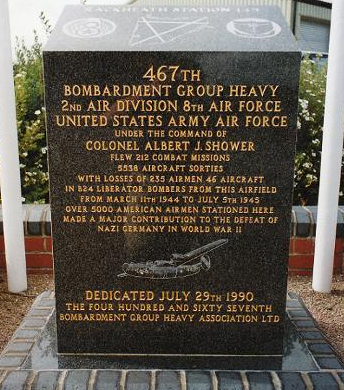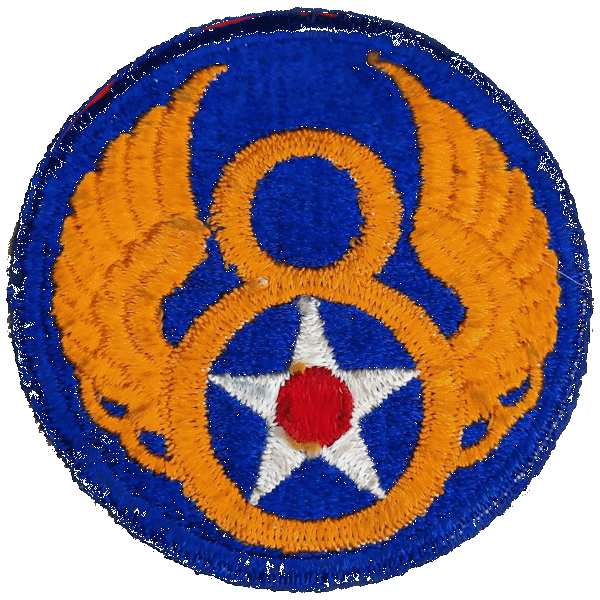
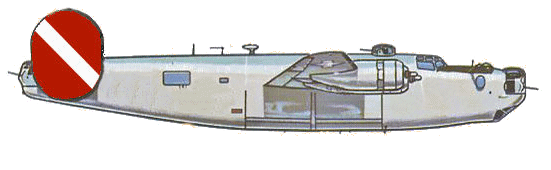
RAF Rackheath (USAAF Station 145), located about five miles (8 km) northeast of Norwich in Norfolk, England, was one of the last heavy-bomber airfields completed for the United States Eighth Air Force during World War II. Built as a Royal Air Force station but intended for American use, Rackheath became the wartime home of the 467th Bombardment Group (Heavy). From this station, the group's B-24 Liberators conducted strategic and tactical operations from April 1944 until April 1945. The airfield and the men who served there became inseparably associated with the name "Rackheath Aggies."
Construction of RAF Rackheath
Construction began during 1943 as part of the rapid expansion of the airfield network in East Anglia. The British building firm John Laing and Company constructed the station on farmland between Rackheath, Salhouse, and the northeastern outskirts of Norwich. Roads and utilities had to be installed or improved, and accommodation was required for several thousand American flying and ground personnel.
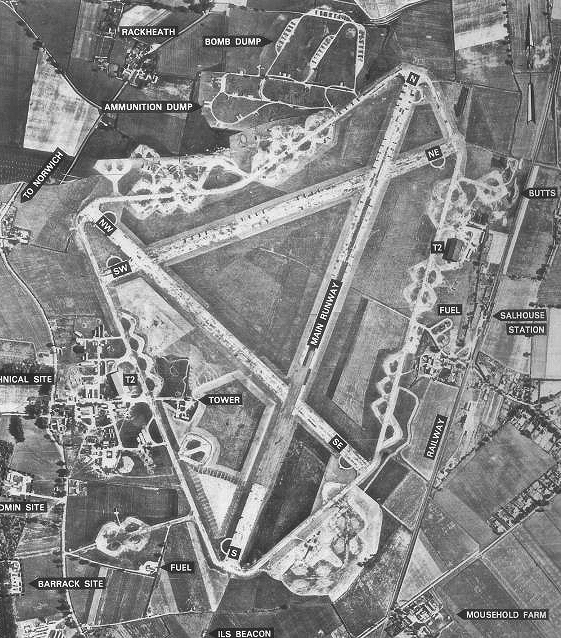
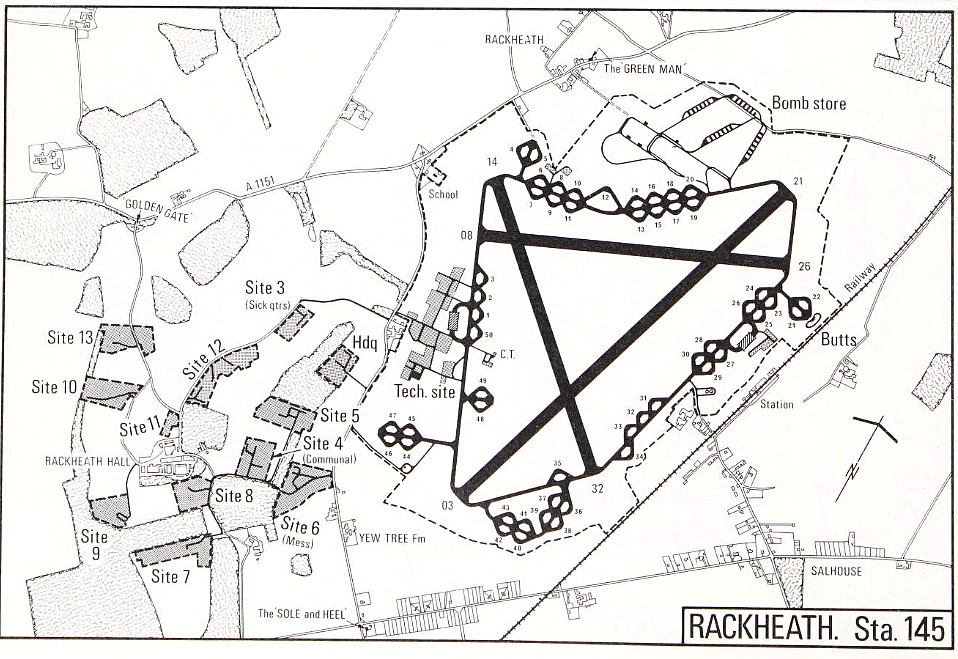
Rackheath followed the standard Class A heavy-bomber airfield design. Its three concrete runways formed a triangular pattern suitable for operating heavily loaded four-engine bombers in varying wind conditions. The principal runway was approximately 2,000 yards long, while the two intersecting secondary runways were approximately 1,400 yards long.
A concrete perimeter track connected the runways with approximately 50 loop-type aircraft hardstands distributed around the flying field. Dispersing the aircraft reduced congestion and limited the damage that a single enemy attack might cause. Two large T-2 hangars stood on opposite sides of the airfield, enabling major aircraft maintenance to continue even if one part of the station became unusable.
Airfield Layout and Facilities
The station's principal installations were deliberately dispersed. The technical site on the western side of the airfield contained workshops, stores, offices, and aircraft-maintenance facilities. The control tower, or watch office, stood near the southwestern portion of the runway system and gave controllers a clear view of aircraft and vehicle movements.
The bomb-storage and ammunition areas were placed near the northern end of the station, away from the technical and domestic sites. Storage bays were separated and protected by earth banks intended to contain accidental explosions. Fuel installations, firing butts, firefighting facilities, and other specialist areas were also positioned around the perimeter.
Administrative offices, mess halls, barracks, medical facilities, and recreational buildings occupied several dispersed sites beyond the western and southern boundaries. This arrangement reduced the possibility that one air raid could destroy a large part of the station's accommodation. The completed base also included engine, instrument, radio, armament, and electrical workshops; parachute storage; photographic facilities; briefing rooms; vehicle maintenance areas; and stores for fuel, bombs, ammunition, food, and spare parts.
Formation and Training of the 467th Bombardment Group
The 467th Bombardment Group (Heavy) was activated in the United States on 1 August 1943. Its four operational units were the 788th, 789th, 790th, and 791st Bomb Squadrons. Equipped with the Consolidated B-24 Liberator, the group trained at Wendover Field, Utah; Mountain Home, Idaho; and Kearns, Utah, before returning to Wendover for its final preparations.
Aircrews trained in long-range navigation, precision bombing, formation flying, aerial gunnery, radio communication, and emergency procedures. At the same time, the group's ground personnel learned to maintain the B-24's engines, electrical equipment, armament, radios, instruments, and other complex systems. By early 1944, the group had completed its operational training and received orders to deploy overseass.
Aircraft and personnel crossed the Atlantic by separate air and sea routes during February and March 1944. The group assembled at Rackheath under the command of Colonel Albert H. Shower, who had assumed command during October 1943. Shower would remain in command from the group's arrival in England through V-E Day, an unusually long period of continuous wartime leadership within the Second Air Division.
Preparing Rackheath for Combat
British construction workers and newly arrived American personnel worked together during the opening months of 1944 to make the station operational. Large quantities of aviation fuel, bombs, ammunition, spare parts, vehicles, and food arrived over the local road and rail networks. Aircraft were assigned to dispersed hardstands, workshops began operating, and the control tower coordinated an increasing volume of training flights.
By the spring of 1944, Rackheath resembled a small town. Thousands of American servicemen and British civilian employees worked throughout its flying, technical, administrative, and domestic sites. Ground crews serviced aircraft around the clock as the 467th prepared to enter the Eighth Air Force's daylight bombing campaign.
Entering Combat
The 467th Bombardment Group flew its first combat mission on 10 April 1944, attacking a German airfield at Bourges, France. Although it was one of the last B-24 groups to enter combat in the European Theater, the 467th quickly established a reputation for disciplined formation flying, operational efficiency, low losses, and exceptional bombing accuracy.
The group served chiefly as a strategic bombardment organization. Its targets included the naval harbor at Kiel, chemical plants near Bonn, textile factories at Stuttgart, power stations at Hamm, steel works at Osnabrück, aircraft factories at Brunswick, and numerous oil refineries, marshalling yards, bridges, canals, ports, communications centers, and military installations. These attacks were intended to weaken Germany's ability to manufacture weapons, produce fuel, and move troops and supplies.
Missions commonly lasted eight to ten hours and were flown at altitudes above 20,000 feet. Aircrews endured subzero temperatures, oxygen shortages, mechanical failures, heavy antiaircraft fire, German fighter attacks, and rapidly changing weather while holding close combat formations for mutual protection. Behind every mission stood the work of mechanics, armorers, fuel crews, radio specialists, clerks, cooks, medics, and many others at Rackheath.
The Night Attack of 22 April 1944
One of the most tragic events in the histories of both Rackheath and the 467th occurred during the night of 22 April 1944, after the group's aircraft returned from a mission against Hamm, Germany. German Junkers Ju 88 night fighters followed the returning bomber stream across the North Sea and attacked near the English airfields.
As aircraft approached Rackheath in darkness, tracer fire and explosions filled the sky while antiaircraft batteries responded. A German aircraft dropped bombs near the runway, and confusion developed as damaged and fuel-depleted B-24s attempted to land. During the action, a returning Liberator was mistakenly engaged by friendly antiaircraft fire. Two B-24s were lost over England, fifteen aircrew members were killed, one member of the ground personnel died at the base, and others were injured. The incident demonstrated that the dangers of a combat mission did not necessarily end when the crews reached England.
Normandy and the Liberation of France
As the Allies prepared to invade Normandy, the 467th attacked airfields, coastal defenses, bridges, transportation centers, and communications facilities supporting German forces in northern France. On D-Day, 6 June 1944, its Liberators bombed shore installations and bridges in the Cherbourg area in support of Operation Overlord.
During the Allied breakout from Normandy, the group attacked enemy troop concentrations and supply areas near Montreuil on 25 July 1944. In September, it temporarily suspended its normal strategic bombing role to transport aviation gasoline to Allied forces on the European continent. These supply missions helped sustain mechanized and tactical air units whose rapid advance across France had stretched the normal supply system.
Wartime Operations at the Airfield
Mission days began long before daylight. Briefing rooms filled with aircrews while armorers and bomb crews loaded aircraft, fuel trucks moved among the hardstands, and mechanics completed final inspections. Heavily loaded Liberators then taxied around the perimeter track and took off at short intervals, creating a tremendous noise heard throughout the surrounding countryside.
The control tower served as the operational center of the flying field. Controllers coordinated takeoffs, landings, and runway traffic and maintained contact with neighboring stations as large bomber formations assembled over eastern England. Meteorological and communications personnel worked from the tower's lower floors. Returning aircraft with wounded men, battle damage, or dangerously low fuel received priority while ambulances, fire engines, and recovery crews waited beside the runway.
Fog, low cloud, ice, and strong winds frequently made operations hazardous, especially during winter. Radio-navigation aids and airfield lighting helped crews find Rackheath in poor visibility. Once a bomber returned to its hardstand, maintenance personnel immediately inspected it, repaired battle damage, replaced equipment, and prepared it for another mission.
The Final Campaigns
During the Battle of the Bulge in December 1944 and January 1945, the 467th attacked German communications centers, bridges, railroads, transportation hubs, and defensive positions supporting the Ardennes offensive. In March 1945, the group struck transportation and communication targets in support of Operation Varsity and the Allied crossing of the Rhine.
On 22 March 1945, the group completed its 200th combat mission. Officers and enlisted men gathered at Rackheath for a stand-down celebration. The following day's activities included a party and aerial demonstrations by P-47 Thunderbolt and P-51 Mustang pilots. The celebration ended tragically when a P-51 pilot lost control while attempting a low-altitude roll and crashed near the Red Cross gymnasium area.
Record Bombing Accuracy and Witchcraft
On 15 April 1945, the 467th achieved one of its most celebrated bombing performances during an attack on the German-held coastal defenses at Pointe de Grave, France. Twenty-four B-24s placed their bombs within the assigned target area, earning the group a reported 100-percent bombing score and recognition for exceptional accuracy.
The B-24J Liberator Witchcraft of the 790th Bomb Squadron became another symbol of the group's efficiency. The aircraft completed 130 combat missions without aborting for a mechanical or other non-combat reason and without a crew member being injured aboard it. Its record reflected the skill of the many flight crews who operated it and the ground crews who inspected, repaired, and maintained it.
The 467th flew its final combat mission on 25 April 1945 against railway facilities in the Traunstein area of Germany. Germany surrendered less than two weeks later, bringing the European air war to an end.
Combat Record
During its year of combat, the 467th Bombardment Group flew 212 combat missions. Its B-24s attacked targets central to Germany's aircraft industry, transportation system, oil production, military infrastructure, and industrial economy. The group's gunners were credited with destroying approximately thirteen enemy aircraft.
The group lost 48 B-24 Liberators in combat and non-combat operations, a comparatively low total among the Second Air Division's heavy-bombardment groups. Its record reflected disciplined operational procedures, experienced leadership, skilled aircrews, and the sustained work of the ground personnel at Rackheath.
Life Beyond the Airfield
The construction and operation of Rackheath transformed the surrounding rural district. Military trucks, buses, and construction vehicles crowded local roads, while residents became accustomed to American uniforms and the continuous sound of aircraft. British civilians found work in construction, catering, transportation, maintenance, and clerical positions at the station.
During their free time, American servicemen visited Norwich and nearby villages. Friendships developed with local residents, and some servicemen were welcomed into British homes. The community also lived with traffic, noise, blackout restrictions, and the risks associated with a major military airfield.
Airfield Defense and Safety
Camouflage, blackout measures, dispersed facilities, defensive positions, and light antiaircraft weapons protected Rackheath. Buildings were painted in subdued colors, vital supplies were divided among separate storage areas, and aircraft were distributed around the perimeter rather than concentrated near the hangars. Firefighting, medical, bomb-disposal, and emergency personnel remained ready even after the likelihood of a major German air raid had diminished.
Departure of the 467th and Closure of the Station
Flying activity declined rapidly after V-E Day. Aircraft and personnel gradually left Rackheath during 1945, and the station returned to British control. Because Rackheath was not selected as a permanent postwar RAF flying station, it closed later that year.
Many temporary buildings were sold, removed, or allowed to deteriorate. Most of the runways, perimeter track, and hardstands were eventually broken up, and much of their concrete was reused for construction. Large areas of the former flying field returned to agriculture.
Postwar Development and Surviving Remains
The former technical site became the Rackheath Industrial Estate. Some wartime buildings were adapted, enlarged, or reclad for commercial use, making their military origins difficult to recognize. Wendover Road on the estate commemorates the Utah airfield associated with the 467th's early training.
Surviving traces of the wartime station include:
Rackheath's control tower escaped the demolition that claimed many similar wartime structures. After years of deterioration and the threat of removal, it was restored and converted for commercial office use. Most surviving features elsewhere on the former airfield stand on private property and should be visited only with the owner's permission.
Memorial and Legacy
A memorial on the former technical site commemorates the American personnel who served at Rackheath, while photographs, records, and local displays help preserve the station's history. Although much of the runway complex has disappeared beneath farmland and industrial development, the control tower, scattered buildings, surviving concrete, and memorial continue to mark the location of a once-busy Eighth Air Force base.
The history of RAF Rackheath cannot be separated from the accomplishments and sacrifices of the 467th Bombardment Group. From this single Norfolk airfield, the "Rackheath Aggies" participated in the strategic bombing offensive, the Normandy invasion, the liberation of France, the Battle of the Bulge, the Rhine crossing, and the final air offensive against Germany. Their bombing accuracy, operational efficiency, low loss rate, and aircraft such as Witchcraft gave the group a distinguished place in the history of the Eighth Air Force and the Second Air Division.
Squadrons
788th Bombardment Squadron, 1943-1945
789th Bombardment Squadron, 1943-1945
790th Bombardment Squadron, 1943-1945
791st Bombardment Squadron, 1943-1945
Stations
Wendover Field, Utah, August 1943
Mountain Home, Idaho, September 1943
Kearns, Utah, October 1943
Wendover Field, Utah, November 1943
RAF Rackheath, England, March 1944
Commanding Officers
Capt. Garnet B. Palmer, September 1943
Col. Frederic E. Glantzberg, September 1943
Col. Albert H. Shower, October 1943-May 1945
Col. Albert H. Shower commanded the group throughout its combat service in England and remained in command through V-E Day.
Campaigns
American Theater; Air Offensive, Europe; Normandy; Northern France; Rhineland; Ardennes-Alsace; and Central Europe.

467th Bomb Group Roll of Honor: Roll of Honor
Overseas Burials: 467th Bomb Group Overseas Burials
Group Website: 467th Bomb Group Association