RAF Halesworth, designated USAAF Station 365 (HA), was one of the important heavy bomber airfields constructed in Suffolk, England, for the United States Army Air Forces during the Second World War. Located on farmland between the villages of Holton, Westhall, and Sotherton, approximately two miles northeast of the market town of Halesworth, the station became the wartime home of the 489th Bombardment Group (Heavy). Although the group occupied the base for only about seven months during 1944, its combat achievements and distinguished service made RAF Halesworth one of the most respected stations of the Eighth Air Force's Second Air Division.
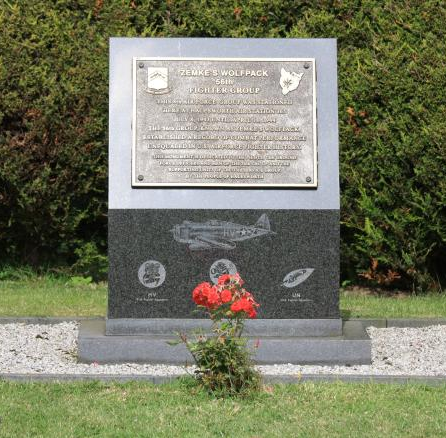
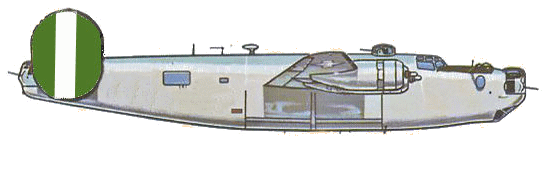
While Halesworth is most closely associated with the 489th Bomb Group, the station also played an important role in the development of long-range fighter operations. Before the arrival of the heavy bombers, the airfield served as the home of the famous 56th Fighter Group, whose Republic P-47 Thunderbolts provided escort protection for American bombers deep into occupied Europe. After the fighter group relocated to nearby RAF Boxted in April 1944, Halesworth assumed the role for which it had originally been designed—a permanent heavy bomber base supporting Consolidated B-24 Liberators.
Construction of RAF Halesworth
Construction of RAF Halesworth began during 1942 as part of Britain's massive wartime airfield expansion program. Designed as a standard Royal Air Force Class "A" heavy bomber station, the airfield was built to accommodate the large four-engine bombers that would carry the strategic air war to the heart of Nazi Germany. American engineers and British contractors transformed hundreds of acres of farmland into a modern military installation capable of supporting thousands of personnel and dozens of heavy aircraft.
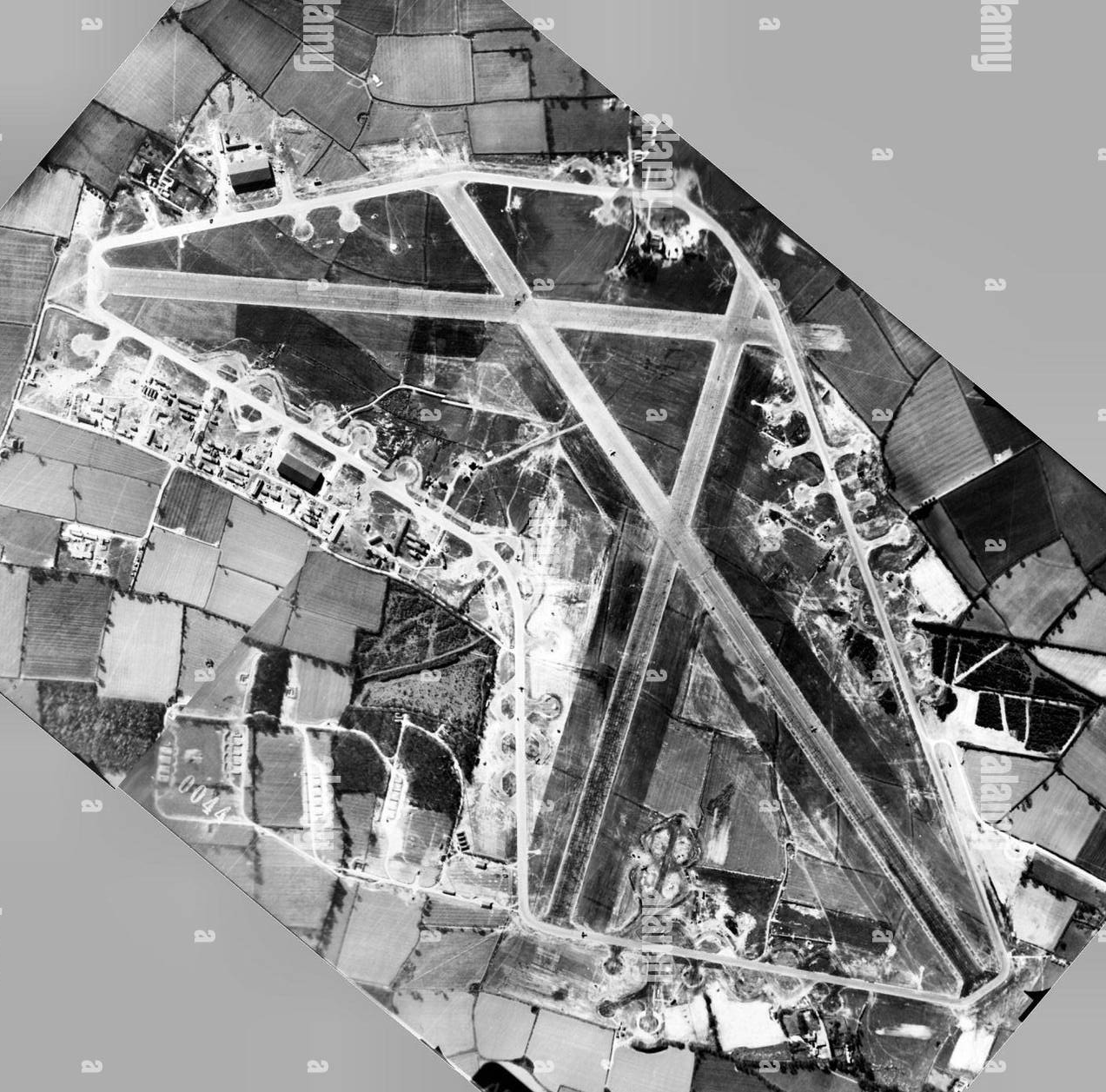
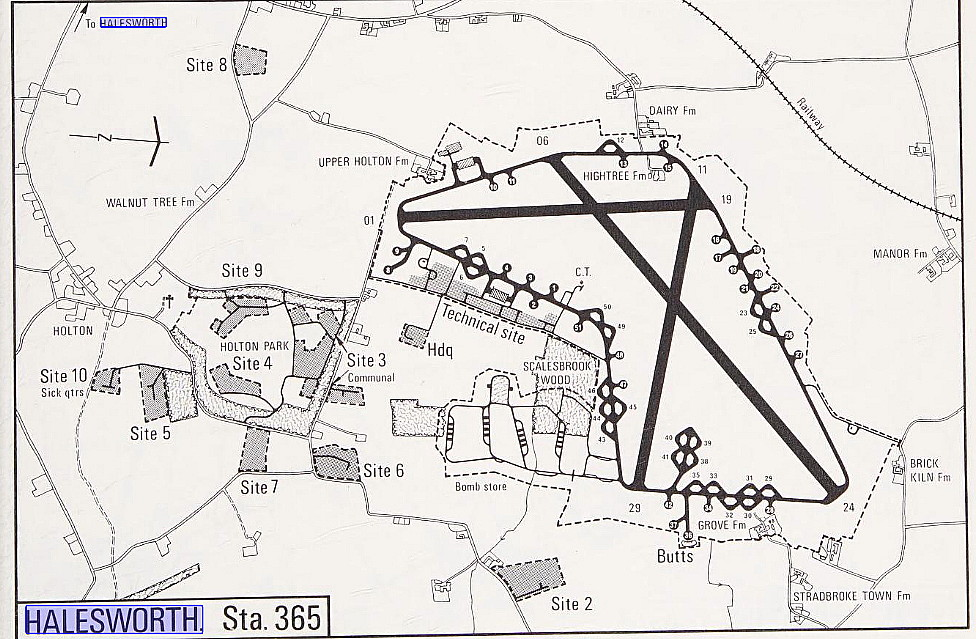
The completed station featured three long concrete runways connected by a perimeter taxiway and more than fifty aircraft dispersal hardstands. Two large T-2 hangars provided maintenance and repair facilities, while extensive bomb dumps, fuel storage areas, workshops, operations buildings, communications centers, medical facilities, barracks, and mess halls made the station a completely self-contained military installation capable of supporting thousands of personnel, including:
Like nearly every American bomber base in East Anglia, RAF Halesworth was designed as a self-contained community. Thousands of airmen, mechanics, armorers, cooks, medics, and support personnel lived and worked within the station's dispersed camps. Connected by narrow roads and protected through wide dispersion, the layout reduced vulnerability to enemy attack while allowing the base to operate continuously under wartime conditions.
Airfield Layout
Like most Eighth Air Force bomber stations, RAF Halesworth followed the standardized layout developed throughout East Anglia. The technical site adjoined the flying field, while personnel lived in dispersed camps connected by narrow roads to reduce vulnerability to enemy attack. Aircraft occupied individual "frying pan" and loop dispersal hardstands around the perimeter track, permitting rapid taxiing and efficient launching of bomber formations. Bomb dumps and fuel storage areas were intentionally located well away from accommodation sites for safety.
Strategic Location
RAF Halesworth occupied an ideal location in northeastern Suffolk. As one of the easternmost heavy bomber stations assigned to the Second Air Division, aircraft reached the North Sea only minutes after takeoff, reducing flight time over England and allowing bomber formations to assemble rapidly before crossing into enemy-controlled Europe. The station's proximity to the coast also made it valuable during its earlier role as a fighter base, enabling escort aircraft to rendezvous quickly with outbound bomber formations.
The 56th Fighter Group at Halesworth
Before heavy bombers arrived, RAF Halesworth gained an enviable reputation as the home of the legendary 56th Fighter Group. Flying Republic P-47 Thunderbolts, the "Zemke's Wolfpack" became the highest-scoring American fighter group in the European Theater. During its stay at Halesworth, the group escorted bomber formations, swept enemy airspace, attacked transportation targets, and established air superiority over Western Europe. In April 1944 the 56th transferred to RAF Boxted, allowing Halesworth to assume its intended role as a heavy bomber station.
Arrival of the 489th Bombardment Group
The 489th Bombardment Group (Heavy) was activated on 1 October 1943 at Wendover Field, Utah. Composed of the 844th, 845th, 846th, and 847th Bomb Squadrons, the group trained extensively on the Consolidated B-24 Liberator before deploying overseass early in 1944. Following trans-Atlantic movement, personnel assembled in England and occupied RAF Halesworth during the spring of 1944.
The arrival of the 489th transformed Station 365 into a bustling heavy bomber base. Hundreds of B-24 Liberators filled the dispersal areas while thousands of American personnel prepared for combat operations supporting the Allied invasion of Europe. Every mission required the coordinated efforts of pilots, navigators, bombardiers, engineers, mechanics, armorers, communications specialists, weather officers, intelligence personnel, and countless support troops who kept the bombers flying.
Although the group's operational tour in England would last only about six months, it entered combat during one of the most critical periods of the European war.
Combat Operations
The 489th Bomb Group flew its first combat mission on 30 May 1944 against industrial targets in Oldenburg, Germany. The timing of its arrival placed the group immediately into one of the most critical phases of the European air war. During the weeks preceding D-Day, the group attacked bridges, rail yards, airfields, coastal defenses, radar stations, troop concentrations, and transportation centers designed to isolate the Normandy invasion area and prevent German reinforcements from reaching the beaches.
On 6 June 1944, the 489th participated in Operation Overlord by bombing German coastal batteries and defensive positions supporting the Allied landings in Normandy. Throughout the summer campaign the group continued attacking rail networks, fuel depots, bridges, marshalling yards, and military installations that supported the Allied advance across France.
As the strategic bombing offensive intensified, the Liberators of the 489th struck aircraft factories, synthetic oil refineries, chemical plants, steel works, communications centers, and transportation facilities throughout Germany and German-occupied Europe. The group also flew missions against submarine installations, V-weapon sites, and heavily defended industrial complexes that formed the backbone of the German war economy.
Preparing for Operation Overlord
The 489th flew its first combat mission on 30 May 1944, only days before the Allied invasion of Normandy. Crews immediately began attacking German airfields, transportation centers, bridges, coastal defenses, and military installations throughout occupied France in preparation for Operation Overlord. These missions formed part of the massive Allied effort to isolate the invasion area before troops landed on the beaches of Normandy.
This mission marked the beginning of the liberation of Western Europe and remains one of the group's proudest accomplishments.
Distinguished Service
One of the most celebrated events in the history of RAF Halesworth occurred on 5 June 1944. While leading an attack against German coastal defenses near Wimereux, France, Lieutenant Colonel Leon R. Vance Jr., the deputy group commander, assumed control of his badly damaged B-24 after the pilot was killed. Despite suffering severe wounds that nearly amputated his foot, Vance continued leading the formation, completed the bombing mission, returned across the English Channel, ordered his crew to bail out, and successfully ditched the crippled aircraft in the Channel before being rescued. For his extraordinary courage he received the Medal of Honor, becoming one of the Eighth Air Force's most famous bomber heroes.
Strategic Bombing Operations
Following the Normandy invasion, RAF Halesworth became a busy operational station as the 489th expanded its missions into Germany. Flying from Station 365, the group's Liberators attacked aircraft factories, synthetic oil refineries, transportation centers, military airfields, marshalling yards, bridges, communications facilities, and industrial complexes throughout the Reich. Among the principal targets were Ludwigshafen, Magdeburg, Brunswick, and Saarbrücken.
Typical missions lasted eight to ten hours at altitudes exceeding 20,000 feet. Aircrews endured freezing temperatures, heavy anti-aircraft fire, poor weather, and attacks by German fighters while maintaining close defensive formations throughout the long flights over occupied Europe.
Supporting the Liberation of Europe
In addition to strategic bombing, the 489th supported Allied ground operations throughout Western Europe. During the Normandy campaign the group attacked German bridges, railroads, communications centers, coastal defenses, and V-weapon sites. During July 1944 its Liberators participated in the saturation bombing preceding the breakout at Saint-Lô.
Later in the campaign the group's aircraft dropped food supplies to liberated civilians and advancing Allied forces and flew supply missions during Operation Market Garden, demonstrating the remarkable flexibility of heavy bomber units.
Combat Record
From RAF Halesworth the 489th Bombardment Group flew 106 combat missions. During those operations it participated in Operation Overlord, the liberation of France, the strategic bombing offensive against Germany, humanitarian relief operations, and airborne resupply missions. The group lost 41 B-24 Liberators while many of its airmen were killed, wounded, captured, or listed as missing in action. Although one of the newest and shortest-serving bomb groups in the Second Air Division, the 489th established an outstanding combat reputation through its courage, professionalism, and combat effectiveness.
Transfer to the Pacific
Unlike most Eighth Air Force heavy bomber groups, the 489th's combat service from RAF Halesworth was relatively brief. In November 1944 the group was withdrawn from combat in Europe and returned to the United States to prepare for redeployment to the Pacific Theater as part of the growing campaign against Japan. Although the war ended before the group entered combat in the Pacific, its distinguished service during the European campaign had firmly established its reputation within the Eighth Air Force.
After the departure of the 489th, RAF Halesworth briefly became home to the 491st Bombardment Group, which completed the final months of the strategic bombing campaign from Station 365 until Germany's surrender in May 1945.
Life at RAF Halesworth
During its peak wartime operations, RAF Halesworth functioned as a small American community transplanted into the English countryside. Around-the-clock maintenance kept aircraft mission-ready, armorers loaded thousands of pounds of bombs, weather officers prepared detailed forecasts, intelligence personnel briefed crews before every mission, and medical teams stood ready to treat returning airmen. Recreation facilities, athletic fields, chapels, clubs, and local dances helped maintain morale during the constant strain of combat operations.
The relationship between American personnel and the surrounding Suffolk communities became one of the enduring legacies of the station. Friendships developed between local residents and the young Americans stationed there, many of which continued long after the war had ended.
The Group Departs
Unlike most heavy bombardment groups of the Eighth Air Force, the 489th completed only a relatively short combat tour in England. During November and December 1944 the group departed RAF Halesworth and returned to the United States to prepare for redeployment to the Pacific Theater. Japan's surrender in August 1945 ended the war before the group entered combat in the Pacific.
After the War
Following Germany's surrender in May 1945, RAF Halesworth briefly returned to Royal Air Force control before being transferred to the Royal Navy, which commissioned the station as HMS Sparrowhawk for advanced flying training. Naval use was relatively short-lived, and flying operations ceased during 1946. Soon afterward, the station was officially closed as an active military airfield.
Much of the airfield was gradually returned to agricultural production, while other sections were developed for light industry and commercial use. Numerous wartime buildings were demolished over the following decades, although significant portions of the runways, perimeter track, aircraft dispersals, road network, and foundations survived, preserving much of the original wartime layout.
RAF Halesworth Today
Today RAF Halesworth remains one of the more recognizable former USAAF stations in East Anglia. Visitors can still trace the outline of the wartime airfield by following surviving sections of the perimeter road, dispersal hardstands, and runway pavement visible both on the ground and in aerial photography.
The Halesworth Airfield Museum, located near the former control tower, preserves the history of both the 56th Fighter Group and the 489th Bombardment Group. Through exhibits of uniforms, equipment, photographs, aircraft artifacts, documents, and personal accounts, the museum tells the story of the thousands of American and British personnel who served at Station 365 during World War II.
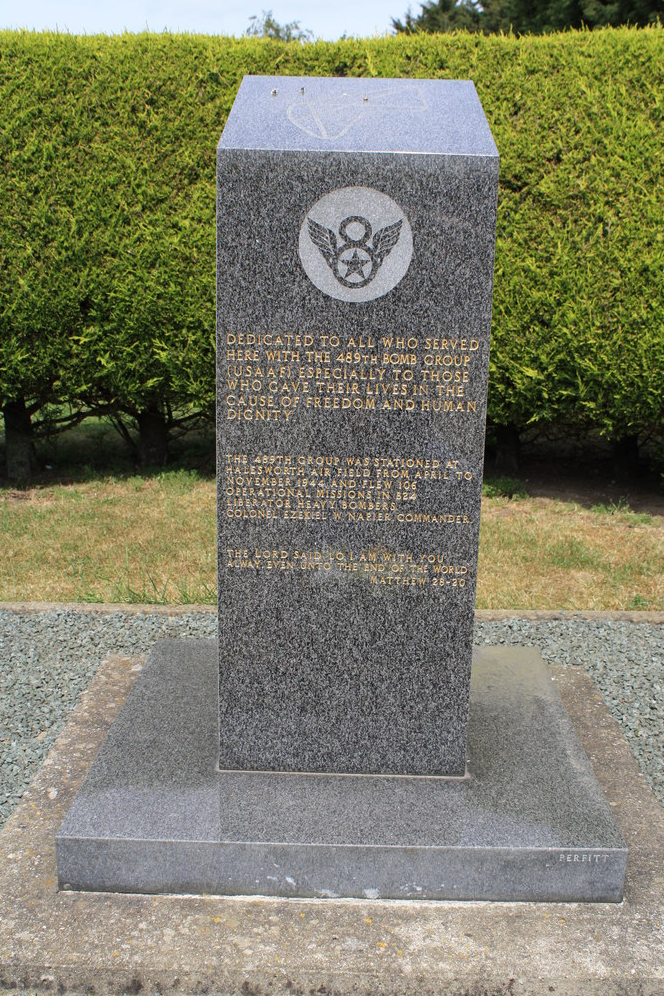
Several memorials located around the former airfield honor the men of the 56th Fighter Group, the 489th Bomb Group, the later 491st Bomb Group, and all who served from RAF Halesworth. Together they ensure that the legacy of this important Second Air Division station—and the sacrifices of those who flew and maintained its aircraft—will continue to be remembered by future generations.
Squadrons
844th Bombardment Squadron 1943-1945
845th Bombardment Squadron 1943-1945
846th Bombardment Squadron 1943-1945
847th Bombardment Squadron 1943-1945
Stations
Wendover Field, Utah Oct 1943
Halesworth, England May 1944
Commanding Officers
Col Ezekiel W. Napier Oct 1943
Lt Col Robert E. Kollimer Feb 1945
Col Paul C. Ashworth April 1945
Campaigns
The 489th Bombardment Group participated in the following campaigns: American Theater, Air Offensive - Europe, Normandy, Northern France, Rhineland
Decorations
Leon R. Vance, Jr., was awarded the Medal of Honor for action on 5 June 1944 where he was severely wounded on the way to the target, but took control of his crippled B-24, successfully completed the mission and saved his crew.
489th Bomb Group Roll of Honor: Roll of Honor
Oversea Burials 489th Bomb Group Oversea Burials
Group Web Site Halesworth Airfield Museum