RAF Metfield (USAAF Station 366), located southeast of the village of Metfield in Suffolk, England, was constructed during World War II for the United States Army Air Forces. Although built to the standard of a heavy-bomber station, its first operational occupants were the P-47 Thunderbolts of the 353rd Fighter Group. It later became the first combat home of the 491st Bombardment Group (Heavy), one of the last B-24 Liberator groups to enter combat with the Eighth Air Force's Second Air Division. The 491st operated from Metfield during the decisive months surrounding the Normandy invasion before moving to RAF North Pickenham in August 1944.
Construction of RAF Metfield
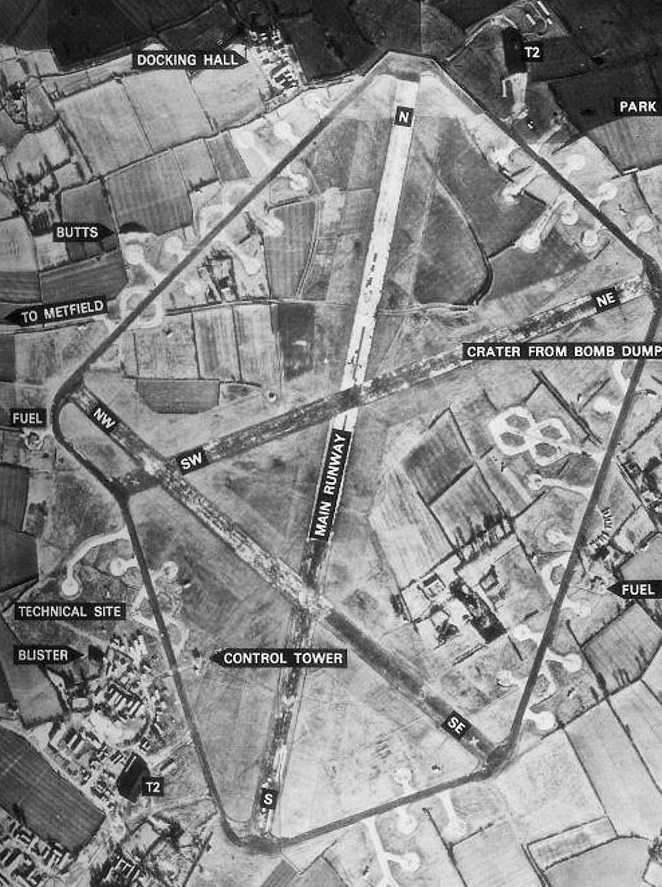
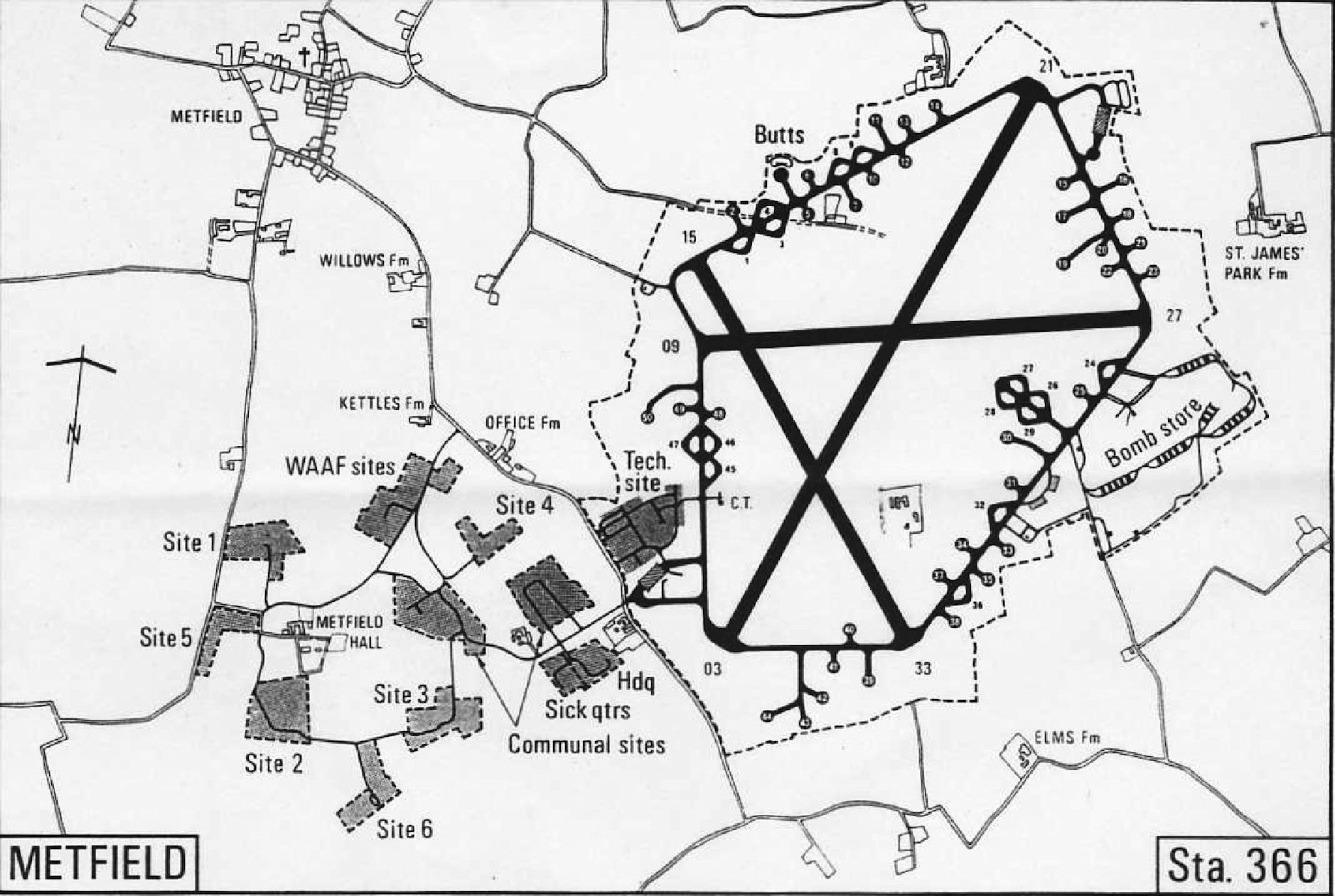
Construction was completed in 1943 on former farmland in rural Suffolk. The opening of the station required the wartime closure of part of the B1123 road between Halesworth and Harleston. Metfield was one of the more isolated American stations in East Anglia, but it was equipped to support sustained operations by a large combat group.
The airfield's principal features included:
The 353rd Fighter Group at Metfield
The first American combat organization to occupy RAF Metfield was the 353rd Fighter Group, which arrived from RAF Goxhill on 3 August 1943. Its 350th, 351st, and 352nd Fighter Squadrons flew Republic P-47 Thunderbolts. From Metfield, the group escorted Eighth Air Force bombers, conducted fighter sweeps over France and the Low Countries, and attacked enemy airfields and other tactical targets. The 353rd moved to RAF Raydon in April 1944, clearing the station for the arrival of a B-24 heavy-bombardment group.
Formation and Training of the 491st Bombardment Group
The 491st Bombardment Group (Heavy) was constituted on 14 September 1943 and activated at Davis-Monthan Field, Arizona, on 1 October 1943. Its four operational units were the 852nd, 853rd, 854th, and 855th Bombardment Squadrons. The 855th developed from the former 17th Antisubmarine Squadron, which supplied the new group with an experienced cadre.
The group moved to El Paso Army Air Field, Texas, in November 1943 and trained with the Consolidated B-24 Liberator. Its air echelon later continued training at Pueblo Army Air Base, Colorado. Crews received instruction in long-range navigation, high-altitude formation flying, aerial gunnery, precision bombing, radio communications, and emergency procedures. During a period of rapid Army Air Forces expansion, much of the group's original ground echelon was reassigned to other units. The Eighth Air Force therefore created a replacement ground organization in England with personnel drawn principally from the 93rd, 389th, 446th, and 448th Bomb Groups of the Second Air Division.
Key personnel departed the United States in April 1944, while the combat crews began ferrying their B-24s to Britain by the southern air route through Florida, South America, Africa, and onward to the United Kingdom. The American-trained air echelon and the newly assembled ground echelon came together at Metfield during May. The last of the group's aircraft arrived near the end of the month.
The 491st Bomb Group at RAF Metfield
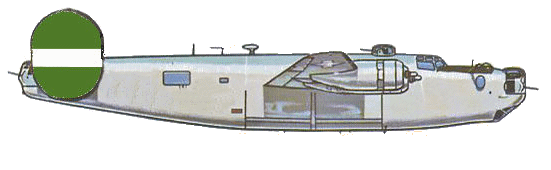
The 491st was assigned to the 95th Combat Bombardment Wing of the Second Air Division. Its B-24s carried the group's Circle-Z tail marking. The four squadrons and their fuselage identification codes were:
The group flew its first combat mission on 2 June 1944, attacking Brétigny Airfield near Paris. Entering combat only four days before D-Day, the 491st immediately joined the massive air campaign intended to isolate the Normandy battlefield. During its first operations, the group attacked airfields, bridges, coastal defenses, rail facilities, and other lines of communication in France.
On 6 June 1944, as Allied troops landed in Normandy, the men at Metfield supported the invasion effort as part of the Eighth Air Force's extensive operations over France. In the following weeks the 491st continued attacking targets that could be used to reinforce the German defenses. On 24 and 25 July, its Liberators bombed enemy positions in support of Operation Cobra, the American breakout near Saint-Lô.
After the Allied lodgment in France had been secured, the group increasingly turned toward strategic objectives in Germany and occupied Europe. Its targets included oil refineries, fuel-storage depots, industrial areas, shipyards, airfields, railway centers, bridges, and communications facilities. These missions demanded flights of many hours at high altitude, often through severe weather, intense antiaircraft fire, and attacks by German fighters.
The Metfield Bomb Dump Explosion
On the evening of 15 July 1944, Metfield became the scene of one of the most destructive accidental explosions at an American airfield in Britain. A convoy from the 2218th Quartermaster Truck Company (Aviation) arrived at the bomb-storage area while the regular unloading detail was away for its evening meal. Rather than wait for the proper bomb hoists and trained personnel, several men attempted to unload the bombs by backing their trucks rapidly and braking sharply so the weapons would roll from the vehicles.
One bomb struck another on the ground and detonated, beginning a chain reaction among the high-explosive and incendiary weapons stored in the dump. Of approximately 1,200 tons of ammunition at the site, an estimated 700 tons exploded or were rendered unusable. The blasts and fires continued as fragments and burning incendiaries were thrown across the area.
The disaster:
The force of the explosion was felt for miles. An axle from one of the trucks was reportedly thrown more than a mile, and windows were broken far beyond the airfield. The eastern T-2 hangar suffered heavy damage, while aircraft, technical buildings, and equipment across the base were struck by blast and debris. Investigators reconstructed the accident with help from the only surviving convoy driver, whose vehicle carried fuses and tail assemblies and had been parked some distance from the unloading point.
Despite the destruction, Metfield remained operational. An extended roadway was later constructed around the crater, and the bomb-dump site became one of the most enduring physical reminders of the airfield's wartime history.
To view “The Definitive Story of the Metfield Bomb Dump Explosion” by Riccard Parsonson, click here.
Transfer to RAF North Pickenham
A reorganization of the Second Air Division during August 1944 brought the 491st's brief residence at Metfield to an end. The 492nd Bombardment Group was withdrawn from regular strategic operations, and the 491st moved to the 492nd's former station at RAF North Pickenham (USAAF Station 143). The transfer began on 15 August 1944. At North Pickenham, the group joined the 14th Combat Bombardment Wing and remained there for the rest of its combat tour.
Strategic Operations from North Pickenham
From its new base, the 491st concentrated upon Germany's oil industry, transportation network, military installations, and industrial production. Its B-24s attacked objectives in Berlin, Hamburg, Kassel, Cologne, Gelsenkirchen, Bielefeld, Hannover, Magdeburg, and other heavily defended areas. On one mission, the group struck the German military headquarters complex at Zossen, south of Berlin.
The work was physically and mentally exhausting. Crews frequently flew eight- to ten-hour missions at altitudes above 20,000 feet, where they depended upon oxygen equipment and electrically heated clothing. Mechanical failures, icing, cloud cover, navigational errors, antiaircraft fire, and enemy fighters could turn any mission into a struggle for survival. On the ground, mechanics, armorers, fuel crews, radio specialists, cooks, drivers, clerks, and many other personnel worked around the clock to return damaged aircraft to service and prepare the group for its next mission.
Operation Market Garden
On 18 September 1944, the 491st temporarily exchanged its normal bomb load for supplies during Operation Market Garden. Its B-24s dropped food, ammunition, medical equipment, and other urgently needed material to Allied airborne forces fighting in the Netherlands. The low-altitude supply mission exposed the large bombers to intense ground fire and demonstrated the group's ability to perform a role very different from high-altitude strategic bombing.
The Misburg Mission and Distinguished Unit Citation
The most costly and celebrated mission in the group's history occurred on 26 November 1944, when the 491st attacked the synthetic-oil installation at Misburg, near Hannover. Germany depended heavily upon synthetic fuel, making plants such as Misburg among the highest-priority targets of the Allied air offensive.
Large formations of German fighters attacked the group with exceptional determination. Fifteen of the 491st's B-24s were lost—approximately half of the attacking formation. Despite these devastating losses, the surviving crews fought their way to the objective and bombed the refinery. The 491st received the Distinguished Unit Citation for the courage, discipline, and determination displayed during the mission.
The Battle of the Bulge and the Final Offensive
During the Battle of the Bulge in December 1944 and January 1945, the group attacked rail centers, bridges, highways, supply lines, and fortifications supporting the German offensive in the Ardennes. In March 1945, it supported Operation Varsity and the Allied crossing of the Rhine by attacking enemy positions and transportation targets associated with the airborne and ground assault.
As Allied armies advanced across Germany, the 491st continued striking railways, bridges, communications centers, oil facilities, and other objectives that sustained the remaining German forces. The group flew its final combat mission on 25 April 1945, bringing to an end nearly eleven months of combat operations.
Combat Record
The 491st Bombardment Group completed 187 combat missions and more than 5,000 combat sorties. Its operational record was among the most intensive achieved by an Eighth Air Force B-24 group. Forty-seven Liberators were lost during its combat tour, including the fifteen aircraft lost on the Misburg mission. Many more returned to England damaged, and numerous airmen were killed, wounded, captured, or listed as missing.
The group participated in the Air Offensive—Europe, Normandy, Northern France, Rhineland, Ardennes-Alsace, and Central Europe campaigns. Its Distinguished Unit Citation for Misburg became the formal recognition of the courage demonstrated by its aircrews and the sustained effort of the ground personnel who kept the Liberators flying.
RAF Metfield After the 491st's Departure
Metfield did not become inactive when the 491st moved to North Pickenham. The 1409th Army Air Force Base Unit operated B-24s, C-47 Skytrains, and C-54 Skymasters from the station under the European Division of Air Transport, United States Strategic Air Forces in Europe. The unit supported sensitive transport operations, including flights connected with neutral Sweden, and also used RAF Leuchars in Scotland as an advanced base.
During the night of 3–4 March 1945, German intruder aircraft carried out Operation Gisela against returning Allied bombers and their bases. Metfield was attacked by a Junkers Ju 88G-6, and an American serviceman in the control tower was killed. The German aircraft subsequently crashed south of the airfield.
RAF Metfield closed in May 1945 and was returned to the Royal Air Force. It was not selected for continued postwar military use and remained largely abandoned under Air Ministry ownership.
Return of the 491st to the United States
Following V-E Day, the 491st began sending its aircraft back to the United States in June 1945. The ground echelon sailed from Britain in July, and the group reassembled at McChord Field, Washington. With the European war over and the Army Air Forces reducing its wartime establishment, the 491st Bombardment Group was inactivated at McChord Field on 8 September 1945.
RAF Metfield After World War II
The abandoned airfield remained in government hands until its land and buildings were sold during 1964 and 1965. Most of the site returned to agricultural use. In the late 1960s, much of the runway system, perimeter track, and aircraft parking areas was broken up, although sections of concrete were retained as farm roads and access routes.
The bomb-dump crater survived for many years as a water-filled depression. When it was later drained and cleared, wartime equipment and unexploded ordnance were discovered. Fragments thrown outward by the 1944 explosion continued to be found in surrounding fields long after the war.
Evidence of the former station that may still be seen includes:
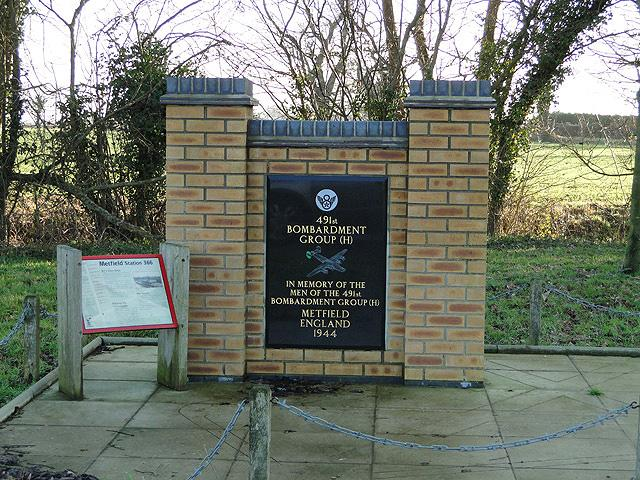
Most surviving remains stand on private property and should be viewed only with the landowner's permission. The memorial near the former station entrance preserves the story of the 353rd Fighter Group, the 491st Bombardment Group, and the Metfield bomb-dump disaster. Although little of the once-busy airfield remains intact, the rural landscape continues to mark the place where thousands of Americans lived, worked, fought, and died during World War II.
Squadrons
852nd Bombardment Squadron (3Q), 1943–1945
853rd Bombardment Squadron (T8), 1943–1945
854th Bombardment Squadron (6X), 1943–1945
855th Bombardment Squadron (V2), 1943–1945
Principal Stations
Davis-Monthan Field, Arizona, October 1943
El Paso Army Air Field, Texas, November 1943–January 1944
Pueblo Army Air Base, Colorado, January–April 1944 (air echelon)
RAF Metfield, England, April–August 1944
RAF North Pickenham, England, August 1944–July 1945
McChord Field, Washington, July–September 1945
Commanding Officers
Col. Dwight O. Monteith, October 1943
Maj. Jack G. Merrell, December 1943
Col. Wilson H. Banks, January 1944
Maj. Alex E. Burleigh, January 1944
Col. Frederic H. Miller, June 1944
Col. Allen W. Reed, October 1944
Lt. Col. Jack G. Merrell, January 1945
Lt. Col. Carl T. Goldenberg, February 1945
Campaigns
Air Offensive—Europe; Normandy; Northern France; Rhineland; Ardennes-Alsace; Central Europe.
Decoration
Distinguished Unit Citation: Misburg, Germany, 26 November 1944.

491st Bomb Group Roll of Honor: Roll of Honor
Overseas Burials: 491st Bomb Group Overseas Burials