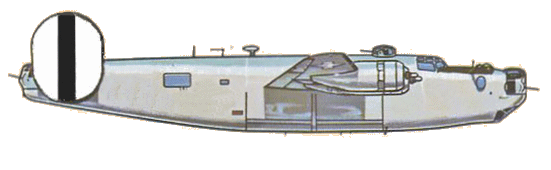
Formation of the 44th Bombardment Group
RAF Shipdham (USAAF Station 115) occupies one of the most distinguished places in the history of the Eighth Air Force and the Second Air Division. Constructed as one of Britain's permanent Class "A" heavy bomber stations, it became the first permanent United States Army Air Forces heavy bomber base established in Norfolk and the first home of B-24 Liberator operations within the Eighth Air Force.
The station served as the wartime home of the famed 44th Bombardment Group (Heavy), "The Flying Eight Balls," one of the original American heavy bombardment groups to arrive in England. More importantly, Shipdham became the longest continuously occupied B-24 Liberator base in Britain, operating Liberators from October 1942 until June 1945.
Its importance increased even further in September 1943 when the station became the headquarters of the 14th Combat Bombardment Wing, making Shipdham one of the principal operational command centers of the Eighth Air Force's Second Bomb Division (later redesignated the Second Air Division).
The 44th Bombardment Group (Heavy) was one of the most distinguished B-24 Liberator units of the Eighth Air Force and holds a unique place in aviation history as the first B-24 Liberator bombardment group to operate with the Eighth Air Force in England. Stationed at RAF Shipdham (USAAF Station 115) in Norfolk from October 1942 until June 1945, the group became one of the principal combat organizations of the Second Air Division and participated in nearly every major phase of the Allied strategic bombing campaign against Nazi Germany.
Formation and Training
The 44th Bombardment Group was constituted on 20 November 1940 and activated on 15 January 1941, making it one of the earliest heavy bombardment groups created during the expansion of the U.S. Army Air Corps before America's entry into World War II. During training in the United States, the group became one of the first organizations equipped with the revolutionary Consolidated B-24 Liberator, an aircraft offering greater range, speed, and bomb-carrying capacity than many contemporary bombers.
Before deploying overseas, the group conducted antisubmarine patrols along the Atlantic coast following the attack on Pearl Harbor, protecting Allied shipping from German U-boats while gaining valuable operational experience.
Squadron Organization
The 44th Bomb Group consisted of four operational squadrons:
The group's distinctive tail marking—a large black circle containing a white numeral "8"—earned the organization its famous nickname: "The Flying Eight Balls."
Construction and Early Development
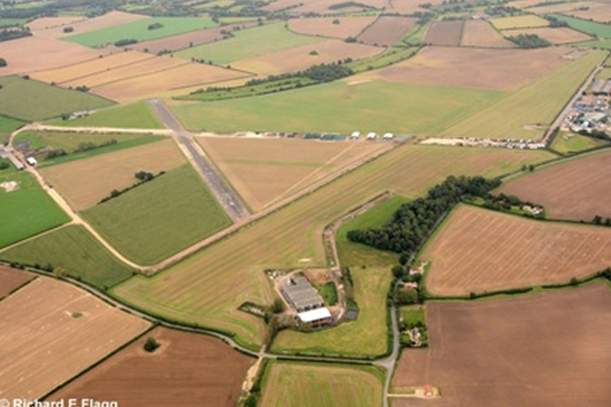
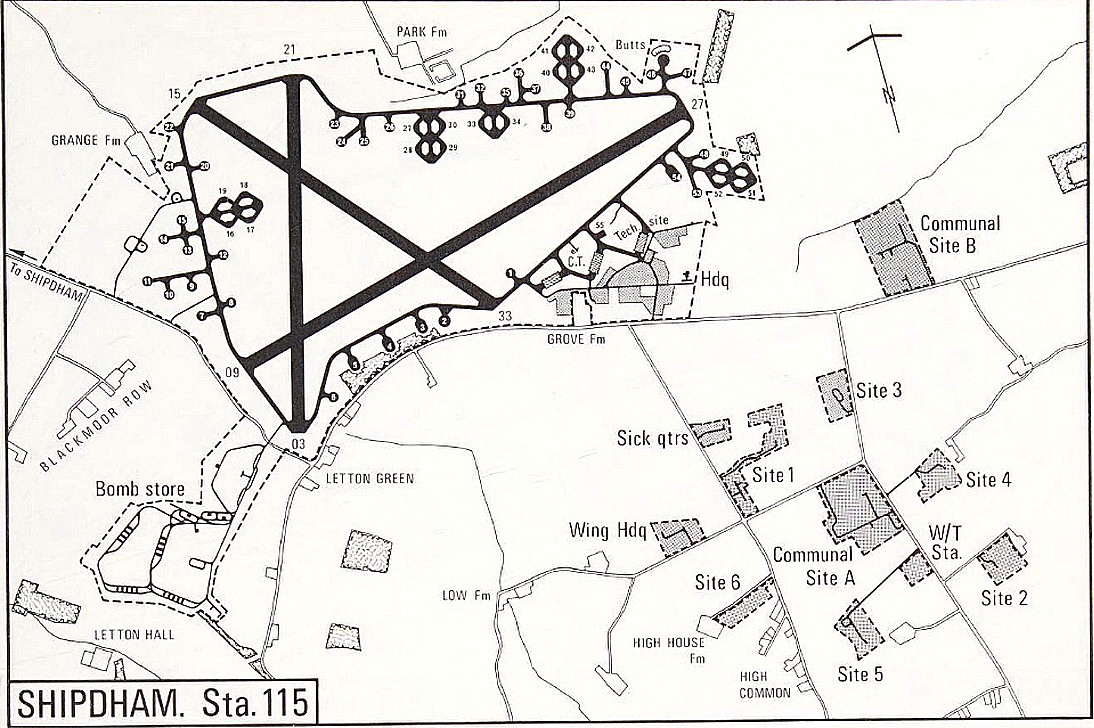
Construction of RAF Shipdham began during 1941 as part of Britain's wartime expansion program to create permanent heavy bomber airfields throughout East Anglia. Built on farmland between the villages of Shipdham and Cranworth in Norfolk, the station followed the standard RAF Class "A" heavy bomber design with three intersecting concrete runways, extensive perimeter taxiways, aircraft dispersal areas, technical facilities, and large domestic sites capable of supporting thousands of personnel.
The station officially opened during June 1942 under Royal Air Force control. Before permanent American heavy bomber units arrived, Shipdham briefly served as a staging base for the 319th Bombardment Group (Medium) flying Martin B-26 Marauders. The group used the airfield while preparing for deployment to North Africa in support of Operation Torch, the Allied invasion of French North Africa.
Following the departure of the 319th, Shipdham was selected as the permanent English base for one of America's newest heavy bombardment groups.
Arrival of the 44th Bomb Group
In October 1942 the 44th Bombardment Group (Heavy) arrived from the United States after completing training with the Consolidated B-24 Liberator.
The arrival of the 44th marked an historic milestone. The group became the first Eighth Air Force bombardment group equipped with the B-24 Liberator, introducing the long-range heavy bomber into sustained combat operations over occupied Europe.
For the remainder of World War II, Shipdham remained the permanent home of the "Flying Eight Balls." During nearly three years of combat operations, thousands of aircrew and ground personnel lived and worked from the station while participating in every major phase of the Allied strategic bombing campaign.
Life at RAF Shipdham
Combat operations represented only a portion of the daily routine experienced by the men of the 44th Bombardment Group. Thousands of officers and enlisted personnel worked around the clock to keep the B-24 Liberators ready for combat. Aircraft mechanics, armorers, engine specialists, radio technicians, sheet metal workers, electricians, and ordnance crews often labored through the night repairing battle damage sustained during the previous day's mission. Many aircraft returned to Shipdham with flak holes, damaged control surfaces, inoperative engines, or wounded crew members aboard. Through remarkable dedication and technical skill, maintenance personnel frequently restored heavily damaged bombers to flying condition within a matter of days.
The airfield itself functioned as a small American community in the English countryside. Barracks, mess halls, briefing rooms, hospitals, maintenance shops, ammunition storage areas, and administrative buildings supported nearly every aspect of military life. While combat crews prepared for dangerous missions over Europe, thousands of support personnel ensured that fuel, bombs, replacement parts, food, medical care, and communications were always available. Their contributions were indispensable to the group's operational success.
Cooperation with the British People
The arrival of the 44th Bombardment Group brought lasting relationships between American servicemen and the residents of Norfolk. Local families welcomed many of the airmen into their homes, providing friendship and hospitality far from home. Community events, church services, sporting competitions, and social gatherings helped strengthen the close bond that developed between the Americans and their British hosts. Those friendships continued long after the war, with veterans and their families returning to Shipdham for reunions and commemorative ceremonies celebrating the shared sacrifices of the Allied nations.
Becoming Headquarters of the 14th Combat Bombardment Wing
As the Eighth Air Force expanded rapidly during 1943, Shipdham's strategic importance continued to grow.
Beginning in September 1943, RAF Shipdham also became headquarters of the 14th Combat Bombardment Wing, which directed combat operations for numerous B-24 Liberator groups within the Second Bomb Division.
From this headquarters, wing staff coordinated mission planning, operational control, intelligence, maintenance policy, and combat readiness for subordinate bombardment groups. The dual role as both an active combat station and wing headquarters made Shipdham one of the busiest and most influential bomber bases in East Anglia.
Runways
The airfield featured three tarmac (asphalt) runways. These dimensions accommodated fully loaded B-24 Liberators operating on long-range missions:A continuous concrete perimeter taxiway encircled the flying field. This allowed large formations of Liberators to taxi efficiently to the active runway. Aircraft Dispersals. Approximately 50 loop hardstands were positioned around the perimeter track.
Each dispersal accommodated a single B-24 Liberator and included nearby servicing areas for maintenance crews.
Spacing the aircraft throughout the airfield reduced the danger of accidents and minimized losses should enemy aircraft attack the station.
The dispersals were generally organized by squadron, allowing maintenance personnel and flight crews to work efficiently within their assigned operational areas.
Technical Site
Immediately south of the flying field lay the technical site, the operational heart of RAF Shipdham. Facilities included:
Here mission plans were developed, crews briefed, aircraft assigned, and operational decisions coordinated before every combat mission.
Bomb Dump
The bomb storage area was located southwest of the airfield, separated from operational areas for safety. This complex coordinated both the 44th Bomb Group and, later, the 14th Combat Bombardment Wing. ulk aviation gasoline was stored in dispersed underground tanks connected by pipelines and refueling points around the station.
Thousands of tons of bombs passed through these facilities during the station's wartime service before being transported to waiting Liberators.
Fuel Storage
Large underground fuel tanks stored aviation gasoline safely away from operational buildings.
An underground pipeline system distributed fuel to numerous refueling points located throughout the station, allowing multiple bombers to be serviced simultaneously before missions.
Domestic Camps
Accommodation for approximately 3,000 personnel was dispersed across fields southeast of the airfield. The dispersed arrangement reduced vulnerability and eased congestion. Daily Operations Facilities included:
Beginning Combat Operations
The group's first combat missions were flown during November 1942, attacking German submarine facilities, ports, airfields, and industrial targets in occupied Europe.
As one of only a handful of B-24 groups available at the time, the 44th frequently pioneered new tactics for employing the Liberator in large-scale daylight strategic bombing. Their early experience helped shape operational procedures later adopted throughout the Second Air Division.
Strategic Bombing Campaign
Throughout the war, the group attacked a wide variety of strategic targets, including:
Operations carried the group over:
These missions formed part of the Eighth Air Force's effort to cripple Germany's industrial production and transportation network while supporting Allied ground operations.
Distinguished Unit Citation—Kiel
One of the group's earliest and most celebrated missions occurred on 14 May 1943 against the German naval base at Kiel.
Flying behind formations of B-17 Flying Fortresses, the 44th carried incendiary bombs that were to ignite fires after high explosives had struck the target. Because they attacked after the main formations had passed, the Liberators received concentrated anti-aircraft fire and determined fighter attacks.
Despite severe opposition, the group accurately bombed its objective and earned its first Distinguished Unit Citation (DUC) for extraordinary heroism.
Operation Tidal Wave
Perhaps the most famous chapter in the group's history came during Operation Tidal Wave, the low-level attack against the Romanian oil refineries at Ploie?ti on 1 August 1943.
The 44th temporarily deployed to North Africa before the mission and flew hundreds of miles at treetop level into one of the most heavily defended targets in Europe.
Leading the formation was Colonel Leon W. Johnson, whose exceptional leadership under devastating enemy fire earned him the Medal of Honor. The group also received its second Distinguished Unit Citation for its performance during the raid.
Although losses were severe, Operation Tidal Wave remains one of the most famous bombing missions of World War II and demonstrated the extraordinary courage of the aircrews flying from Shipdham.
Return to England
Following the North African deployment, the 44th returned to Shipdham and resumed participation in the Combined Bomber Offensive. The group participated in virtually every major Eighth Air Force campaign during this period. From late 1943 through April 1945, the group attacked:
Wartime Contributions
From Shipdham, the 44th Bomb Group participated in nearly every major phase of the Allied strategic air offensive against Nazi Germany. The group attacked aircraft factories, submarine bases, oil refineries, transportation networks, rail centers, industrial complexes, bridges, ports, and military installations throughout occupied Europe and Germany.
The group earned two Distinguished Unit Citations—one for the attack on Kiel in May 1943 and another for its heroic participation in Operation Tidal Wave, the famous low-level raid against the oil refineries at Ploesti, Romania, on 1 August 1943. Colonel Leon W. Johnson received the Medal of Honor for his leadership during the Ploesti mission.
Throughout nearly three years of continuous combat, Shipdham served as the launching point for hundreds of bombing missions that helped cripple Germany's industrial capacity and contributed significantly to Allied victory in Europe.
The 44th Bomb Group completed 343 combat missions and approximately 330 enemy aircraft credited destroyed by its gunners.
End of the War
Following Germany's surrender in May 1945, the personnel and aircraft of the 44th Bombardment Group gradually prepared for redeployment. Many veterans returned home through established separation centers while others remained briefly for occupation duties or reassignment. The group departed England during the summer of 1945 and was inactivated in the United States later that year as the Army Air Forces rapidly demobilized following the end of World War II. Although its wartime service had concluded, the accomplishments of the "Flying Eight Balls" became a permanent part of Eighth Air Force history.
The airfield had fulfilled its wartime mission as one of the most important B-24 bases in Britain.
The Cost Was Extremely High.
The group lost approximately 153 B-24 Liberators, the highest combat aircraft loss of any B-24 group in the Eighth Air Force. Hundreds of officers and enlisted men were killed, wounded, or became prisoners of war during nearly three years of continuous combat.
Memorials to the 44th Bomb Group
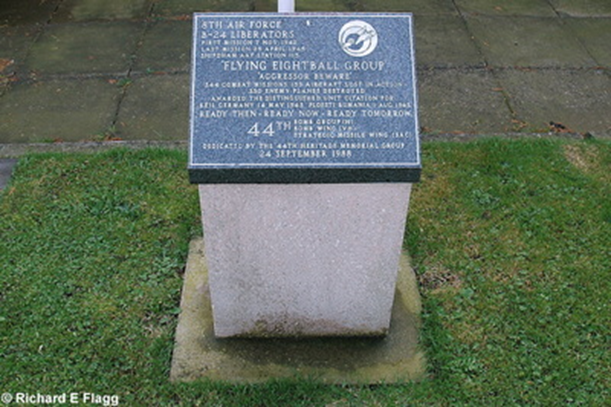
The men of the 44th Bomb Group are commemorated by memorials in the Shipdham area. A granite memorial dedicated during a veterans’ reunion in September 1983 honors the group and the Americans who served at the airfield. Another memorial stands near All Saints Church in Shipdham, maintaining the connection between the village and the thousands of American servicemen who lived and worked nearby during the war.
Airbase Today
Following the war, the station briefly served as a transit center for German prisoners of war awaiting repatriation before the property was gradually sold into private ownership during the late 1950s and early 1960s. In 1970, part of the former airfield reopened for civilian aviation, allowing a new generation of pilots to use the historic runways.
Shipdham ceased operating as a civilian airfield in November 2023, ending more than fifty years of postwar private flying and approximately eighty-one years of aviation activity at the site. The former airfield is now officially regarded as disused, with portions of the property devoted to agriculture and industrial activity. Proposals for renewable-energy development have also been associated with land in and around the former airfield, although future development remains subject to the planning process.
Despite the closure of the civilian airfield and the loss of the control tower, the wartime landscape has not completely disappeared. Sections of runway pavement, perimeter track, hardstands, hangars, foundations, and other fragments of the former station continue to mark the countryside. Some surviving areas are located on privately owned land, and permission should be obtained before attempting to visit or examine them.
Many surviving features lie on privately owned property, and permission should always be obtained before visiting these areas.
Despite decades of redevelopment, RAF Shipdham remains one of the best locations for understanding the scale and organization of a major Eighth Air Force Liberator station.
Memorials to the 44th Bomb Group
The service and sacrifice of the men of the 44th Bombardment Group continue to be remembered in the Shipdham community.
A granite memorial dedicated during the veterans' reunion of September 1983 honors the Americans who served at RAF Shipdham and commemorates the achievements of the "Flying Eight Balls."
A second memorial stands near All Saints Church in the village of Shipdham, symbolizing the enduring friendship between the local community and the thousands of American airmen who called the village home during World War II.
Today these memorials serve as lasting reminders that RAF Shipdham was not simply another wartime airfield—it was one of the pioneering bases of the Eighth Air Force, the longest-serving B-24 Liberator station in Britain, and a place from which generations of airmen departed to fight for the liberation of Europe.
Squadrons
66th Bombardment Squadron 1941-1946
67th Bombardment Squadron 1941-1946
68th Bombardment Squadron 1941-1946
506th Bombardment Squadron 1943-1946
Stations
MacDill Field, Florida Jan 1941
Barksdale Field, Louisiana Feb 1942
Will Rogers Field, Oklahoma July 1942
RAF Shipdham, England Oct 1942
Commanding Officers
Lt. Col. Melvin B. Asp Jan 1941
Lt. Col. Hugo P. Rush May 1941
Col. Frederick H. Robinson Apr 1942
Col. Leon W. Johnson Jan 1943
Lt. Col. James T. Posey Sep 1943
Col. Frederick R. Dent Dec 1943
Col. John H. Gibson Apr 1944
Col. Eugene H. Snavely Aug 1944
Col. Vernon C. Smith Apr 1945
Campaigns
The 44th Bombardment Group received campaign participation credit for the following campaigns: Antisubmarine - American Theater, Air Combat - EAME Theater, Air Offensive - Europe, Normandy, Northern France, Rhineland, Ardennes-Alsace, and Central Europe.
Decorations
Distinguished Unit Citations (DUC):
14 May 1943 - Kiel, Germany,
1 August 1943 - Ploesti, Romania
Individual Awards
Medal of Honor - awarded to Leon W. Johnson for leadership during the Ploesti mission.

44th Bomb Group Roll of Honor: Roll of Honor:
Oversea Burials: 44th Bomb Group Oversea Burials
Group Web Site: https://www.44thbombgroup.org